Finding the New Platform
Trouver le nouveau quai
Emma checks the station signs and asks a staff member where to catch her next train. She gets to the right platform before it leaves.
Emma consulte les panneaux de la gare et demande à un membre du personnel où prendre son prochain train. Elle arrive sur le bon quai avant le départ.
Dialogue8
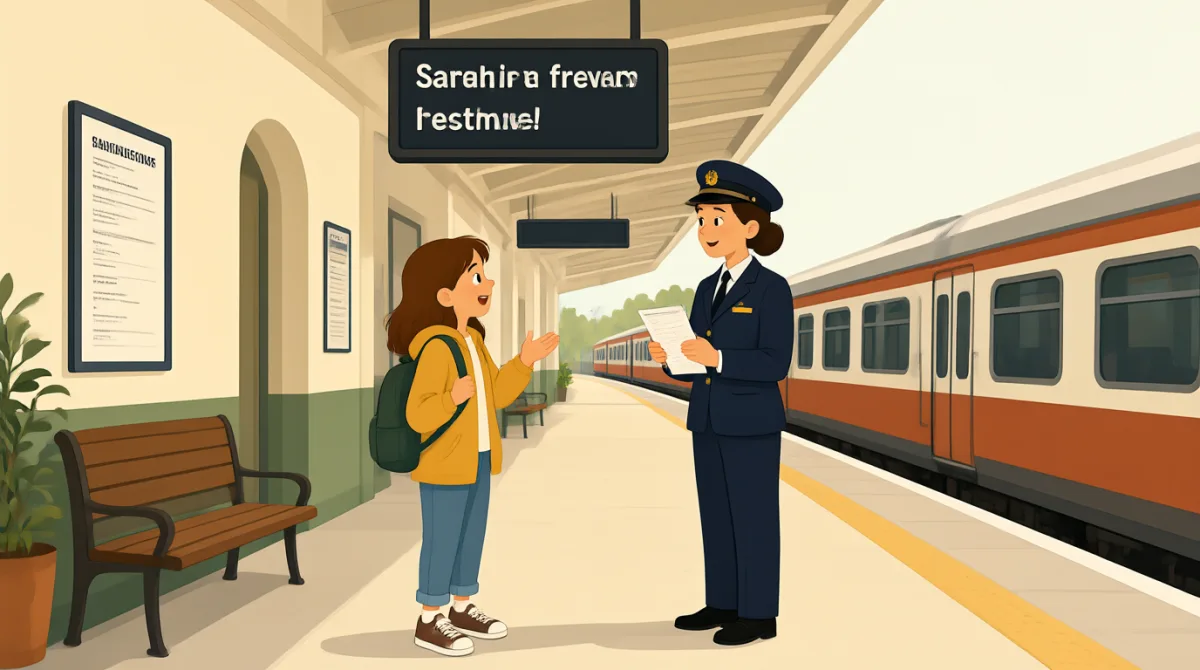

Excuse me, where can I catch the next train to Boston?
Excusez-moi, où puis-je prendre le prochain train pour Boston ?

Let me check your ticket. It leaves from Platform 6.
Je vais vérifier votre billet. Il part du quai 6.
Thanks. Is Platform 6 far from here?
Merci. Le quai 6 est loin d’ici ?
No, it’s just down that hall. Follow the blue signs.
Non, c’est juste au bout de ce couloir. Suivez les panneaux bleus.
How much time do I have before it leaves?
Combien de temps me reste-t-il avant le départ ?
It leaves in ten minutes, so you should head there now.
Il part dans dix minutes, alors vous devriez y aller maintenant.
Okay, I’ll hurry. Do I need to show my new ticket?
D’accord, je vais me dépêcher. Est-ce que je dois montrer mon nouveau billet ?
Yes, show it when you get on. You have enough time.
Oui, montrez-le en montant dans le train. Vous avez assez de temps.
Vocabulaire8
- catch the next trainprendre le prochain train
This means to get on the next train that is going to your destination. You can use “catch” when talking about getting on a bus or train.
Cela signifie monter dans le prochain train qui va à votre destination. En anglais, vous pouvez utiliser « catch » pour parler du fait de prendre un bus ou un train.
- Platform 6le quai 6
This is the numbered area where passengers wait for and get on a train. Replace “6” with the platform number you need.
C’est la zone numérotée où les voyageurs attendent le train et montent à bord. Remplacez « 6 » par le numéro du quai dont vous avez besoin.
- far from hereloin d’ici
This asks whether a place is a long distance away. You can use it to ask about the distance to a station, shop, or other place.
Cette expression sert à demander si un endroit se trouve à une grande distance. Vous pouvez l’utiliser pour demander la distance jusqu’à une gare, un magasin ou un autre lieu.
- down that hallau bout de ce couloir
This gives a simple direction to a place along the hall. You can use “down that hall” when pointing someone toward a place indoors.
Cette expression indique simplement qu’un lieu se trouve plus loin dans le couloir. Vous pouvez utiliser « down that hall » pour orienter quelqu’un vers un endroit à l’intérieur d’un bâtiment.
- Follow the blue signs.Suivez les panneaux bleus.
This tells someone to use the blue signs to find the way. You can replace “blue” with another color or describe a different sign.
Cette phrase indique à quelqu’un de suivre les panneaux bleus pour trouver son chemin. Vous pouvez remplacer « blue » par une autre couleur ou décrire un autre panneau.
- head there nowy aller maintenant
This means to go to that place right away. You can use “head” to give someone a simple direction, such as “Head to the station.”
Cela signifie se rendre tout de suite à cet endroit. Vous pouvez utiliser « head » pour donner une indication simple, par exemple « Head to the station. » (Allez à la gare.)
- show my new ticketmontrer mon nouveau billet
This means to present the ticket so someone can check it. You can use “show my” with other things you need to present, such as an ID.
Cela signifie présenter le billet pour que quelqu’un puisse le vérifier. Vous pouvez utiliser « show my » avec d’autres choses que vous devez présenter, comme une pièce d’identité.
- when you get onen montant dans le train
This means at the time you board the train. You can also use this phrase when talking about getting on a bus.
Cela signifie au moment où vous montez dans le train. Vous pouvez aussi utiliser cette expression pour parler du moment où vous montez dans un bus.
Phrases clés8
- 1
Excuse me, where can I catch the next train to Boston?
Excusez-moi, où puis-je prendre le prochain train pour Boston ?
This is a polite way to ask where to board a train. Replace “Boston” with the name of your destination.
C’est une façon polie de demander où monter dans un train. Remplacez « Boston » par le nom de votre destination.
- 2
Let me check your ticket.
Je vais vérifier votre billet.
This is a helpful phrase when you need to look at someone’s ticket before giving information. You can use “Let me check” before looking at a schedule or booking.
C’est une expression utile quand vous devez regarder le billet de quelqu’un avant de lui donner un renseignement. Vous pouvez dire « Let me check » avant de consulter un horaire ou une réservation.
- 3
Is Platform 6 far from here?
Le quai 6 est loin d’ici ?
Use this question to ask how far away a place is. Replace “Platform 6” with another place you need to find.
Utilisez cette question pour demander si un endroit est loin. Remplacez « Platform 6 » par un autre lieu que vous cherchez.
- 4
Follow the blue signs.
Suivez les panneaux bleus.
This is a short, clear way to give directions. You can replace “blue signs” with another landmark or set of directions.
C’est une façon courte et claire d’indiquer le chemin. Vous pouvez remplacer « blue signs » par un autre repère ou une autre indication.
- 5
How much time do I have before it leaves?
Combien de temps me reste-t-il avant le départ ?
Use this to ask how long you have before a train or other transport departs. Replace “it” with a bus, flight, or event.
Utilisez cette question pour demander combien de temps il vous reste avant le départ d’un train ou d’un autre moyen de transport. Remplacez « it » par un bus, un vol ou un événement.
- 6
Okay, I’ll hurry.
D’accord, je vais me dépêcher.
This is a simple way to say that you will move quickly. You can use it when someone tells you that time is short.
C’est une façon simple de dire que vous allez vous déplacer rapidement. Vous pouvez l’utiliser quand quelqu’un vous dit que vous manquez de temps.
- 7
Do I need to show my new ticket?
Est-ce que je dois montrer mon nouveau billet ?
Use this question to check whether you need to present a ticket or other document. Replace “my new ticket” with the item you need to ask about.
Utilisez cette question pour vérifier si vous devez présenter un billet ou un autre document. Remplacez « my new ticket » par l’objet sur lequel vous voulez poser la question.
- 8
You have enough time.
Vous avez assez de temps.
This is a reassuring way to tell someone they can still do something before a deadline. You can use it when someone is worried about being late.
C’est une façon rassurante de dire à quelqu’un qu’il peut encore faire quelque chose avant une échéance. Vous pouvez l’utiliser quand une personne craint d’être en retard.