Finding the New Platform
Encontrando a nova plataforma
Emma checks the station signs and asks a staff member where to catch her next train. She gets to the right platform before it leaves.
Emma confere as placas da estação e pergunta a um funcionário onde pegar o próximo trem. Ela chega à plataforma certa antes de ele partir.
Diálogo8
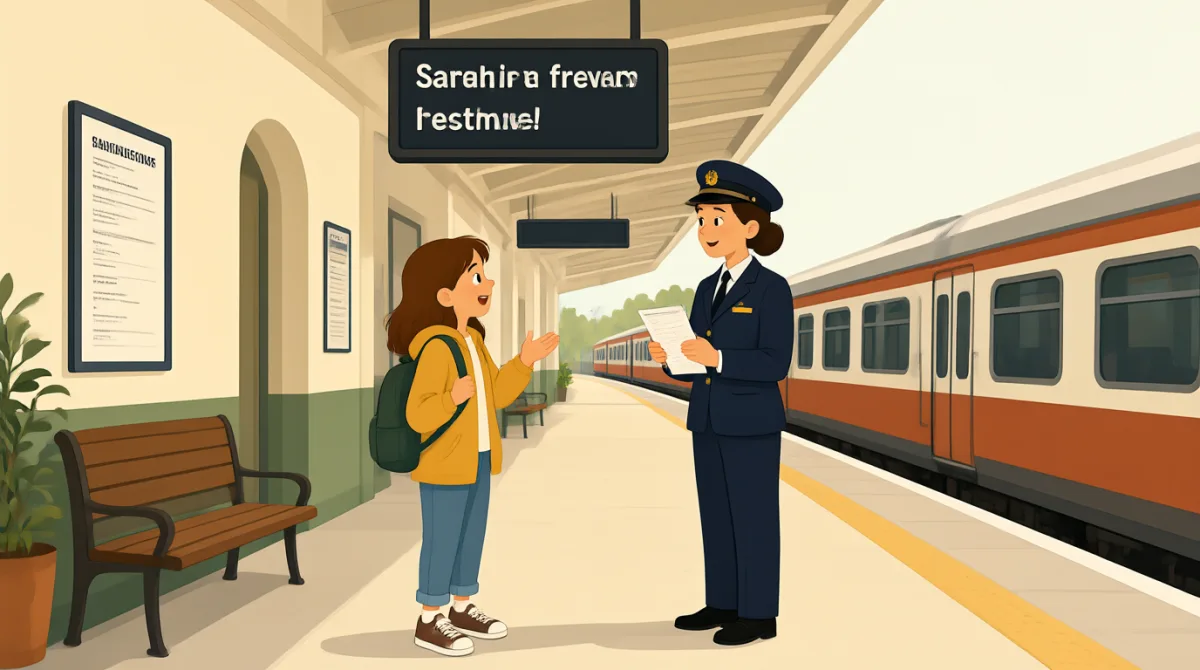

Excuse me, where can I catch the next train to Boston?
Com licença, onde posso pegar o próximo trem para Boston?

Let me check your ticket. It leaves from Platform 6.
Deixe-me conferir sua passagem. Ele parte da Plataforma 6.
Thanks. Is Platform 6 far from here?
Obrigada. A Plataforma 6 fica longe daqui?
No, it’s just down that hall. Follow the blue signs.
Não, fica logo ali, descendo aquele corredor. Siga as placas azuis.
How much time do I have before it leaves?
Quanto tempo tenho antes de ele partir?
It leaves in ten minutes, so you should head there now.
Ele parte em dez minutos, então é melhor você ir para lá agora.
Okay, I’ll hurry. Do I need to show my new ticket?
Certo, vou me apressar. Preciso mostrar minha nova passagem?
Yes, show it when you get on. You have enough time.
Sim, mostre-a quando embarcar. Você tem tempo suficiente.
Vocabulário8
- catch the next trainpegar o próximo trem
This means to get on the next train that is going to your destination. You can use “catch” when talking about getting on a bus or train.
Isso significa embarcar no próximo trem que vai para o seu destino. Você pode usar “catch” quando falar de pegar um ônibus ou trem.
- Platform 6Plataforma 6
This is the numbered area where passengers wait for and get on a train. Replace “6” with the platform number you need.
É a área numerada onde os passageiros esperam pelo trem e embarcam. Troque “6” pelo número da plataforma de que você precisa.
- far from herelonge daqui
This asks whether a place is a long distance away. You can use it to ask about the distance to a station, shop, or other place.
Essa expressão pergunta se um lugar fica a uma grande distância. Você pode usá-la para perguntar a distância até uma estação, uma loja ou outro lugar.
- down that halldescendo aquele corredor
This gives a simple direction to a place along the hall. You can use “down that hall” when pointing someone toward a place indoors.
Essa expressão indica um caminho simples até um lugar ao longo do corredor. Você pode usá-la para orientar alguém dentro de um edifício.
- Follow the blue signs.Siga as placas azuis.
This tells someone to use the blue signs to find the way. You can replace “blue” with another color or describe a different sign.
Essa frase orienta alguém a seguir as placas azuis para encontrar o caminho. Você pode trocar “blue” por outra cor ou descrever uma placa diferente.
- head there nowir para lá agora
This means to go to that place right away. You can use “head” to give someone a simple direction, such as “Head to the station.”
Isso significa ir para aquele lugar imediatamente. Você pode usar “head” para dar uma orientação simples, como “Head to the station.”
- show my new ticketmostrar minha nova passagem
This means to present the ticket so someone can check it. You can use “show my” with other things you need to present, such as an ID.
Isso significa apresentar a passagem para que alguém possa conferi-la. Você pode usar “show my” com outras coisas que precisa apresentar, como um documento de identidade.
- when you get onquando você embarcar
This means at the time you board the train. You can also use this phrase when talking about getting on a bus.
Isso significa no momento em que você embarca no trem. Você também pode usar essa expressão ao falar de embarcar em um ônibus.
Frases-chave8
- 1
Excuse me, where can I catch the next train to Boston?
Com licença, onde posso pegar o próximo trem para Boston?
This is a polite way to ask where to board a train. Replace “Boston” with the name of your destination.
Essa é uma forma educada de perguntar onde embarcar em um trem. Troque “Boston” pelo nome do seu destino.
- 2
Let me check your ticket.
Deixe-me conferir sua passagem.
This is a helpful phrase when you need to look at someone’s ticket before giving information. You can use “Let me check” before looking at a schedule or booking.
Essa é uma frase prestativa para usar quando você precisa olhar a passagem de alguém antes de dar uma informação. Você pode dizer “Let me check” antes de consultar um horário ou uma reserva.
- 3
Is Platform 6 far from here?
A Plataforma 6 fica longe daqui?
Use this question to ask how far away a place is. Replace “Platform 6” with another place you need to find.
Use essa pergunta para saber a que distância fica um lugar. Troque “Platform 6” por outro lugar que você precisa encontrar.
- 4
Follow the blue signs.
Siga as placas azuis.
This is a short, clear way to give directions. You can replace “blue signs” with another landmark or set of directions.
Essa é uma forma curta e clara de dar uma orientação. Você pode trocar “blue signs” por outro ponto de referência ou conjunto de instruções.
- 5
How much time do I have before it leaves?
Quanto tempo tenho antes de ele partir?
Use this to ask how long you have before a train or other transport departs. Replace “it” with a bus, flight, or event.
Use essa pergunta para saber quanto tempo falta para um trem ou outro meio de transporte partir. Troque “it” por um ônibus, um voo ou um evento.
- 6
Okay, I’ll hurry.
Certo, vou me apressar.
This is a simple way to say that you will move quickly. You can use it when someone tells you that time is short.
Essa é uma forma simples de dizer que você vai se movimentar rapidamente. Você pode usá-la quando alguém avisa que o tempo está acabando.
- 7
Do I need to show my new ticket?
Preciso mostrar minha nova passagem?
Use this question to check whether you need to present a ticket or other document. Replace “my new ticket” with the item you need to ask about.
Use essa pergunta para confirmar se você precisa apresentar uma passagem ou outro documento. Troque “my new ticket” pelo item sobre o qual você precisa perguntar.
- 8
You have enough time.
Você tem tempo suficiente.
This is a reassuring way to tell someone they can still do something before a deadline. You can use it when someone is worried about being late.
Essa é uma forma tranquilizadora de dizer a alguém que ainda dá tempo de fazer algo antes do prazo. Você pode usá-la quando alguém está preocupado em se atrasar.