Getting an X-Ray
Passer une radiographie
Grace explains why Leo needs an X-ray and guides him through the process. Leo asks what the scan can show and whether it will hurt.
Grace explique pourquoi Leo doit passer une radiographie et le guide tout au long de la procédure. Leo demande ce que l’examen peut montrer et s’il fera mal.
Dialogue10
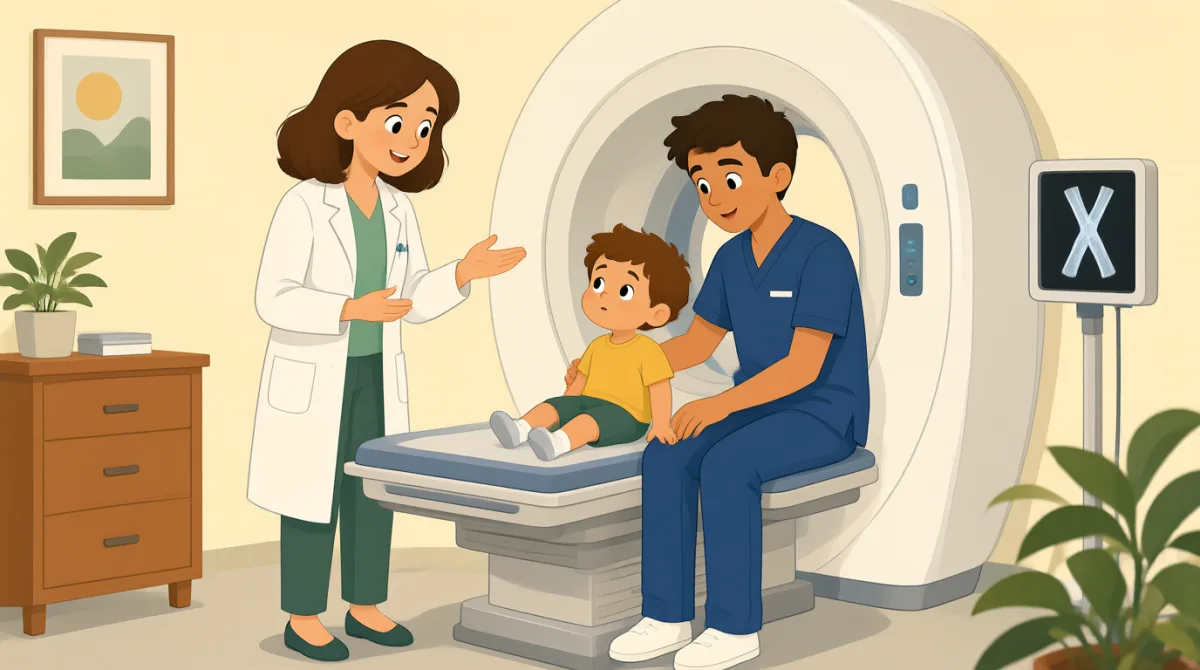

The clinician would like an X-ray to check for a fracture. It can also show how the bones are lined up.
Le médecin voudrait vous faire passer une radiographie pour vérifier si vous avez une fracture. Elle peut aussi montrer si les os sont bien alignés.

Okay. Does the scan hurt, or do I need to do anything to get ready?
D’accord. Est-ce que l’examen fait mal, ou est-ce que je dois faire quelque chose pour me préparer ?
It won’t hurt, and you don’t need special preparation. We’ll just ask you to remove anything metal near your ankle.
Ça ne fera pas mal et vous n’avez pas besoin de préparation particulière. Nous vous demanderons simplement d’enlever tout objet métallique près de votre cheville.
Got it. Will I have to stand on my injured foot, or can I sit down?
Je vois. Est-ce que je devrai poser le pied blessé par terre, ou est-ce que je pourrai m’asseoir ?
You can sit or lie down for the images. The technician may gently move your foot into a few different positions.
Vous pourrez vous asseoir ou vous allonger pour les clichés. Le technicien déplacera peut-être doucement votre pied pour le placer dans quelques positions différentes.
That sounds manageable. Should I tell the technician if moving it makes the pain worse?
Ça devrait aller. Est-ce que je dois prévenir le technicien si le fait de bouger le pied aggrave la douleur ?
Absolutely. Tell them right away, and they’ll work with you. Try to hold still briefly while each image is taken.
Absolument. Dites-le-lui tout de suite, et il s’adaptera à vos besoins. Essayez de ne pas bouger pendant quelques instants à chaque prise de cliché.
How long will it take, and will I get the results before I leave?
Combien de temps ça va prendre, et est-ce que j’aurai les résultats avant de partir ?
The scan itself usually takes just a few minutes. I’ll review the images and explain what we find before you go.
La radiographie en elle-même ne prend généralement que quelques minutes. J’examinerai les images et je vous expliquerai ce qu’on y voit avant votre départ.
Great, thanks for explaining. I was worried it might be painful, but now I know what to expect.
Super, merci pour ces explications. J’avais peur que ça fasse mal, mais maintenant je sais à quoi m’attendre.
Vocabulaire7
- check for a fracturevérifier s’il y a une fracture
To look for a crack or break in a bone. You can use this phrase to describe what a medical test is checking.
Chercher une fissure ou une cassure dans un os. Cette expression permet d’expliquer ce qu’un examen médical vise à détecter.
- lined upbien alignés
Positioned in the correct way in relation to each other. Here, the X-ray shows whether the bones are properly aligned.
Placés correctement les uns par rapport aux autres. Ici, la radiographie montre si les os sont bien alignés.
- special preparationpréparation particulière
Extra steps you need to take before a test or appointment. You can ask, “Do I need any special preparation?”
Les démarches supplémentaires à faire avant un examen ou un rendez-vous. Vous pouvez demander : « Est-ce que je dois faire quelque chose de particulier pour me préparer ? »
- remove anything metalenlever tout objet métallique
Take off metal items, such as jewelry, before a scan. This phrase is useful when explaining what someone needs to do before an X-ray.
Retirer les objets en métal, comme les bijoux, avant un examen d’imagerie. Cette expression est utile pour expliquer ce qu’il faut faire avant une radiographie.
- hold stillne pas bouger
Keep your body or a part of your body from moving. It is often used when someone needs to stay in one position for a photo or medical image.
Garder le corps, ou une partie du corps, immobile. On emploie souvent cette expression quand il faut rester dans une position pour une photo ou une image médicale.
- work with yous’adapter à vos besoins
To cooperate and adjust to someone’s needs. Here, it reassures Leo that the technician will respond if a position is uncomfortable.
Coopérer et tenir compte des besoins de quelqu’un. Ici, cela rassure Leo : le technicien s’adaptera si une position est inconfortable.
- the scan itselfla radiographie en elle-même
The scan alone, not the other parts of the appointment. “The scan itself usually takes just a few minutes” helps clarify how long the procedure takes.
La radiographie seule, sans compter les autres étapes du rendez-vous. « The scan itself usually takes just a few minutes » (La radiographie en elle-même ne prend généralement que quelques minutes) permet de préciser la durée de l’examen.
Phrases clés7
- 1
Does the scan hurt, or do I need to do anything to get ready?
Does the scan hurt, or do I need to do anything to get ready?
This is a useful way to ask about pain and preparation before a medical test. You can replace “the scan” with another procedure or appointment.
C’est une façon pratique de poser des questions sur la douleur et la préparation avant un examen médical. Vous pouvez remplacer “the scan” par le nom d’une autre procédure ou d’un autre rendez-vous.
- 2
We’ll just ask you to remove anything metal near your ankle.
We’ll just ask you to remove anything metal near your ankle.
This politely explains a simple instruction before a scan. You can use “We’ll ask you to…” to describe what someone will need to do.
Cette phrase donne poliment une consigne simple avant un examen. Utilisez “We’ll ask you to…” pour expliquer ce que quelqu’un devra faire.
- 3
Will I have to stand on my injured foot, or can I sit down?
Will I have to stand on my injured foot, or can I sit down?
This asks about what a procedure will require while offering an alternative. You can use the same pattern to ask whether you must do something or can choose another option.
Cette phrase demande ce qu’une procédure exige tout en proposant une autre possibilité. Vous pouvez reprendre la même structure pour demander si vous devez faire quelque chose ou si vous pouvez choisir une autre option.
- 4
Should I tell the technician if moving it makes the pain worse?
Should I tell the technician if moving it makes the pain worse?
This is a helpful way to check whether you should report a problem. You can replace “the technician” and “the pain” with other people or concerns.
C’est une façon utile de vérifier s’il faut signaler un problème. Vous pouvez remplacer “the technician” et “the pain” par d’autres personnes ou préoccupations.
- 5
Tell them right away, and they’ll work with you.
Tell them right away, and they’ll work with you.
This gives clear advice and reassures someone that help is available. “Tell them right away” is useful when a person should report something promptly.
Cette phrase donne un conseil clair et rassure la personne en lui indiquant qu’elle sera aidée. “Tell them right away” est utile quand quelqu’un doit signaler rapidement un problème.
- 6
The scan itself usually takes just a few minutes.
The scan itself usually takes just a few minutes.
This is a simple way to explain how long a procedure normally lasts. Replace “the scan” with another activity to give an estimate for its duration.
C’est une façon simple d’expliquer combien de temps dure généralement une procédure. Remplacez “the scan” par le nom d’une autre activité pour en indiquer la durée approximative.
- 7
I’ll review the images and explain what we find before you go.
I’ll review the images and explain what we find before you go.
This explains what will happen after a test and when the person will hear about the results. You can adapt it to describe the next steps in another service situation.
Cette phrase explique ce qui se passera après un examen et quand la personne connaîtra les résultats. Vous pouvez l’adapter pour décrire les étapes suivantes dans une autre situation de service.