Getting an X-Ray
Grace explains why Leo needs an X-ray and guides him through the process. Leo asks what the scan can show and whether it will hurt.
Dialogue10
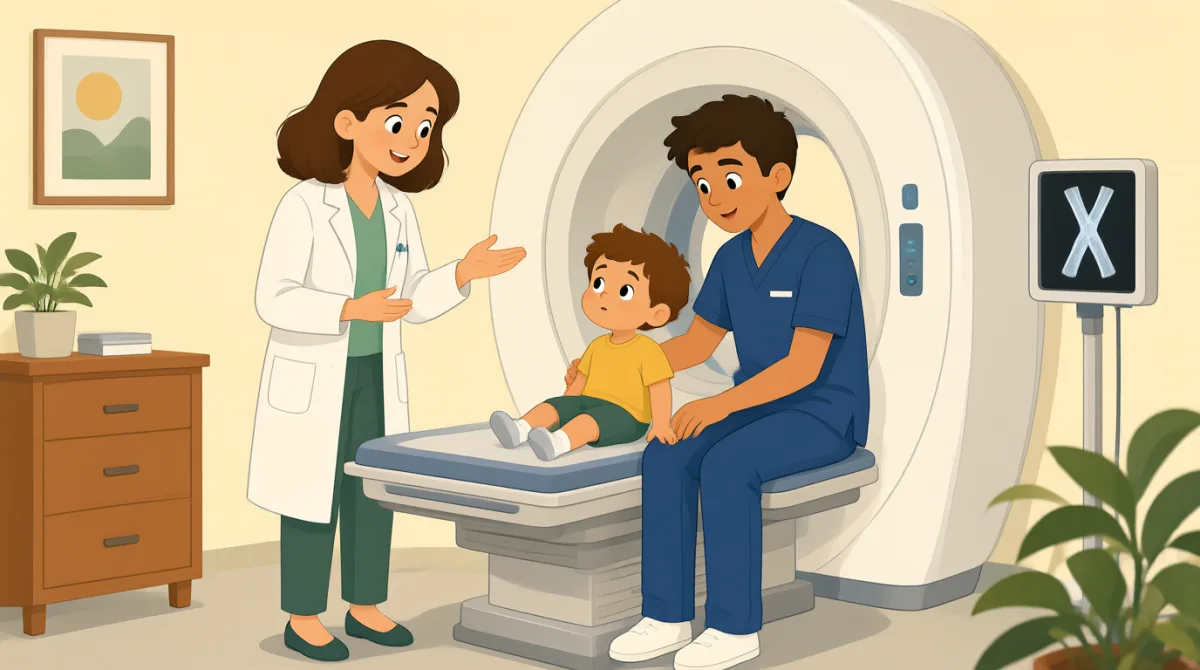

The clinician would like an X-ray to check for a fracture. It can also show how the bones are lined up.

Okay. Does the scan hurt, or do I need to do anything to get ready?
It won’t hurt, and you don’t need special preparation. We’ll just ask you to remove anything metal near your ankle.
Got it. Will I have to stand on my injured foot, or can I sit down?
You can sit or lie down for the images. The technician may gently move your foot into a few different positions.
That sounds manageable. Should I tell the technician if moving it makes the pain worse?
Absolutely. Tell them right away, and they’ll work with you. Try to hold still briefly while each image is taken.
How long will it take, and will I get the results before I leave?
The scan itself usually takes just a few minutes. I’ll review the images and explain what we find before you go.
Great, thanks for explaining. I was worried it might be painful, but now I know what to expect.
Vocabulary7
- check for a fracture
To look for a crack or break in a bone. You can use this phrase to describe what a medical test is checking.
- lined up
Positioned in the correct way in relation to each other. Here, the X-ray shows whether the bones are properly aligned.
- special preparation
Extra steps you need to take before a test or appointment. You can ask, “Do I need any special preparation?”
- remove anything metal
Take off metal items, such as jewelry, before a scan. This phrase is useful when explaining what someone needs to do before an X-ray.
- hold still
Keep your body or a part of your body from moving. It is often used when someone needs to stay in one position for a photo or medical image.
- work with you
To cooperate and adjust to someone’s needs. Here, it reassures Leo that the technician will respond if a position is uncomfortable.
- the scan itself
The scan alone, not the other parts of the appointment. “The scan itself usually takes just a few minutes” helps clarify how long the procedure takes.
Key Sentences7
- 1
Does the scan hurt, or do I need to do anything to get ready?
This is a useful way to ask about pain and preparation before a medical test. You can replace “the scan” with another procedure or appointment.
- 2
We’ll just ask you to remove anything metal near your ankle.
This politely explains a simple instruction before a scan. You can use “We’ll ask you to…” to describe what someone will need to do.
- 3
Will I have to stand on my injured foot, or can I sit down?
This asks about what a procedure will require while offering an alternative. You can use the same pattern to ask whether you must do something or can choose another option.
- 4
Should I tell the technician if moving it makes the pain worse?
This is a helpful way to check whether you should report a problem. You can replace “the technician” and “the pain” with other people or concerns.
- 5
Tell them right away, and they’ll work with you.
This gives clear advice and reassures someone that help is available. “Tell them right away” is useful when a person should report something promptly.
- 6
The scan itself usually takes just a few minutes.
This is a simple way to explain how long a procedure normally lasts. Replace “the scan” with another activity to give an estimate for its duration.
- 7
I’ll review the images and explain what we find before you go.
This explains what will happen after a test and when the person will hear about the results. You can adapt it to describe the next steps in another service situation.