Calling for an Appointment
Prendre rendez-vous
Mia calls the clinic to make an appointment for her sick child. The receptionist asks about the symptoms and offers a time.
Mia appelle la clinique pour prendre rendez-vous pour son enfant malade. La réceptionniste lui demande quels sont ses symptômes et lui propose un créneau.
Dialogue9
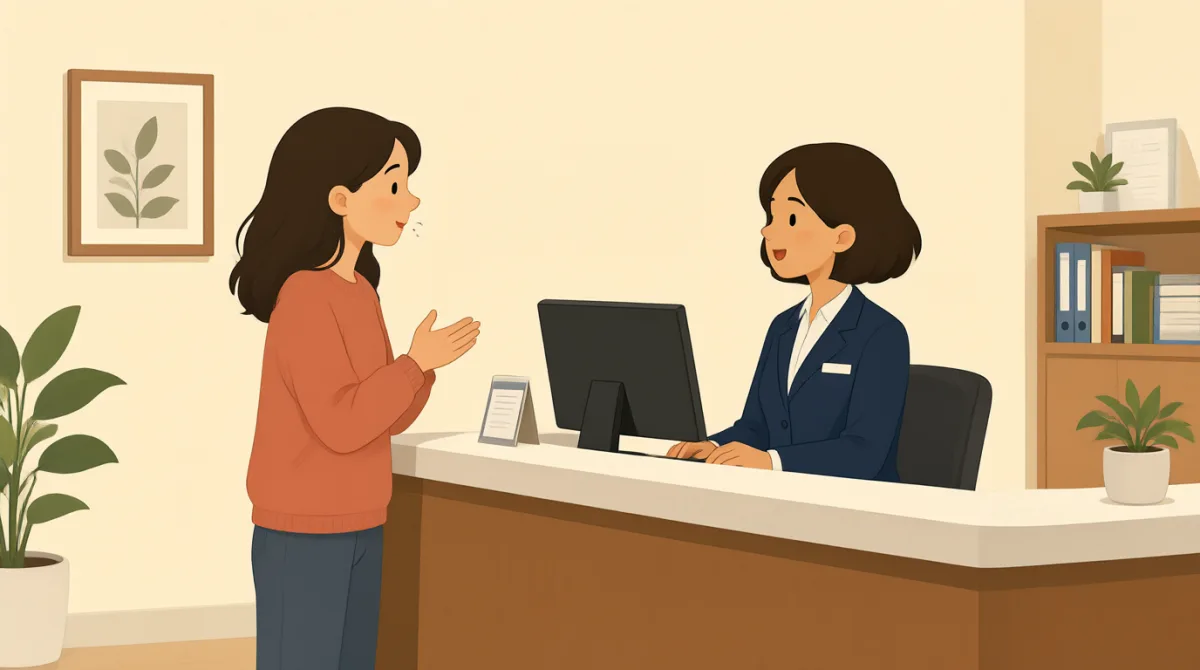

Hello, I’d like to make an appointment for my child, please.
Bonjour, je voudrais prendre rendez-vous pour mon enfant, s’il vous plaît.

Of course. What seems to be the problem?
Bien sûr. Qu’est-ce qui ne va pas ?
She has a fever and a sore throat. She started feeling sick last night.
Elle a de la fièvre et mal à la gorge. Elle a commencé à se sentir malade hier soir.
I’m sorry to hear that. Does she have a cough or a rash?
Je suis désolée de l’apprendre. Est-ce qu’elle tousse ou a des boutons ?
She has a little cough, but no rash. Can she see the doctor today?
Elle tousse un peu, mais elle n’a pas de boutons. Est-ce qu’elle peut voir le médecin aujourd’hui ?
Let me check. We have an opening at two thirty this afternoon.
Je regarde. Nous avons un créneau à quatorze heures trente cet après-midi.
That works for us. Should I bring anything with me?
Ça nous convient. Est-ce que je dois apporter quelque chose ?
Please bring her health card and a list of any medicine she takes.
Veuillez apporter sa carte d’assurance maladie et une liste des médicaments qu’elle prend.
Okay, thank you. We’ll be there a little early.
D’accord, merci. Nous arriverons un peu en avance.
Vocabulaire7
- make an appointmentprendre rendez-vous
To arrange a time to see a doctor. You can also use this phrase when booking other services.
Organiser un moment pour consulter un médecin. Cette expression s’emploie aussi pour réserver d’autres services.
- What seems to be the problem?Qu’est-ce qui ne va pas ?
A polite way to ask what is wrong. A receptionist or doctor may use it to ask about someone’s health.
Une façon polie de demander ce qui se passe. Une réceptionniste ou un médecin peut poser cette question pour s’informer sur la santé de quelqu’un.
- sore throatmal à la gorge
Pain or discomfort in your throat. You can say, “I have a sore throat” when describing a symptom.
Une douleur ou une gêne dans la gorge. Pour décrire ce symptôme, vous pouvez dire “I have a sore throat” (J’ai mal à la gorge).
- rashune éruption cutanée
A patch of irritated or red skin. A doctor may ask if someone has a rash as well as other symptoms.
Une zone de peau irritée ou rouge. Le médecin peut demander si quelqu’un a aussi une éruption cutanée parmi ses autres symptômes.
- openingun créneau disponible
A free time in a schedule. You can ask, “Do you have an opening today?” when booking an appointment.
Un moment libre dans un emploi du temps. Pour prendre rendez-vous, vous pouvez demander “Do you have an opening today?” (Avez-vous un créneau disponible aujourd’hui ?).
- health cardcarte d’assurance maladie
A card with health-care information that you may need to bring to a clinic.
Une carte contenant des informations sur votre couverture santé, que vous devrez peut-être apporter à la clinique.
- a list of any medicine she takesune liste des médicaments qu’elle prend
A written record of the medicines she uses. This information can help the doctor understand her health needs.
Un relevé écrit des médicaments qu’elle prend. Ces informations peuvent aider le médecin à comprendre ses besoins en matière de santé.
Phrases clés8
- 1
I’d like to make an appointment for my child, please.
Je voudrais prendre rendez-vous pour mon enfant, s’il vous plaît.
Use this polite sentence to ask for a visit with a doctor. You can replace “my child” with “myself” or another person.
Utilisez cette phrase polie pour demander un rendez-vous chez le médecin. Vous pouvez remplacer “my child” par “myself” ou par une autre personne.
- 2
She has a fever and a sore throat.
Elle a de la fièvre et mal à la gorge.
Use this sentence to describe someone’s symptoms. Replace the symptoms with the ones the person has.
Utilisez cette phrase pour décrire les symptômes de quelqu’un. Remplacez les symptômes par ceux que la personne présente.
- 3
She started feeling sick last night.
Elle a commencé à se sentir malade hier soir.
This tells someone when the illness began. You can change “last night” to another time, such as “this morning.”
Cette phrase indique quand la maladie a commencé. Vous pouvez remplacer “last night” par un autre moment, par exemple “this morning.”
- 4
Does she have a cough or a rash?
Est-ce qu’elle tousse ou a des boutons ?
Use this question to ask about possible symptoms. Replace “she” and the symptoms to ask about someone else.
Utilisez cette question pour vous renseigner sur des symptômes éventuels. Remplacez “she” et les symptômes pour poser la question à propos d’une autre personne.
- 5
Can she see the doctor today?
Est-ce qu’elle peut voir le médecin aujourd’hui ?
Use this question to ask if a doctor’s visit is possible today. You can change “today” to another day or time.
Utilisez cette question pour demander s’il est possible de consulter un médecin aujourd’hui. Vous pouvez remplacer “today” par un autre jour ou un autre moment.
- 6
We have an opening at two thirty this afternoon.
Nous avons un créneau disponible à quatorze heures trente cet après-midi.
This is a way to offer an available appointment time. You can use the same pattern with a different time.
Cette phrase permet de proposer une heure de rendez-vous disponible. Vous pouvez reprendre la même structure avec une autre heure.
- 7
Should I bring anything with me?
Est-ce que je dois apporter quelque chose ?
Use this question to ask what you need to take to an appointment. It is also useful before meetings or visits.
Utilisez cette question pour demander ce que vous devez apporter à un rendez-vous. Elle est aussi utile avant une réunion ou une visite.
- 8
We’ll be there a little early.
Nous arriverons un peu en avance.
Use this sentence to say that you plan to arrive before the scheduled time. You can replace “a little early” with “on time.”
Utilisez cette phrase pour dire que vous prévoyez d’arriver avant l’heure prévue. Vous pouvez remplacer “a little early” par “on time.”