Calling for an Appointment
Mia calls the clinic to make an appointment for her sick child. The receptionist asks about the symptoms and offers a time.
Dialogue9
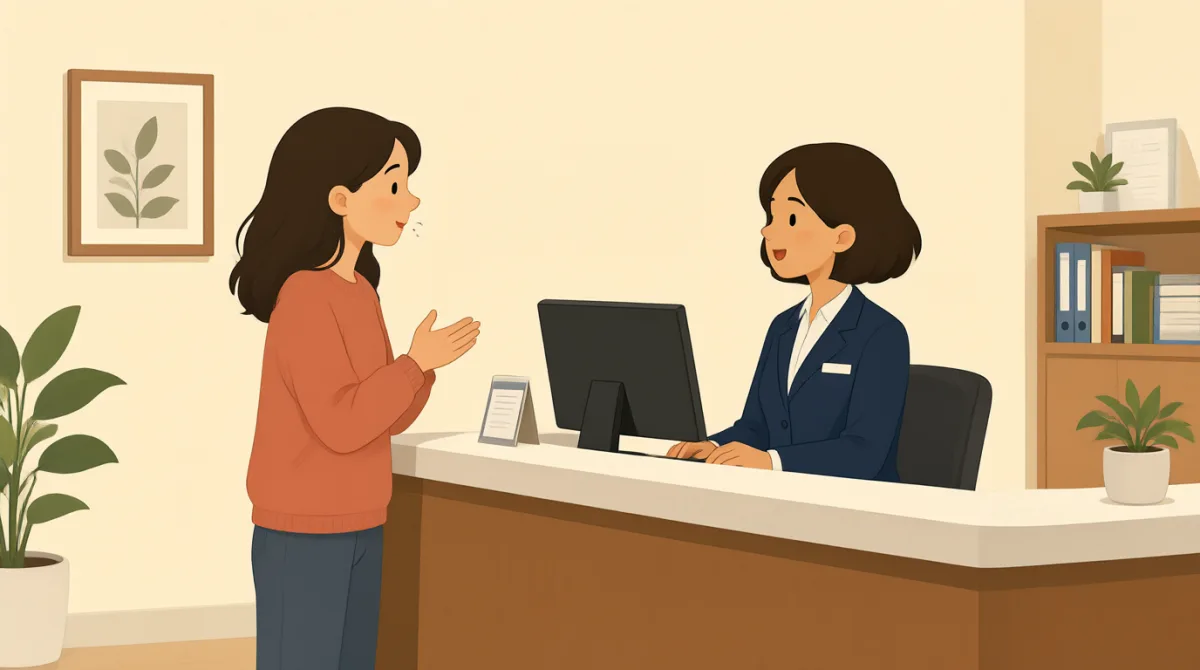

Hello, I’d like to make an appointment for my child, please.

Of course. What seems to be the problem?
She has a fever and a sore throat. She started feeling sick last night.
I’m sorry to hear that. Does she have a cough or a rash?
She has a little cough, but no rash. Can she see the doctor today?
Let me check. We have an opening at two thirty this afternoon.
That works for us. Should I bring anything with me?
Please bring her health card and a list of any medicine she takes.
Okay, thank you. We’ll be there a little early.
Vocabulary7
- make an appointment
To arrange a time to see a doctor. You can also use this phrase when booking other services.
- What seems to be the problem?
A polite way to ask what is wrong. A receptionist or doctor may use it to ask about someone’s health.
- sore throat
Pain or discomfort in your throat. You can say, “I have a sore throat” when describing a symptom.
- rash
A patch of irritated or red skin. A doctor may ask if someone has a rash as well as other symptoms.
- opening
A free time in a schedule. You can ask, “Do you have an opening today?” when booking an appointment.
- health card
A card with health-care information that you may need to bring to a clinic.
- a list of any medicine she takes
A written record of the medicines she uses. This information can help the doctor understand her health needs.
Key Sentences8
- 1
I’d like to make an appointment for my child, please.
Use this polite sentence to ask for a visit with a doctor. You can replace “my child” with “myself” or another person.
- 2
She has a fever and a sore throat.
Use this sentence to describe someone’s symptoms. Replace the symptoms with the ones the person has.
- 3
She started feeling sick last night.
This tells someone when the illness began. You can change “last night” to another time, such as “this morning.”
- 4
Does she have a cough or a rash?
Use this question to ask about possible symptoms. Replace “she” and the symptoms to ask about someone else.
- 5
Can she see the doctor today?
Use this question to ask if a doctor’s visit is possible today. You can change “today” to another day or time.
- 6
We have an opening at two thirty this afternoon.
This is a way to offer an available appointment time. You can use the same pattern with a different time.
- 7
Should I bring anything with me?
Use this question to ask what you need to take to an appointment. It is also useful before meetings or visits.
- 8
We’ll be there a little early.
Use this sentence to say that you plan to arrive before the scheduled time. You can replace “a little early” with “on time.”