Noticing the Flat Tire
Repérer le pneu crevé
Emma and Jack notice a flat tire while getting ready to drive. They pull over and check the car.
Emma et Jack remarquent un pneu crevé en se préparant à partir en voiture. Ils se rangent sur le côté et vérifient la voiture.
Dialogue8
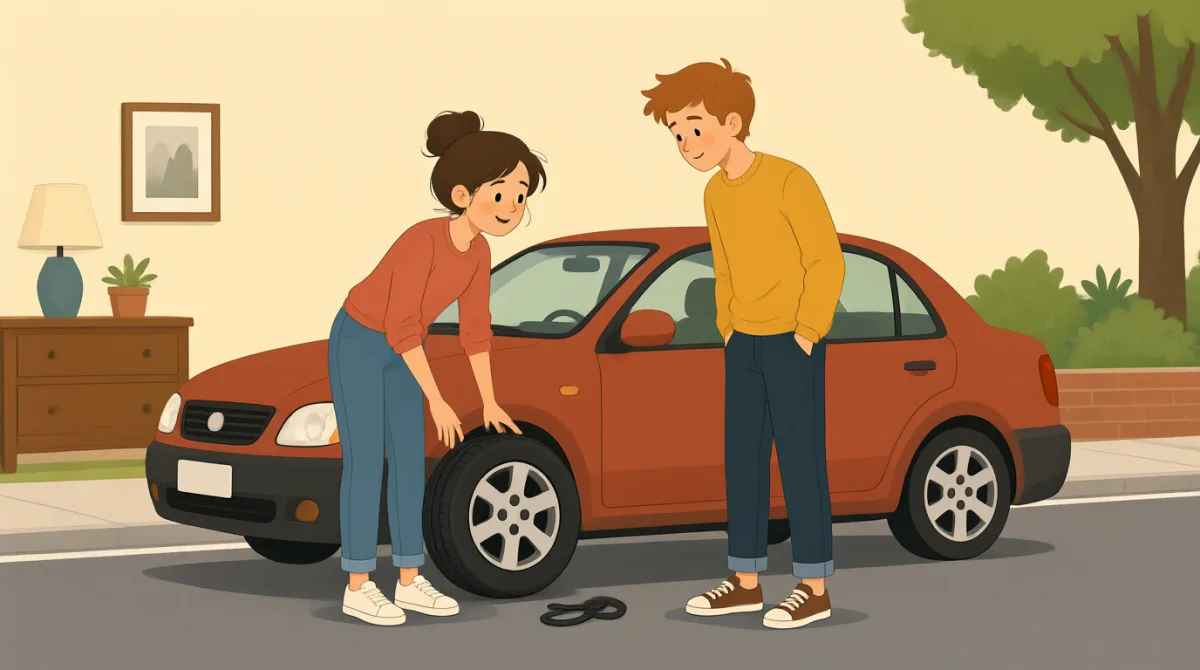

Jack, the car is pulling to the right. Can you check what’s wrong?
Jack, la voiture tire à droite. Tu peux vérifier ce qui ne va pas ?

Sure. I’ll pull over here, away from traffic. Are you okay?
Bien sûr. Je vais me ranger ici, à l’écart de la circulation. Ça va ?
I’m fine. The car feels strange, though. Did we hit something?
Oui, ça va. Mais la voiture se comporte bizarrement. On a heurté quelque chose ?
I don’t think so. Let’s get out and look at the tires.
Je ne crois pas. Sortons et regardons les pneus.
Oh, the back tire is flat! I didn’t notice it before.
Oh, le pneu arrière est crevé ! Je ne l’avais pas remarqué avant.
Yes, it’s completely flat. We shouldn’t drive on it.
Oui, il est complètement à plat. On ne devrait pas rouler comme ça.
Can we change it ourselves, or should we call for help?
On peut le changer nous-mêmes ou on devrait appeler à l’aide ?
Let’s check the trunk for a spare tire and the tools first.
Commençons par vérifier s’il y a une roue de secours et les outils dans le coffre.
Vocabulaire8
- pulling to the righttirer à droite
This means the car is moving toward the right side by itself. You can use “pulling to the left” to describe a similar problem.
Cela signifie que la voiture se déporte toute seule vers la droite. On peut dire “pulling to the left” pour décrire un problème similaire.
- pull overse ranger sur le côté
To pull over is to move a vehicle to the side of the road and stop. You can say, “Please pull over here.”
“Pull over” signifie qu’on déplace un véhicule sur le bas-côté et qu’on s’arrête. On peut dire : “Please pull over here.” (Rangez-vous ici, s’il vous plaît.)
- what’s wrongce qui ne va pas
This asks what the problem is. You can use it when something seems unusual or is not working.
Cette expression sert à demander quel est le problème. Tu peux l’utiliser quand quelque chose semble inhabituel ou ne fonctionne pas.
- get outsortir
Here, “get out” means to leave the car. You can also say, “Let’s get out and stretch our legs.”
Ici, “get out” signifie sortir de la voiture. On peut aussi dire : “Let’s get out and stretch our legs.” (Sortons nous dégourdir les jambes.)
- flatà plat / crevé
A tire is flat when it has lost its air and cannot be used normally. You can say, “The front tire is flat.”
Un pneu est “flat” quand il a perdu son air et qu’on ne peut plus l’utiliser normalement. On peut dire : “The front tire is flat.” (Le pneu avant est à plat.)
- call for helpappeler à l’aide
This means to contact someone who can assist you. You can use it when you need help with a problem or emergency.
Cela signifie contacter quelqu’un qui peut t’aider. Tu peux employer cette expression quand tu as besoin d’aide pour résoudre un problème ou faire face à une urgence.
- spare tireroue de secours
A spare tire is an extra tire kept in a vehicle in case another tire goes flat. You can say, “Let’s check if we have a spare tire.”
Une “spare tire” est une roue supplémentaire conservée dans un véhicule au cas où un autre pneu serait crevé. On peut dire : “Let’s check if we have a spare tire.” (Vérifions si nous avons une roue de secours.)
- trunkcoffre
The trunk is the storage area at the back of a car. You can say, “Put the bags in the trunk.”
Le “trunk” est l’espace de rangement à l’arrière d’une voiture. On peut dire : “Put the bags in the trunk.” (Mets les sacs dans le coffre.)
Phrases clés7
- 1
The car is pulling to the right.
La voiture tire à droite.
Use this sentence to describe a car that seems to move toward one side. You can replace “right” with “left.”
Utilise cette phrase pour décrire une voiture qui semble se déporter d’un côté. Tu peux remplacer “right” par “left”.
- 2
Can you check what’s wrong?
Tu peux vérifier ce qui ne va pas ?
This is a simple way to ask someone to find out what the problem is. Replace “what’s wrong” with the thing you want them to check.
C’est une façon simple de demander à quelqu’un de trouver le problème. Remplace “what’s wrong” par la chose que tu veux qu’il vérifie.
- 3
I’ll pull over here, away from traffic.
Je vais me ranger ici, à l’écart de la circulation.
Use this when you are going to stop your car somewhere safe. “I’ll” is a natural way to talk about a quick decision or plan.
Utilise cette phrase quand tu vas arrêter ta voiture dans un endroit sûr. “I’ll” est une façon naturelle de parler d’une décision ou d’un projet immédiat.
- 4
Let’s get out and look at the tires.
Sortons et regardons les pneus.
This suggests doing two actions together: leaving the car and checking the tires. You can use “Let’s get out and…” to suggest another activity.
Cette phrase propose de faire deux choses : sortir de la voiture et vérifier les pneus. Tu peux utiliser “Let’s get out and…” pour proposer une autre activité.
- 5
We shouldn’t drive on it.
On ne devrait pas rouler comme ça.
Use “shouldn’t” to say that something is not a good or safe idea. Replace “drive on it” with another action to give advice.
Utilise “shouldn’t” pour dire que quelque chose n’est pas une bonne idée ou n’est pas prudent. Remplace “drive on it” par une autre action pour donner un conseil.
- 6
Can we change it ourselves, or should we call for help?
On peut le changer nous-mêmes ou on devrait appeler à l’aide ?
This asks about two possible ways to solve a problem. You can use “Can we… or should we…?” to compare doing something yourself with asking for help.
Cette phrase demande de choisir entre deux façons possibles de résoudre un problème. Tu peux utiliser “Can we… or should we…?” pour comparer le fait de faire quelque chose soi-même et celui de demander de l’aide.
- 7
Let’s check the trunk for a spare tire and the tools first.
Commençons par vérifier s’il y a une roue de secours et les outils dans le coffre.
Use this to suggest checking a place for items you need. Replace “the trunk” and “a spare tire and the tools” with other places and things.
Utilise cette phrase pour proposer de chercher les objets dont tu as besoin à un endroit donné. Remplace “the trunk” et “a spare tire and the tools” par d’autres endroits et objets.