Noticing the Flat Tire
Den platten Reifen bemerken
Emma and Jack notice a flat tire while getting ready to drive. They pull over and check the car.
Emma und Jack bemerken einen platten Reifen, als sie gerade losfahren wollen. Sie halten an und überprüfen das Auto.
Dialog8
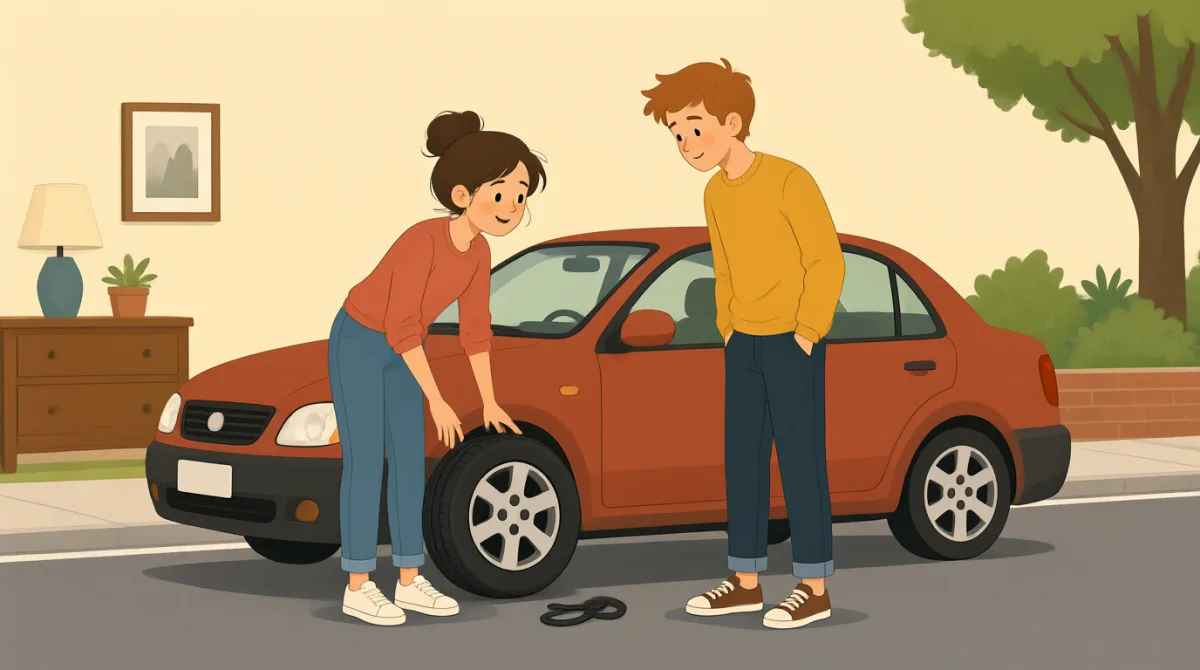

Jack, the car is pulling to the right. Can you check what’s wrong?
Jack, das Auto zieht nach rechts. Kannst du nachsehen, was los ist?

Sure. I’ll pull over here, away from traffic. Are you okay?
Klar. Ich halte hier abseits vom Verkehr an. Geht’s dir gut?
I’m fine. The car feels strange, though. Did we hit something?
Mir geht’s gut. Aber das Auto fühlt sich komisch an. Sind wir über etwas gefahren?
I don’t think so. Let’s get out and look at the tires.
Glaube ich nicht. Lass uns aussteigen und die Reifen ansehen.
Oh, the back tire is flat! I didn’t notice it before.
Oh, der hintere Reifen ist platt! Das ist mir vorher gar nicht aufgefallen.
Yes, it’s completely flat. We shouldn’t drive on it.
Ja, er ist völlig platt. Damit sollten wir nicht weiterfahren.
Can we change it ourselves, or should we call for help?
Können wir ihn selbst wechseln, oder sollen wir Hilfe holen?
Let’s check the trunk for a spare tire and the tools first.
Lass uns zuerst im Kofferraum nach einem Ersatzreifen und dem Werkzeug suchen.
Wortschatz8
- pulling to the rightnach rechts ziehen
This means the car is moving toward the right side by itself. You can use “pulling to the left” to describe a similar problem.
Das bedeutet, dass das Auto von selbst zur rechten Seite fährt. Für ein ähnliches Problem kannst du „pulling to the left“ (nach links ziehen) sagen.
- pull overrechts ranfahren und anhalten
To pull over is to move a vehicle to the side of the road and stop. You can say, “Please pull over here.”
„To pull over“ bedeutet, mit einem Fahrzeug an den Straßenrand zu fahren und anzuhalten. Du kannst zum Beispiel sagen: „Please pull over here.“ (Fahr bitte hier rechts ran.)
- what’s wrongwas los ist
This asks what the problem is. You can use it when something seems unusual or is not working.
Damit fragst du, worin das Problem besteht. Du kannst das sagen, wenn etwas ungewöhnlich wirkt oder nicht funktioniert.
- get outaussteigen
Here, “get out” means to leave the car. You can also say, “Let’s get out and stretch our legs.”
Hier bedeutet „get out“, das Auto zu verlassen. Du kannst auch sagen: „Let’s get out and stretch our legs.“ (Lass uns aussteigen und uns die Beine vertreten.)
- flatplatt
A tire is flat when it has lost its air and cannot be used normally. You can say, “The front tire is flat.”
Ein Reifen ist platt, wenn er Luft verloren hat und nicht mehr normal benutzt werden kann. Du kannst sagen: „The front tire is flat.“ (Der Vorderreifen ist platt.)
- call for helpHilfe holen
This means to contact someone who can assist you. You can use it when you need help with a problem or emergency.
Das bedeutet, jemanden zu kontaktieren, der dir helfen kann. Du kannst den Ausdruck verwenden, wenn du bei einem Problem oder in einem Notfall Hilfe brauchst.
- spare tireErsatzreifen
A spare tire is an extra tire kept in a vehicle in case another tire goes flat. You can say, “Let’s check if we have a spare tire.”
Ein „spare tire“ ist ein zusätzlicher Reifen, den man im Auto mitführt, falls ein anderer Reifen platt wird. Du kannst sagen: „Let’s check if we have a spare tire.“ (Lass uns nachsehen, ob wir einen Ersatzreifen haben.)
- trunkKofferraum
The trunk is the storage area at the back of a car. You can say, “Put the bags in the trunk.”
Der „trunk“ ist der Stauraum hinten im Auto. Du kannst sagen: „Put the bags in the trunk.“ (Leg die Taschen in den Kofferraum.)
Wichtige Sätze7
- 1
The car is pulling to the right.
Das Auto zieht nach rechts.
Use this sentence to describe a car that seems to move toward one side. You can replace “right” with “left.”
Mit diesem Satz beschreibst du ein Auto, das scheinbar zu einer Seite fährt. Du kannst „right“ durch „left“ ersetzen.
- 2
Can you check what’s wrong?
Kannst du nachsehen, was los ist?
This is a simple way to ask someone to find out what the problem is. Replace “what’s wrong” with the thing you want them to check.
So kannst du jemanden einfach bitten, herauszufinden, worin das Problem besteht. Ersetze „what’s wrong“ durch das, was die Person überprüfen soll.
- 3
I’ll pull over here, away from traffic.
Ich halte hier abseits vom Verkehr an.
Use this when you are going to stop your car somewhere safe. “I’ll” is a natural way to talk about a quick decision or plan.
Diesen Satz verwendest du, wenn du dein Auto an einem sicheren Ort anhalten möchtest. „I’ll“ klingt natürlich, wenn du von einer spontanen Entscheidung oder einem Plan sprichst.
- 4
Let’s get out and look at the tires.
Lass uns aussteigen und die Reifen ansehen.
This suggests doing two actions together: leaving the car and checking the tires. You can use “Let’s get out and…” to suggest another activity.
Damit schlägst du zwei Dinge vor, die ihr zusammen machen könnt: aus dem Auto steigen und die Reifen überprüfen. Mit „Let’s get out and…“ kannst du eine andere gemeinsame Aktivität vorschlagen.
- 5
We shouldn’t drive on it.
Damit sollten wir nicht weiterfahren.
Use “shouldn’t” to say that something is not a good or safe idea. Replace “drive on it” with another action to give advice.
Mit „shouldn’t“ sagst du, dass etwas keine gute oder sichere Idee ist. Ersetze „drive on it“ durch eine andere Handlung, um einen Rat zu geben.
- 6
Can we change it ourselves, or should we call for help?
Können wir ihn selbst wechseln, oder sollen wir Hilfe holen?
This asks about two possible ways to solve a problem. You can use “Can we… or should we…?” to compare doing something yourself with asking for help.
Mit diesem Satz fragst du nach zwei möglichen Lösungen für ein Problem. Mit „Can we… or should we…?“ kannst du vergleichen, etwas selbst zu erledigen oder um Hilfe zu bitten.
- 7
Let’s check the trunk for a spare tire and the tools first.
Lass uns zuerst im Kofferraum nach einem Ersatzreifen und dem Werkzeug suchen.
Use this to suggest checking a place for items you need. Replace “the trunk” and “a spare tire and the tools” with other places and things.
Mit diesem Satz schlägst du vor, an einem bestimmten Ort nach Dingen zu suchen, die ihr braucht. Ersetze „the trunk“ und „a spare tire and the tools“ durch andere Orte und Gegenstände.