At the Tire Shop
Au magasin de pneus
Emma and Jack visit a tire shop to have the damaged tire checked. They ask the mechanic about repair options and the cost.
Emma et Jack se rendent dans un magasin de pneus pour faire vérifier le pneu endommagé. Ils demandent au mécanicien quelles sont les options de réparation et combien cela coûte.
Dialogue8
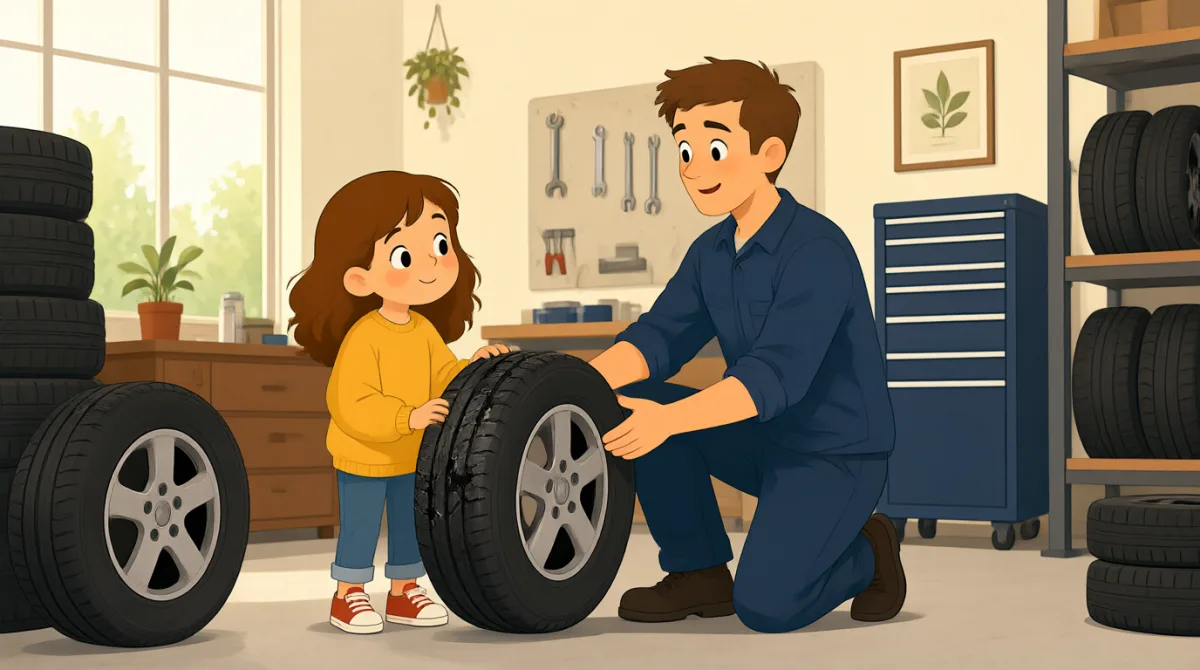

Hi, we have a flat tire. Could you check if you can repair it?
Bonjour, nous avons un pneu à plat. Pourriez-vous vérifier s’il est réparable ?

Sure. I'll take a look. Did you hit anything on the road?
Bien sûr. Je vais y jeter un œil. Vous avez heurté quelque chose sur la route ?

We heard a loud thump, then the tire went flat.
On a entendu un gros boum, puis le pneu s’est dégonflé.
I see a nail in the tire. I'll check how deep the damage is.
Je vois un clou dans le pneu. Je vais vérifier à quelle profondeur il a pénétré.
Can you patch it, or will we need a new tire?
Vous pouvez le réparer avec une rustine, ou il nous en faut un neuf ?
The hole looks small, but I need to check the inside, too.
Le trou a l’air petit, mais je dois aussi vérifier l’intérieur.
How long will the check take? We have the spare on now.
Combien de temps prendra la vérification ? On a monté la roue de secours.
About fifteen minutes. Please leave the car here, and I'll let you know.
Environ quinze minutes. Laissez la voiture ici, s’il vous plaît, et je vous tiendrai au courant.
Vocabulaire8
- flat tirepneu à plat
A flat tire has lost its air and cannot work properly. You can use this phrase to explain a problem with a car tire.
Un « pneu à plat » est un pneu qui a perdu son air et ne peut plus fonctionner correctement. Cette expression permet de signaler un problème avec un pneu de voiture.
- take a lookjeter un œil
This means to examine or check something. You can ask someone to take a look when you need help finding a problem.
“Take a look” signifie examiner ou vérifier quelque chose. Vous pouvez demander à quelqu’un d’y jeter un œil si vous avez besoin d’aide pour trouver un problème.
- hit anythingheurter quelque chose
Here, this means to bump or strike something while driving. You can ask, “Did you hit anything?” to find out what may have caused damage.
Ici, “hit anything” signifie cogner ou heurter quelque chose en conduisant. On peut demander “Did you hit anything?” pour savoir ce qui a pu causer des dégâts.
- went flats’est dégonflé
This means the tire lost its air. Use “went” to describe when it happened in the past.
“Went flat” signifie que le pneu a perdu son air. L’anglais emploie “went” pour indiquer que cela s’est produit dans le passé.
- check the insidevérifier l’intérieur
This means to examine the inner part of something. At a tire shop, the mechanic may check inside the tire for damage.
“Check the inside” signifie examiner la partie intérieure de quelque chose. Dans un magasin de pneus, le mécanicien peut regarder à l’intérieur du pneu pour vérifier s’il est endommagé.
- patch itréparer avec une rustine
To patch a tire means to cover and repair a small hole. You can ask if something can be patched instead of replaced.
“Patch it” signifie réparer un pneu en recouvrant un petit trou avec une rustine. Vous pouvez demander si le pneu peut être réparé ainsi plutôt que remplacé.
- spareroue de secours
A spare is an extra tire kept for use when another tire is damaged. You can say, “We have the spare on” to explain that it is currently being used.
Une « roue de secours » est une roue supplémentaire qu’on garde pour remplacer une roue endommagée. On peut dire “We have the spare on” pour expliquer qu’on l’utilise en ce moment.
- let you knowtenir au courant
This means to tell someone information when you have it. You can use it when you promise to give someone an update.
“Let you know” signifie communiquer une information à quelqu’un dès qu’on l’a. On peut employer cette expression pour promettre de donner des nouvelles.
Phrases clés7
- 1
Could you check if you can repair it?
Pourriez-vous vérifier s’il est réparable ?
This is a polite way to ask someone to see whether something can be fixed. You can reuse “Could you check if you can [do something]?” for other requests.
C’est une manière polie de demander à quelqu’un de vérifier si quelque chose peut être réparé. Vous pouvez réutiliser “Could you check if you can [do something]?” pour formuler d’autres demandes.
- 2
Did you hit anything on the road?
Vous avez heurté quelque chose sur la route ?
This question asks if something caused damage while someone was driving. You can use “Did you hit anything?” to ask about a possible accident or bump.
Cette question cherche à savoir si quelque chose a causé des dégâts pendant que la personne conduisait. Vous pouvez demander “Did you hit anything?” pour savoir s’il y a eu un choc ou un petit accident.
- 3
We heard a loud thump, then the tire went flat.
On a entendu un gros boum, puis le pneu s’est dégonflé.
This sentence explains what happened and in what order. Use “We heard [sound], then [event]” to describe a problem.
Cette phrase explique ce qui s’est passé et dans quel ordre. Utilisez “We heard [sound], then [event]” pour décrire un problème.
- 4
I'll check how deep the damage is.
Je vais vérifier à quelle profondeur il a pénétré.
This is a useful way to say what you will examine next. You can use “I’ll check how [adjective] it is” when you need to measure or assess something.
C’est une façon utile d’indiquer ce que vous allez examiner ensuite. Vous pouvez utiliser “I’ll check how [adjective] it is” quand vous devez mesurer ou évaluer quelque chose.
- 5
Can you patch it, or will we need a new tire?
Vous pouvez le réparer avec une rustine, ou il nous en faut un neuf ?
This asks about two possible solutions. You can reuse “Can you [repair it], or will we need [a replacement]?” when discussing a damaged item.
Cette question porte sur deux solutions possibles. Vous pouvez reprendre “Can you [repair it], or will we need [a replacement]?” pour parler d’un objet endommagé.
- 6
How long will the check take?
Combien de temps prendra la vérification ?
Use this question to ask how much time a task will need. You can change “the check” to another activity, such as “the repair.”
Utilisez cette question pour demander combien de temps une tâche va prendre. Vous pouvez remplacer “the check” par une autre activité, comme “the repair”.
- 7
Please leave the car here, and I'll let you know.
Laissez la voiture ici, s’il vous plaît, et je vous tiendrai au courant.
This gives a polite instruction and explains that you will provide an update later. You can use “I’ll let you know” when you promise to share information.
Cette phrase donne une consigne polie et précise que vous communiquerez des nouvelles plus tard. Vous pouvez utiliser “I’ll let you know” pour promettre de transmettre une information.