Noticing the Flat Tire
Al darse cuenta de que tienen una rueda pinchada
Emma and Jack notice a flat tire while getting ready to drive. They pull over and check the car.
Emma y Jack se dan cuenta de que tienen una rueda pinchada mientras se preparan para salir en coche. Se apartan de la carretera y revisan el auto.
Diálogo8
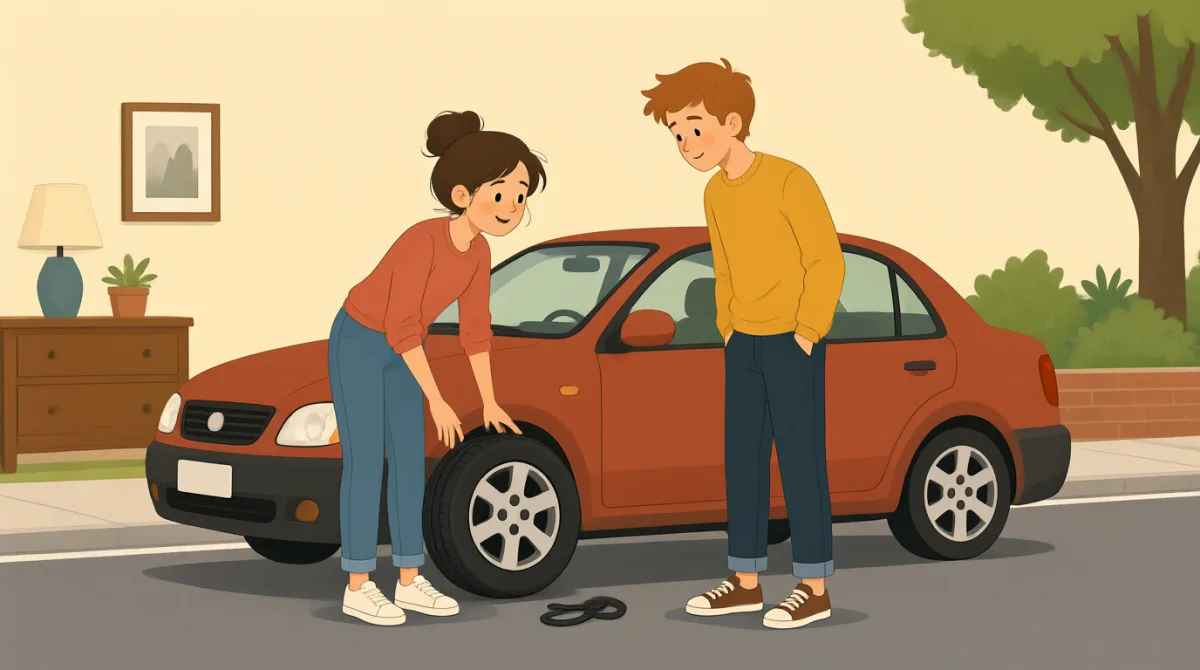

Jack, the car is pulling to the right. Can you check what’s wrong?
Jack, el auto se está yendo hacia la derecha. ¿Puedes revisar qué pasa?

Sure. I’ll pull over here, away from traffic. Are you okay?
Claro. Me aparto aquí, lejos del tráfico. ¿Estás bien?
I’m fine. The car feels strange, though. Did we hit something?
Estoy bien. Aunque el auto se siente raro. ¿Chocamos con algo?
I don’t think so. Let’s get out and look at the tires.
No creo. Bajemos y revisemos las llantas.
Oh, the back tire is flat! I didn’t notice it before.
¡Ay, la llanta trasera está pinchada! No me había dado cuenta.
Yes, it’s completely flat. We shouldn’t drive on it.
Sí, está completamente desinflada. No deberíamos conducir así.
Can we change it ourselves, or should we call for help?
¿Podemos cambiarla nosotros o deberíamos pedir ayuda?
Let’s check the trunk for a spare tire and the tools first.
Primero revisemos el maletero para ver si hay una llanta de repuesto y las herramientas.
Vocabulario8
- pulling to the rightirse hacia la derecha
This means the car is moving toward the right side by itself. You can use “pulling to the left” to describe a similar problem.
Significa que el auto se desvía por sí solo hacia el lado derecho. Puedes decir “pulling to the left” para describir un problema parecido.
- pull overapartarse de la carretera
To pull over is to move a vehicle to the side of the road and stop. You can say, “Please pull over here.”
“Pull over” significa mover un vehículo hacia el borde de la carretera y detenerlo. Puedes decir: “Please pull over here” (Por favor, apártate aquí).
- what’s wrongqué pasa
This asks what the problem is. You can use it when something seems unusual or is not working.
Esta expresión sirve para preguntar cuál es el problema. Puedes usarla cuando algo parece extraño o no funciona bien.
- get outbajarse
Here, “get out” means to leave the car. You can also say, “Let’s get out and stretch our legs.”
Aquí, “get out” significa salir del auto. También puedes decir: “Let’s get out and stretch our legs” (Bajemos y estiremos las piernas).
- flatdesinflado
A tire is flat when it has lost its air and cannot be used normally. You can say, “The front tire is flat.”
Una llanta está “flat” cuando ha perdido el aire y no se puede usar normalmente. Puedes decir: “The front tire is flat” (La llanta delantera está desinflada).
- call for helppedir ayuda
This means to contact someone who can assist you. You can use it when you need help with a problem or emergency.
Significa contactar a alguien que pueda ayudarte. Puedes usarlo cuando necesitas ayuda con un problema o una emergencia.
- spare tirellanta de repuesto
A spare tire is an extra tire kept in a vehicle in case another tire goes flat. You can say, “Let’s check if we have a spare tire.”
Una “spare tire” es una llanta extra que se guarda en el vehículo por si otra se pincha. Puedes decir: “Let’s check if we have a spare tire” (Revisemos si tenemos una llanta de repuesto).
- trunkmaletero
The trunk is the storage area at the back of a car. You can say, “Put the bags in the trunk.”
El “trunk” es el espacio de almacenamiento que está en la parte trasera de un auto. Puedes decir: “Put the bags in the trunk” (Pon las bolsas en el maletero).
Frases clave7
- 1
The car is pulling to the right.
El auto se está yendo hacia la derecha.
Use this sentence to describe a car that seems to move toward one side. You can replace “right” with “left.”
Usa esta frase para describir un auto que parece desviarse hacia un lado. Puedes cambiar “right” por “left”.
- 2
Can you check what’s wrong?
¿Puedes revisar qué pasa?
This is a simple way to ask someone to find out what the problem is. Replace “what’s wrong” with the thing you want them to check.
Esta es una forma sencilla de pedirle a alguien que averigüe cuál es el problema. Puedes sustituir “what’s wrong” por aquello que quieres que revise.
- 3
I’ll pull over here, away from traffic.
Me aparto aquí, lejos del tráfico.
Use this when you are going to stop your car somewhere safe. “I’ll” is a natural way to talk about a quick decision or plan.
Usa esta frase cuando vas a detener el auto en un lugar seguro. “I’ll” es una forma natural de hablar de una decisión o un plan inmediato.
- 4
Let’s get out and look at the tires.
Bajemos y revisemos las llantas.
This suggests doing two actions together: leaving the car and checking the tires. You can use “Let’s get out and…” to suggest another activity.
Esta frase propone hacer dos cosas: salir del auto y revisar las llantas. Puedes usar “Let’s get out and…” para proponer otra actividad.
- 5
We shouldn’t drive on it.
No deberíamos conducir así.
Use “shouldn’t” to say that something is not a good or safe idea. Replace “drive on it” with another action to give advice.
Usa “shouldn’t” para decir que algo no es una buena idea o no es seguro. Puedes sustituir “drive on it” por otra acción para dar un consejo.
- 6
Can we change it ourselves, or should we call for help?
¿Podemos cambiarla nosotros o deberíamos pedir ayuda?
This asks about two possible ways to solve a problem. You can use “Can we… or should we…?” to compare doing something yourself with asking for help.
Esta pregunta plantea dos maneras posibles de resolver un problema. Puedes usar “Can we… or should we…?” para comparar hacer algo por cuenta propia con pedir ayuda.
- 7
Let’s check the trunk for a spare tire and the tools first.
Primero revisemos el maletero para ver si hay una llanta de repuesto y las herramientas.
Use this to suggest checking a place for items you need. Replace “the trunk” and “a spare tire and the tools” with other places and things.
Usa esta frase para proponer que revisen un lugar en busca de lo que necesitan. Puedes sustituir “the trunk” y “a spare tire and the tools” por otros lugares y objetos.