Noticing the Flat Tire
Percebendo que o pneu está furado
Emma and Jack notice a flat tire while getting ready to drive. They pull over and check the car.
Emma e Jack percebem que um pneu está furado quando estão se preparando para sair de carro. Eles encostam e verificam o carro.
Diálogo8
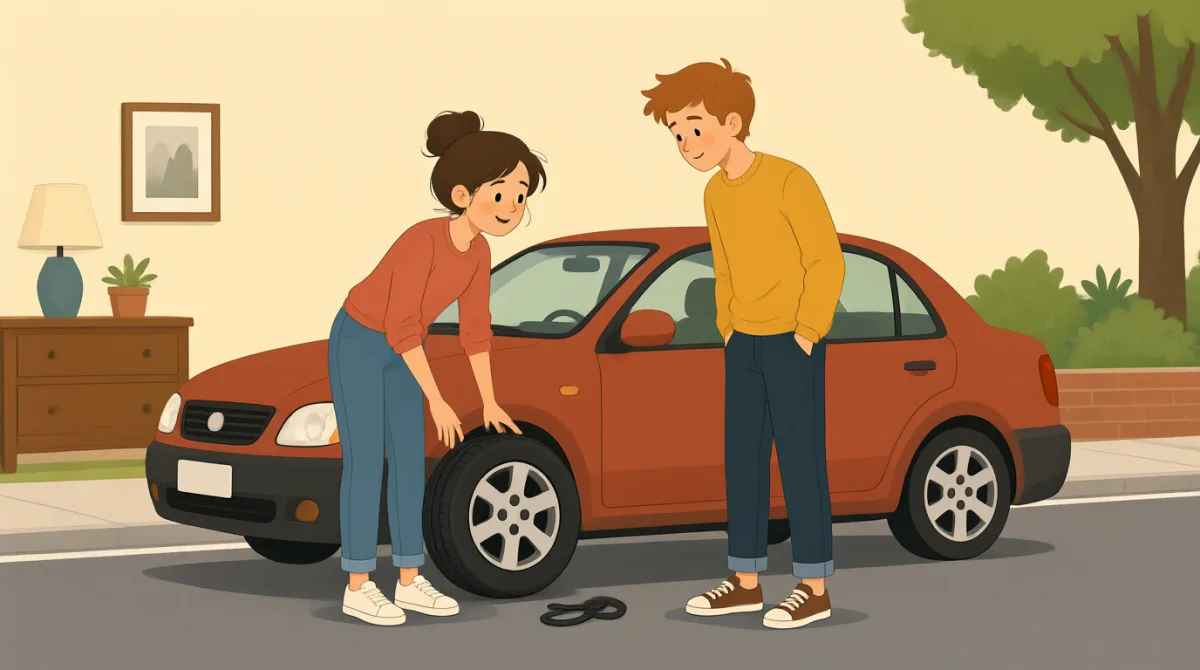

Jack, the car is pulling to the right. Can you check what’s wrong?
Jack, o carro está puxando para a direita. Você pode ver o que está acontecendo?

Sure. I’ll pull over here, away from traffic. Are you okay?
Claro. Vou encostar aqui, longe do trânsito. Você está bem?
I’m fine. The car feels strange, though. Did we hit something?
Estou bem. Mas o carro está estranho. Será que passamos por cima de alguma coisa?
I don’t think so. Let’s get out and look at the tires.
Acho que não. Vamos sair do carro e olhar os pneus.
Oh, the back tire is flat! I didn’t notice it before.
Ah, o pneu de trás está furado! Não tinha percebido antes.
Yes, it’s completely flat. We shouldn’t drive on it.
É, está completamente murcho. Não devemos dirigir assim.
Can we change it ourselves, or should we call for help?
Será que conseguimos trocar sozinhos ou é melhor chamar alguém para ajudar?
Let’s check the trunk for a spare tire and the tools first.
Vamos ver primeiro se tem um estepe e as ferramentas no porta-malas.
Vocabulário8
- pulling to the rightpuxando para a direita
This means the car is moving toward the right side by itself. You can use “pulling to the left” to describe a similar problem.
Isso quer dizer que o carro está indo para o lado direito sozinho. Você pode usar “pulling to the left” para descrever um problema parecido.
- pull overencostar
To pull over is to move a vehicle to the side of the road and stop. You can say, “Please pull over here.”
“Pull over” é tirar o veículo da pista e parar no acostamento ou à beira da estrada. Você pode dizer: “Please pull over here.” (Por favor, encoste aqui.)
- what’s wrongo que está acontecendo
This asks what the problem is. You can use it when something seems unusual or is not working.
Essa expressão pergunta qual é o problema. Você pode usá-la quando algo parece estranho ou não está funcionando.
- get outsair do carro
Here, “get out” means to leave the car. You can also say, “Let’s get out and stretch our legs.”
Aqui, “get out” significa sair do carro. Você também pode dizer: “Let’s get out and stretch our legs.” (Vamos sair e esticar as pernas.)
- flatfurado; murcho
A tire is flat when it has lost its air and cannot be used normally. You can say, “The front tire is flat.”
Um pneu está “flat” quando perdeu o ar e não pode ser usado normalmente. Você pode dizer: “The front tire is flat.” (O pneu da frente está furado.)
- call for helpchamar alguém para ajudar
This means to contact someone who can assist you. You can use it when you need help with a problem or emergency.
Isso significa entrar em contato com alguém que possa ajudar. Você pode usar essa expressão quando precisar de ajuda com um problema ou uma emergência.
- spare tireestepe
A spare tire is an extra tire kept in a vehicle in case another tire goes flat. You can say, “Let’s check if we have a spare tire.”
Um “spare tire” é um pneu extra que fica no veículo para o caso de outro furar. Você pode dizer: “Let’s check if we have a spare tire.” (Vamos ver se temos um estepe.)
- trunkporta-malas
The trunk is the storage area at the back of a car. You can say, “Put the bags in the trunk.”
O “trunk” é o espaço para guardar coisas na parte de trás do carro. Você pode dizer: “Put the bags in the trunk.” (Coloque as bolsas no porta-malas.)
Frases-chave7
- 1
The car is pulling to the right.
O carro está puxando para a direita.
Use this sentence to describe a car that seems to move toward one side. You can replace “right” with “left.”
Use essa frase para descrever um carro que parece estar indo para um dos lados. Você pode trocar “right” por “left”.
- 2
Can you check what’s wrong?
Você pode ver o que está acontecendo?
This is a simple way to ask someone to find out what the problem is. Replace “what’s wrong” with the thing you want them to check.
Essa é uma forma simples de pedir a alguém que descubra qual é o problema. Troque “what’s wrong” pelo que você quer que a pessoa verifique.
- 3
I’ll pull over here, away from traffic.
Vou encostar aqui, longe do trânsito.
Use this when you are going to stop your car somewhere safe. “I’ll” is a natural way to talk about a quick decision or plan.
Use essa frase quando for parar o carro em um lugar seguro. “I’ll” é uma forma natural de falar de uma decisão ou plano imediato.
- 4
Let’s get out and look at the tires.
Vamos sair do carro e olhar os pneus.
This suggests doing two actions together: leaving the car and checking the tires. You can use “Let’s get out and…” to suggest another activity.
Essa frase sugere fazer duas coisas em sequência: sair do carro e verificar os pneus. Você pode usar “Let’s get out and…” para sugerir outra atividade.
- 5
We shouldn’t drive on it.
Não devemos dirigir assim.
Use “shouldn’t” to say that something is not a good or safe idea. Replace “drive on it” with another action to give advice.
Use “shouldn’t” para dizer que algo não é uma boa ideia ou não é seguro. Troque “drive on it” por outra ação para dar um conselho.
- 6
Can we change it ourselves, or should we call for help?
Será que conseguimos trocar sozinhos ou é melhor chamar alguém para ajudar?
This asks about two possible ways to solve a problem. You can use “Can we… or should we…?” to compare doing something yourself with asking for help.
Essa frase pergunta sobre duas maneiras possíveis de resolver um problema. Você pode usar “Can we… or should we…?” para comparar fazer algo por conta própria com pedir ajuda.
- 7
Let’s check the trunk for a spare tire and the tools first.
Vamos ver primeiro se tem um estepe e as ferramentas no porta-malas.
Use this to suggest checking a place for items you need. Replace “the trunk” and “a spare tire and the tools” with other places and things.
Use essa frase para sugerir que alguém procure em um lugar os itens de que precisa. Troque “the trunk” e “a spare tire and the tools” por outros lugares e objetos.