Helping Someone in Line
列に並んでいる人を手伝う
A confused traveler in the immigration line is unsure which form to complete. Mia explains what she learned and helps him find the right counter.
入国審査の列で、どの用紙に記入すればよいかわからず困っている旅行者。ミアは自分が学んだことを説明し、正しいカウンターを見つけるのを手伝います。
会話10
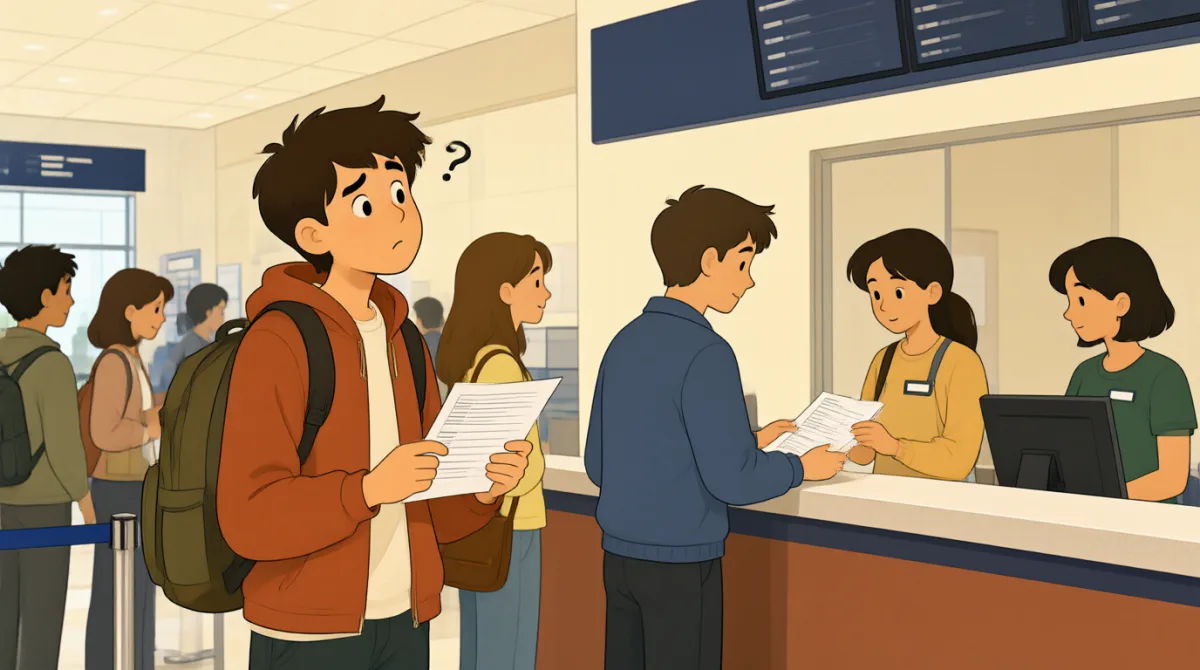

Excuse me, do you know which form I need to fill out? I’m visiting for a few days, but the signs are confusing.
すみません、どの用紙に記入すればいいかご存じですか?数日だけ滞在するのですが、案内表示がわかりにくくて。

Sure. If you’re here for a short visit, you probably need the arrival card, not the work or study form.
もちろんです。短期滞在なら、就労用や留学用の用紙ではなく、入国カードが必要だと思います。
That makes sense. I picked up a form near the entrance, but I’m not sure it’s the right one.
なるほど。入口の近くで用紙を取ったのですが、これで合っているか自信がなくて。
Let me take a look. Yes, this is the arrival card. You’ll need your passport and the address where you’re staying.
ちょっと見せてください。はい、これは入国カードです。パスポートと滞在先の住所が必要ですよ。
Thanks. I’ve got my hotel details on my phone. Do I fill it out before I get to the counter?
ありがとうございます。ホテルの情報はスマホに入っています。カウンターに着く前に記入しておけばいいですか?
Yes, it’s best to complete it while you’re in line. The immigration officer will ask about your visit, too.
はい、列に並んでいる間に記入しておくのがおすすめです。入国審査官から滞在についても質問されますよ。
Got it. And where should I go after I finish? There are two counters up ahead.
わかりました。記入し終わったら、どこへ行けばいいですか?前方にカウンターが二つありますね。
The counter on the left is for visitors. The one on the right is for residents, so follow that sign.
左のカウンターは旅行者用です。右は居住者用なので、あの表示に従ってください。
That clears things up. Thanks for helping me out—I was starting to feel a little lost.
これでよくわかりました。助けてくださってありがとうございます。少し迷い始めていたところでした。
No problem. I was confused at first, too. Just have your passport ready, and you’ll be fine.
どういたしまして。私も最初は戸惑いました。パスポートをすぐ出せるようにしておけば大丈夫ですよ。
語彙6
- fill out記入する
To complete a form by writing the required information on it. You can use this phrase when asking what information a form needs.
必要な情報を用紙に書き込んで完成させることです。用紙に何を記入すればよいか尋ねるときにも使えます。
- arrival card入国カード
A form that visitors may need to complete when they arrive in a country. Here, Mia explains that it is for someone visiting briefly.
国に到着したとき、旅行者が記入を求められることのある用紙です。ここでは、短期間滞在する人向けの用紙としてミアが説明しています。
- details詳細情報
Specific pieces of information. Here, David has his hotel address and other information saved on his phone.
具体的な情報のことです。ここでは、デイビッドがホテルの住所などをスマホに保存しています。
- complete it記入を終える
To finish filling in a form. You can use this phrase to ask when you should finish paperwork.
用紙に必要事項をすべて書き込むことです。書類をいつ書き終えればよいか尋ねるときに使えます。
- up ahead前方に
Farther forward in the direction you are going. David uses it to refer to the counters in front of him.
進んでいる方向の、もう少し先のことです。デイビッドは自分の前にあるカウンターを指して使っています。
- helping me out手伝ってくれて
Giving someone help or support. It is a friendly, informal way to thank someone for assisting you.
人に助けやサポートを与えることです。誰かに手助けしてもらったときに、親しみを込めて感謝する表現です。
重要な文8
- 1
Excuse me, do you know which form I need to fill out?
すみません、どの用紙に記入すればいいかご存じですか?
This is a polite way to ask for help with paperwork. You can reuse the pattern “Do you know which [item] I need to [action]?” when asking for directions or instructions.
書類について丁寧に助けを求める表現です。“Do you know which [item] I need to [action]?”(どの[物]に[動作]すればよいかご存じですか?)という形は、道順や手順を尋ねるときにも使えます。
- 2
If you’re here for a short visit, you probably need the arrival card, not the work or study form.
短期滞在なら、就労用や留学用の用紙ではなく、入国カードが必要だと思います。
This sentence gives advice based on someone’s situation. Use “If you’re here for…” to explain which option may apply.
相手の状況に応じてアドバイスする文です。“If you’re here for…”(ここに来た目的が〜なら)を使うと、どの選択肢が当てはまりそうか説明できます。
- 3
I picked up a form near the entrance, but I’m not sure it’s the right one.
入口の近くで用紙を取ったのですが、これで合っているか自信がありません。
This explains what you have done while expressing uncertainty. You can replace “form” and “near the entrance” with another item and location.
自分がしたことを伝えながら、確信がないことも表す文です。“form”や“near the entrance”を別の物や場所に置き換えて使えます。
- 4
Do I fill it out before I get to the counter?
カウンターに着く前に記入しておけばいいですか?
This is a useful way to check when to complete a task. You can reuse “Do I [action] before I [next step]?” to ask about the order of steps.
作業をいつ済ませればよいか確認するときに便利な表現です。“Do I [action] before I [next step]?”(次の手順に進む前に[動作]すればいいですか?)の形で、手順の順番を尋ねられます。
- 5
The counter on the left is for visitors.
左のカウンターは旅行者用です。
This gives a clear direction and explains who should use a particular counter. You can use “The [place] on the [side] is for…” to identify the right place or service.
場所をはっきり案内し、どんな人がそのカウンターを使うのか説明する文です。“The [place] on the [side] is for…”([側]にある[場所]は〜用です)を使って、適切な場所やサービスを示せます。
- 6
That clears things up.
これでよくわかりました。
This is a natural way to say that an explanation has made something easier to understand. Use it when someone has resolved your confusion.
説明を聞いて、物事がわかりやすくなったと伝える自然な表現です。相手のおかげで疑問や混乱が解消したときに使えます。
- 7
Thanks for helping me out—I was starting to feel a little lost.
助けてくださってありがとうございます。少し迷い始めていたところでした。
This thanks someone and explains why their help mattered. You can use “I was starting to feel a little…” to describe how you felt before someone assisted you.
相手に感謝し、なぜ助けがありがたかったのかを伝える文です。“I was starting to feel a little…”(少し〜と感じ始めていました)を使うと、助けてもらう前の気持ちを表せます。
- 8
Just have your passport ready, and you’ll be fine.
パスポートをすぐ出せるようにしておけば大丈夫ですよ。
This gives simple, reassuring advice. You can use “Have your [item] ready, and you’ll be fine” to help someone feel prepared.
簡単に安心させるアドバイスです。“Have your [item] ready, and you’ll be fine”([持ち物]をすぐ使えるようにしておけば大丈夫です)を使うと、相手が準備できていると感じられるように伝えられます。