Declaring Food at Customs
税関で食品を申告する
At customs, Mia tells the officer she has packaged food in her bag and asks whether she needs to declare it. The officer explains what can be brought into the country.
税関で、ミアはバッグに包装された食品が入っていることを係官に伝え、申告が必要か尋ねます。係官は、何を持ち込めるか説明します。
会話10
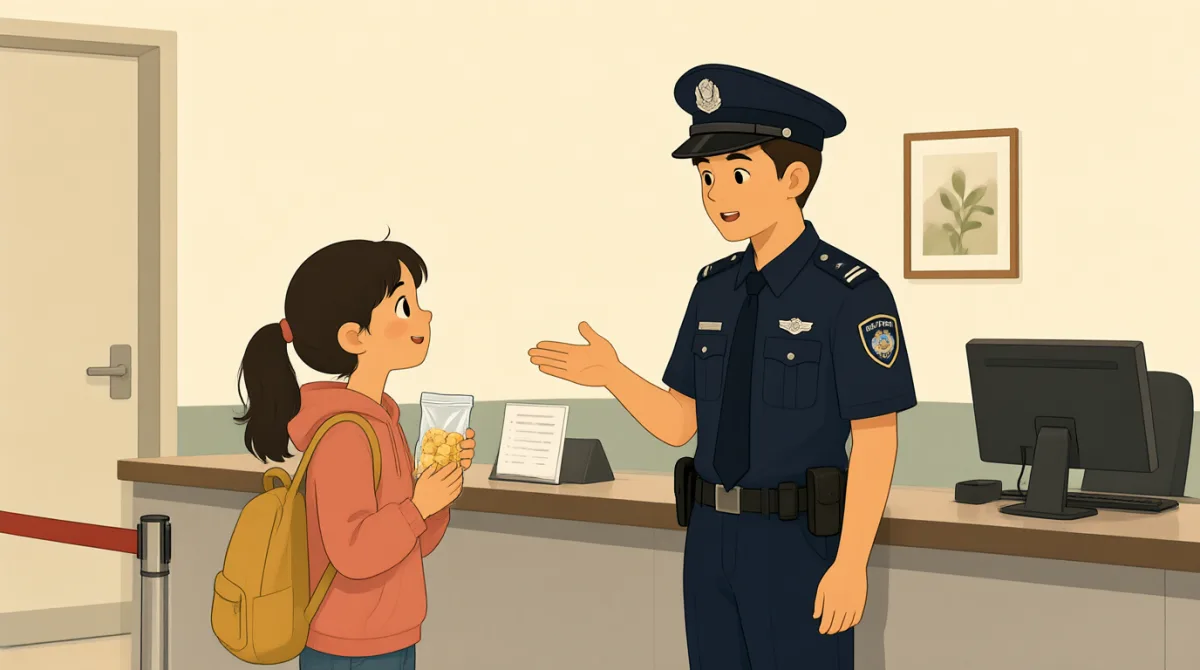

Hi. I have some packaged food in my bag. Do I need to declare it?
こんにちは。バッグに包装された食品が入っているんですが、申告が必要ですか?

What kind of food is it? Some items, like fresh fruit, meat, and seeds, may be restricted.
どんな食品ですか?生の果物や肉、種などは、持ち込みが制限されている場合があります。
I have sealed tea, crackers, and a few chocolate bars. They’re all for my own use.
密封されたお茶とクラッカー、それにチョコレートバーが何本かあります。全部、自分で使うものです。
Packaged snacks are usually fine, but you should still declare them so an officer can check.
包装されたお菓子ならたいてい問題ありませんが、係官が確認できるように申告してください。
Okay, I’d rather be safe than sorry. Should I take them out of my bag?
分かりました。念のため、申告しておいたほうがいいですね。バッグから出したほうがいいですか?
Yes, please. Keep the labels visible, and don’t open anything unless the officer asks you to.
はい、お願いします。ラベルが見えるようにして、係官に言われない限り、開けないでください。
Here they are. The tea is from home, and I bought the crackers and chocolate at the airport.
はい、どうぞ。お茶は家から持ってきたもので、クラッカーとチョコレートは空港で買いました。
Thanks. These are allowed. Just remember to declare any food, even if it’s sealed or store-bought.
ありがとうございます。これらは持ち込みできます。密封されていたり、お店で買ったものだったりしても、食品は必ず申告するようにしてください。
Got it. I’m glad I asked before going through. Is there anything else I need to do?
分かりました。通過する前に聞いてよかったです。他に何かすることはありますか?
You’re all set. Put everything back in your bag, and you can continue through customs.
これで手続きは完了です。全部バッグに戻して、税関を通過して大丈夫ですよ。
語彙7
- declare it申告する
To tell a customs officer that you are bringing something into the country. Use this when asking whether you need to report an item.
税関の係官に、国へ持ち込むものがあると伝えることです。品物の申告が必要か尋ねるときに使います。
- restricted持ち込みが制限されている
Limited or not allowed under certain rules. Customs may restrict items such as fresh fruit, meat, and seeds.
一定の規則によって数量や持ち込みが制限されていることです。税関では、生の果物や肉、種などの持ち込みが制限される場合があります。
- for my own use自分で使うために
For yourself rather than for sale or for someone else. You can use this phrase to explain why you are carrying something.
販売したり、誰かにあげたりするのではなく、自分で使うためだという意味です。持ち物の目的を説明するときに使えます。
- sealed密封された
Closed securely, usually in its original packaging. A sealed item has not been opened.
通常は元の包装のまま、しっかり封がされていることです。密封された品物は、開封されていません。
- I’d rather be safe than sorry.念には念を入れたいです。
A way to say you prefer to be cautious so you do not have problems later. Use it when taking a careful option.
あとで困らないように、慎重にしておきたいと伝える言い方です。慎重な選択をするときに使います。
- labels visibleラベルが見える
Easy to see the information printed on the packages. This helps an officer identify what the items are.
包装に印刷された情報が見やすい状態のことです。係官が品物の内容を確認しやすくなります。
- You’re all set.これで手続きは完了です。
A friendly way to say that everything is finished and there is nothing else you need to do.
必要なことはすべて終わり、もうすることはないと伝える親しみのある表現です。
重要な文8
- 1
Do I need to declare it?
Do I need to declare it?
Use this to ask whether you must report an item to an official. Replace “it” with the thing you are carrying.
品物を係官に申告しなければならないか尋ねる表現です。“it”を、自分が持っている品物に置き換えて使いましょう。
- 2
Some items, like fresh fruit, meat, and seeds, may be restricted.
Some items, like fresh fruit, meat, and seeds, may be restricted.
This sentence explains that rules can limit certain items. You can use “Some items, like [examples], may be restricted” to give examples of possible restrictions.
規則によって、持ち込みが制限される品物があると説明する文です。“Some items, like [examples], may be restricted”を使うと、制限される可能性のある品物の例を挙げられます。
- 3
They’re all for my own use.
They’re all for my own use.
Use this to explain that items are for you, not for selling. Replace “they” with the items you are carrying.
品物は販売用ではなく、自分で使うものだと説明するときに使います。“they”を、自分が持っている品物に置き換えましょう。
- 4
Packaged snacks are usually fine, but you should still declare them so an officer can check.
Packaged snacks are usually fine, but you should still declare them so an officer can check.
This gives reassurance while explaining a necessary step. Use “usually fine, but you should still…” to describe something generally allowed that still needs attention.
問題ないことが多いと伝えつつ、必要な手順も説明する文です。“usually fine, but you should still…”は、たいてい許可されるものの、注意や手続きが必要な場合に使えます。
- 5
I’d rather be safe than sorry.
I’d rather be safe than sorry.
Use this when you choose the cautious option to avoid a possible problem. It works in many everyday situations, not just at customs.
問題が起きないように、慎重なほうを選ぶときに使います。税関だけでなく、日常のさまざまな場面で使える表現です。
- 6
Keep the labels visible, and don’t open anything unless the officer asks you to.
Keep the labels visible, and don’t open anything unless the officer asks you to.
This gives clear instructions about what to do with packaged items. “Don’t… unless…” means you should avoid doing something except when a condition is met.
包装された品物をどう扱うか、はっきり指示する文です。“Don’t… unless…”は、ある条件を満たす場合を除いて、何かをしないように伝える表現です。
- 7
Just remember to declare any food, even if it’s sealed or store-bought.
Just remember to declare any food, even if it’s sealed or store-bought.
This is a useful reminder that a rule applies to all food, including packaged items. Use “even if…” to emphasize that a condition does not change the requirement.
包装された食品も含め、すべての食品に規則が適用されることを念押しする表現です。“even if…”を使うと、ある条件があっても必要なことは変わらないと強調できます。
- 8
You’re all set.
You’re all set.
Use this friendly phrase to tell someone they have finished everything required. It is common in service situations.
必要なことはすべて終わったと相手に伝える、親しみのある表現です。接客の場面でよく使われます。