Helping Someone in Line
A confused traveler in the immigration line is unsure which form to complete. Mia explains what she learned and helps him find the right counter.
Dialogue10
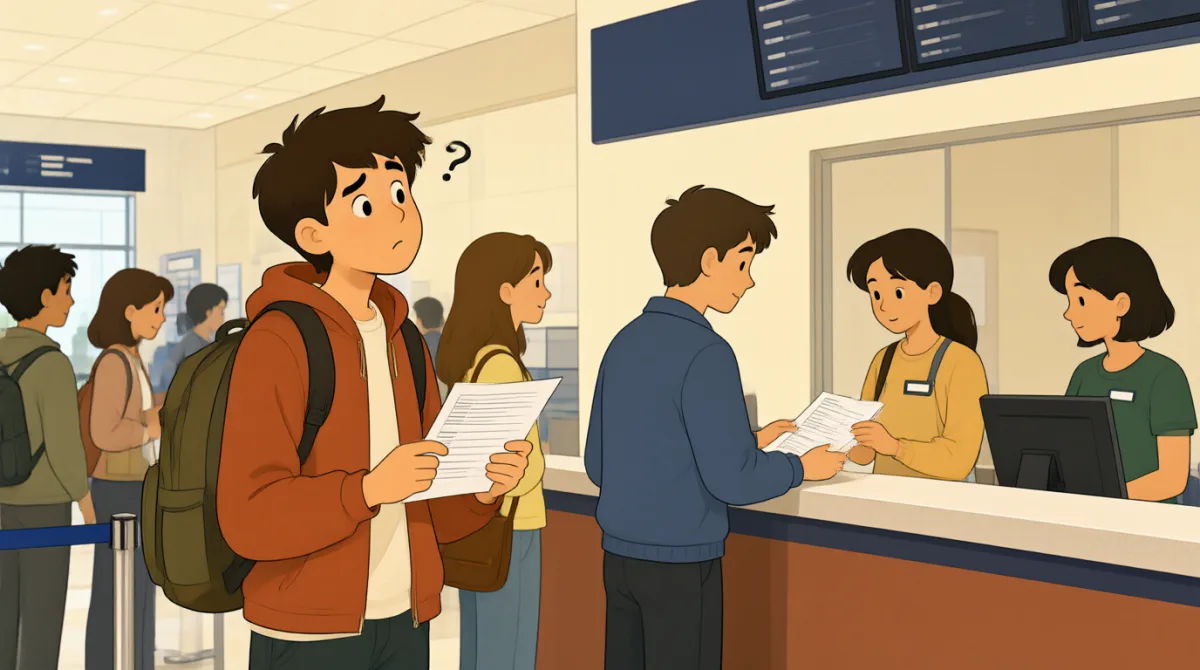

Excuse me, do you know which form I need to fill out? I’m visiting for a few days, but the signs are confusing.

Sure. If you’re here for a short visit, you probably need the arrival card, not the work or study form.
That makes sense. I picked up a form near the entrance, but I’m not sure it’s the right one.
Let me take a look. Yes, this is the arrival card. You’ll need your passport and the address where you’re staying.
Thanks. I’ve got my hotel details on my phone. Do I fill it out before I get to the counter?
Yes, it’s best to complete it while you’re in line. The immigration officer will ask about your visit, too.
Got it. And where should I go after I finish? There are two counters up ahead.
The counter on the left is for visitors. The one on the right is for residents, so follow that sign.
That clears things up. Thanks for helping me out—I was starting to feel a little lost.
No problem. I was confused at first, too. Just have your passport ready, and you’ll be fine.
Vocabulary6
- fill out
To complete a form by writing the required information on it. You can use this phrase when asking what information a form needs.
- arrival card
A form that visitors may need to complete when they arrive in a country. Here, Mia explains that it is for someone visiting briefly.
- details
Specific pieces of information. Here, David has his hotel address and other information saved on his phone.
- complete it
To finish filling in a form. You can use this phrase to ask when you should finish paperwork.
- up ahead
Farther forward in the direction you are going. David uses it to refer to the counters in front of him.
- helping me out
Giving someone help or support. It is a friendly, informal way to thank someone for assisting you.
Key Sentences8
- 1
Excuse me, do you know which form I need to fill out?
This is a polite way to ask for help with paperwork. You can reuse the pattern “Do you know which [item] I need to [action]?” when asking for directions or instructions.
- 2
If you’re here for a short visit, you probably need the arrival card, not the work or study form.
This sentence gives advice based on someone’s situation. Use “If you’re here for…” to explain which option may apply.
- 3
I picked up a form near the entrance, but I’m not sure it’s the right one.
This explains what you have done while expressing uncertainty. You can replace “form” and “near the entrance” with another item and location.
- 4
Do I fill it out before I get to the counter?
This is a useful way to check when to complete a task. You can reuse “Do I [action] before I [next step]?” to ask about the order of steps.
- 5
The counter on the left is for visitors.
This gives a clear direction and explains who should use a particular counter. You can use “The [place] on the [side] is for…” to identify the right place or service.
- 6
That clears things up.
This is a natural way to say that an explanation has made something easier to understand. Use it when someone has resolved your confusion.
- 7
Thanks for helping me out—I was starting to feel a little lost.
This thanks someone and explains why their help mattered. You can use “I was starting to feel a little…” to describe how you felt before someone assisted you.
- 8
Just have your passport ready, and you’ll be fine.
This gives simple, reassuring advice. You can use “Have your [item] ready, and you’ll be fine” to help someone feel prepared.