Declaring Food at Customs
At customs, Mia tells the officer she has packaged food in her bag and asks whether she needs to declare it. The officer explains what can be brought into the country.
Dialogue10
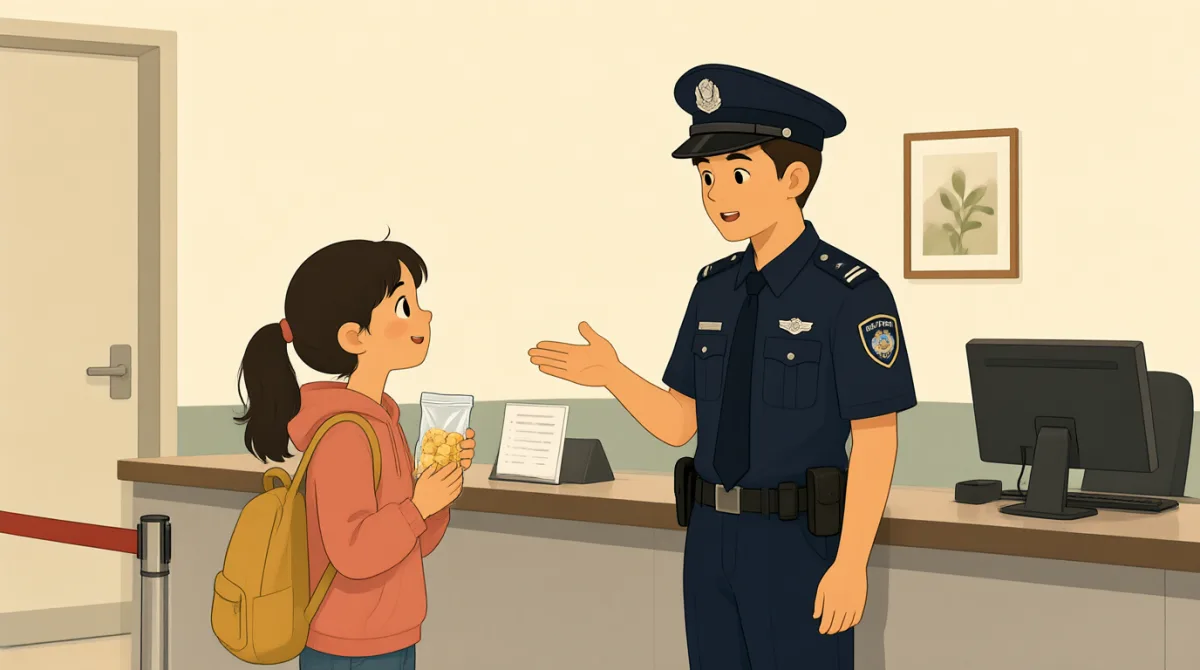

Hi. I have some packaged food in my bag. Do I need to declare it?

What kind of food is it? Some items, like fresh fruit, meat, and seeds, may be restricted.
I have sealed tea, crackers, and a few chocolate bars. They’re all for my own use.
Packaged snacks are usually fine, but you should still declare them so an officer can check.
Okay, I’d rather be safe than sorry. Should I take them out of my bag?
Yes, please. Keep the labels visible, and don’t open anything unless the officer asks you to.
Here they are. The tea is from home, and I bought the crackers and chocolate at the airport.
Thanks. These are allowed. Just remember to declare any food, even if it’s sealed or store-bought.
Got it. I’m glad I asked before going through. Is there anything else I need to do?
You’re all set. Put everything back in your bag, and you can continue through customs.
Vocabulary7
- declare it
To tell a customs officer that you are bringing something into the country. Use this when asking whether you need to report an item.
- restricted
Limited or not allowed under certain rules. Customs may restrict items such as fresh fruit, meat, and seeds.
- for my own use
For yourself rather than for sale or for someone else. You can use this phrase to explain why you are carrying something.
- sealed
Closed securely, usually in its original packaging. A sealed item has not been opened.
- I’d rather be safe than sorry.
A way to say you prefer to be cautious so you do not have problems later. Use it when taking a careful option.
- labels visible
Easy to see the information printed on the packages. This helps an officer identify what the items are.
- You’re all set.
A friendly way to say that everything is finished and there is nothing else you need to do.
Key Sentences8
- 1
Do I need to declare it?
Use this to ask whether you must report an item to an official. Replace “it” with the thing you are carrying.
- 2
Some items, like fresh fruit, meat, and seeds, may be restricted.
This sentence explains that rules can limit certain items. You can use “Some items, like [examples], may be restricted” to give examples of possible restrictions.
- 3
They’re all for my own use.
Use this to explain that items are for you, not for selling. Replace “they” with the items you are carrying.
- 4
Packaged snacks are usually fine, but you should still declare them so an officer can check.
This gives reassurance while explaining a necessary step. Use “usually fine, but you should still…” to describe something generally allowed that still needs attention.
- 5
I’d rather be safe than sorry.
Use this when you choose the cautious option to avoid a possible problem. It works in many everyday situations, not just at customs.
- 6
Keep the labels visible, and don’t open anything unless the officer asks you to.
This gives clear instructions about what to do with packaged items. “Don’t… unless…” means you should avoid doing something except when a condition is met.
- 7
Just remember to declare any food, even if it’s sealed or store-bought.
This is a useful reminder that a rule applies to all food, including packaged items. Use “even if…” to emphasize that a condition does not change the requirement.
- 8
You’re all set.
Use this friendly phrase to tell someone they have finished everything required. It is common in service situations.