Declaring Food at Customs
Lebensmittel beim Zoll anmelden
At customs, Mia tells the officer she has packaged food in her bag and asks whether she needs to declare it. The officer explains what can be brought into the country.
Am Zoll teilt Mia dem Beamten mit, dass sie verpackte Lebensmittel in ihrer Tasche hat, und fragt, ob sie diese anmelden muss. Der Beamte erklärt, was ins Land eingeführt werden darf.
Dialog10
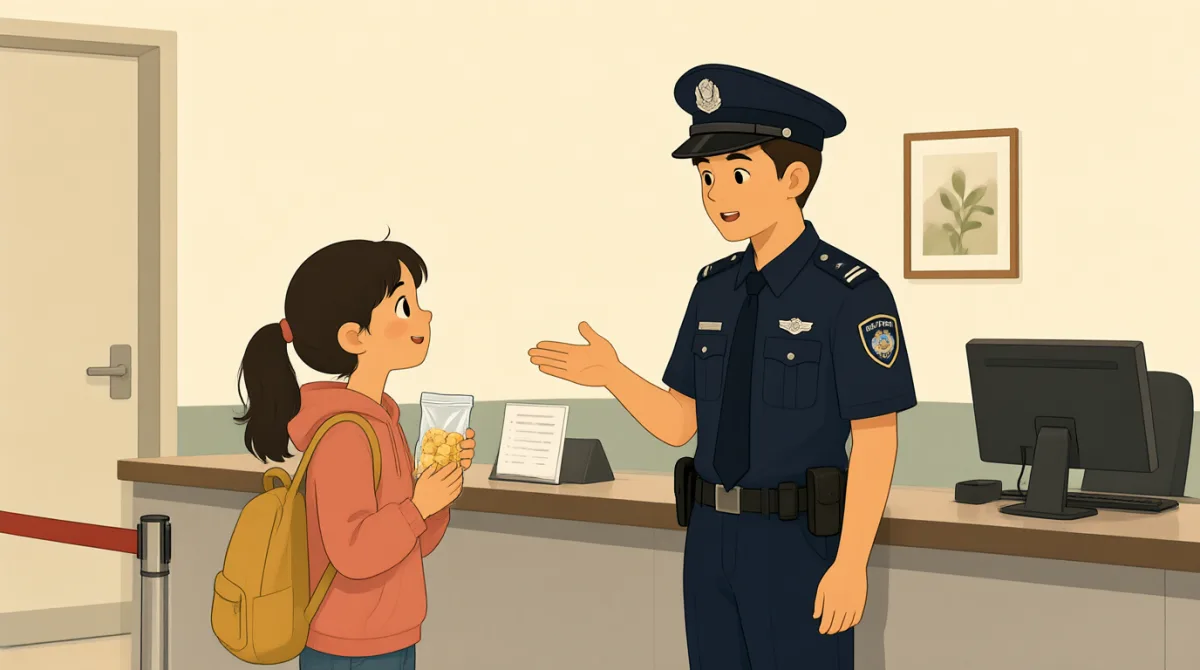

Hi. I have some packaged food in my bag. Do I need to declare it?
Guten Tag. Ich habe verpackte Lebensmittel in meiner Tasche. Muss ich die anmelden?

What kind of food is it? Some items, like fresh fruit, meat, and seeds, may be restricted.
Um welche Lebensmittel handelt es sich? Manche Dinge, zum Beispiel frisches Obst, Fleisch und Samen, können Beschränkungen unterliegen.
I have sealed tea, crackers, and a few chocolate bars. They’re all for my own use.
Ich habe versiegelten Tee, Cracker und ein paar Schokoriegel dabei. Das ist alles für meinen eigenen Gebrauch.
Packaged snacks are usually fine, but you should still declare them so an officer can check.
Verpackte Snacks sind normalerweise kein Problem, aber Sie sollten sie trotzdem anmelden, damit ein Beamter sie kontrollieren kann.
Okay, I’d rather be safe than sorry. Should I take them out of my bag?
In Ordnung, sicher ist sicher. Soll ich sie aus meiner Tasche nehmen?
Yes, please. Keep the labels visible, and don’t open anything unless the officer asks you to.
Ja, bitte. Lassen Sie die Etiketten gut sichtbar, und öffnen Sie nichts, außer der Beamte bittet Sie darum.
Here they are. The tea is from home, and I bought the crackers and chocolate at the airport.
Hier sind sie. Der Tee ist von zu Hause, und die Cracker und die Schokolade habe ich am Flughafen gekauft.
Thanks. These are allowed. Just remember to declare any food, even if it’s sealed or store-bought.
Danke. Diese Lebensmittel sind erlaubt. Denken Sie einfach daran, alle Lebensmittel anzumelden, auch wenn sie versiegelt oder im Geschäft gekauft sind.
Got it. I’m glad I asked before going through. Is there anything else I need to do?
Verstanden. Ich bin froh, dass ich gefragt habe, bevor ich durchgegangen bin. Muss ich sonst noch etwas tun?
You’re all set. Put everything back in your bag, and you can continue through customs.
Dann ist alles erledigt. Packen Sie alles wieder in Ihre Tasche, und Sie können weiter durch den Zoll gehen.
Wortschatz7
- declare itetwas anmelden
To tell a customs officer that you are bringing something into the country. Use this when asking whether you need to report an item.
Einem Zollbeamten mitteilen, dass du etwas ins Land einführst. Diese Wendung verwendest du, wenn du fragen möchtest, ob du einen Gegenstand angeben musst.
- restrictedbeschränkt
Limited or not allowed under certain rules. Customs may restrict items such as fresh fruit, meat, and seeds.
Durch bestimmte Regeln eingeschränkt oder nicht erlaubt. Der Zoll kann zum Beispiel frisches Obst, Fleisch und Samen beschränken.
- for my own usefür den eigenen Gebrauch
For yourself rather than for sale or for someone else. You can use this phrase to explain why you are carrying something.
Für dich selbst und nicht zum Verkauf oder für jemand anderen. Mit dieser Wendung kannst du erklären, warum du etwas dabeihast.
- sealedversiegelt
Closed securely, usually in its original packaging. A sealed item has not been opened.
Sicher verschlossen, normalerweise in der Originalverpackung. Ein versiegelter Gegenstand wurde noch nicht geöffnet.
- I’d rather be safe than sorry.I’d rather be safe than sorry.
A way to say you prefer to be cautious so you do not have problems later. Use it when taking a careful option.
Damit sagst du, dass du lieber vorsichtig bist, um später keine Probleme zu bekommen. Die Wendung passt, wenn du dich für die sicherere Möglichkeit entscheidest.
- labels visibleEtiketten gut sichtbar
Easy to see the information printed on the packages. This helps an officer identify what the items are.
Die Angaben auf den Verpackungen sind gut zu erkennen. So kann ein Beamter feststellen, um welche Lebensmittel es sich handelt.
- You’re all set.You’re all set.
A friendly way to say that everything is finished and there is nothing else you need to do.
Eine freundliche Art zu sagen, dass alles erledigt ist und du nichts weiter tun musst.
Wichtige Sätze8
- 1
Do I need to declare it?
Muss ich das anmelden?
Use this to ask whether you must report an item to an official. Replace “it” with the thing you are carrying.
Mit „Do I need to declare it?“ fragst du, ob du einem Beamten einen Gegenstand melden musst. Ersetze „it“ durch den Gegenstand, den du dabeihast.
- 2
Some items, like fresh fruit, meat, and seeds, may be restricted.
Manche Dinge, zum Beispiel frisches Obst, Fleisch und Samen, können Beschränkungen unterliegen.
This sentence explains that rules can limit certain items. You can use “Some items, like [examples], may be restricted” to give examples of possible restrictions.
Dieser Satz erklärt, dass bestimmte Gegenstände durch Regeln eingeschränkt sein können. Mit „Some items, like [examples], may be restricted“ kannst du Beispiele für mögliche Beschränkungen nennen.
- 3
They’re all for my own use.
Das ist alles für meinen eigenen Gebrauch.
Use this to explain that items are for you, not for selling. Replace “they” with the items you are carrying.
Mit „They’re all for my own use“ erklärst du, dass die Gegenstände für dich selbst und nicht zum Verkauf bestimmt sind. Ersetze „they“ durch die Dinge, die du dabeihast.
- 4
Packaged snacks are usually fine, but you should still declare them so an officer can check.
Verpackte Snacks sind normalerweise kein Problem, aber Sie sollten sie trotzdem anmelden, damit ein Beamter sie kontrollieren kann.
This gives reassurance while explaining a necessary step. Use “usually fine, but you should still…” to describe something generally allowed that still needs attention.
Der Satz beruhigt die Person und erklärt gleichzeitig, was sie tun muss. Mit „usually fine, but you should still…“ beschreibst du etwas, das normalerweise erlaubt ist, aber trotzdem beachtet werden muss.
- 5
I’d rather be safe than sorry.
Sicher ist sicher.
Use this when you choose the cautious option to avoid a possible problem. It works in many everyday situations, not just at customs.
Mit „I’d rather be safe than sorry“ sagst du, dass du lieber vorsichtig bist, um ein mögliches Problem zu vermeiden. Die Wendung passt zu vielen Alltagssituationen, nicht nur am Zoll.
- 6
Keep the labels visible, and don’t open anything unless the officer asks you to.
Lassen Sie die Etiketten gut sichtbar, und öffnen Sie nichts, außer der Beamte bittet Sie darum.
This gives clear instructions about what to do with packaged items. “Don’t… unless…” means you should avoid doing something except when a condition is met.
Dieser Satz gibt klare Anweisungen zum Umgang mit verpackten Gegenständen. „Don’t… unless…“ bedeutet, dass du etwas nicht tun sollst, außer eine bestimmte Bedingung ist erfüllt.
- 7
Just remember to declare any food, even if it’s sealed or store-bought.
Denken Sie einfach daran, alle Lebensmittel anzumelden, auch wenn sie versiegelt oder im Geschäft gekauft sind.
This is a useful reminder that a rule applies to all food, including packaged items. Use “even if…” to emphasize that a condition does not change the requirement.
Das ist eine hilfreiche Erinnerung daran, dass die Regel für alle Lebensmittel gilt, auch für verpackte. Mit „even if…“ betonst du, dass eine bestimmte Bedingung an der Vorschrift nichts ändert.
- 8
You’re all set.
Dann ist alles erledigt.
Use this friendly phrase to tell someone they have finished everything required. It is common in service situations.
Mit „You’re all set.“ sagst du freundlich, dass jemand alles Erforderliche erledigt hat. Die Wendung ist im Kundenservice üblich.