Getting Your Student Card
Obtenir sa carte étudiante
Emma visits the student services desk to get her student card and asks Jack how it works for campus facilities. Jack explains where she can use it and what to do if she loses it.
Emma se rend au bureau des services aux étudiants pour obtenir sa carte étudiante et demande à Jack comment l’utiliser pour accéder aux services du campus. Jack lui explique où elle peut l’utiliser et quoi faire si elle la perd.
Dialogue10
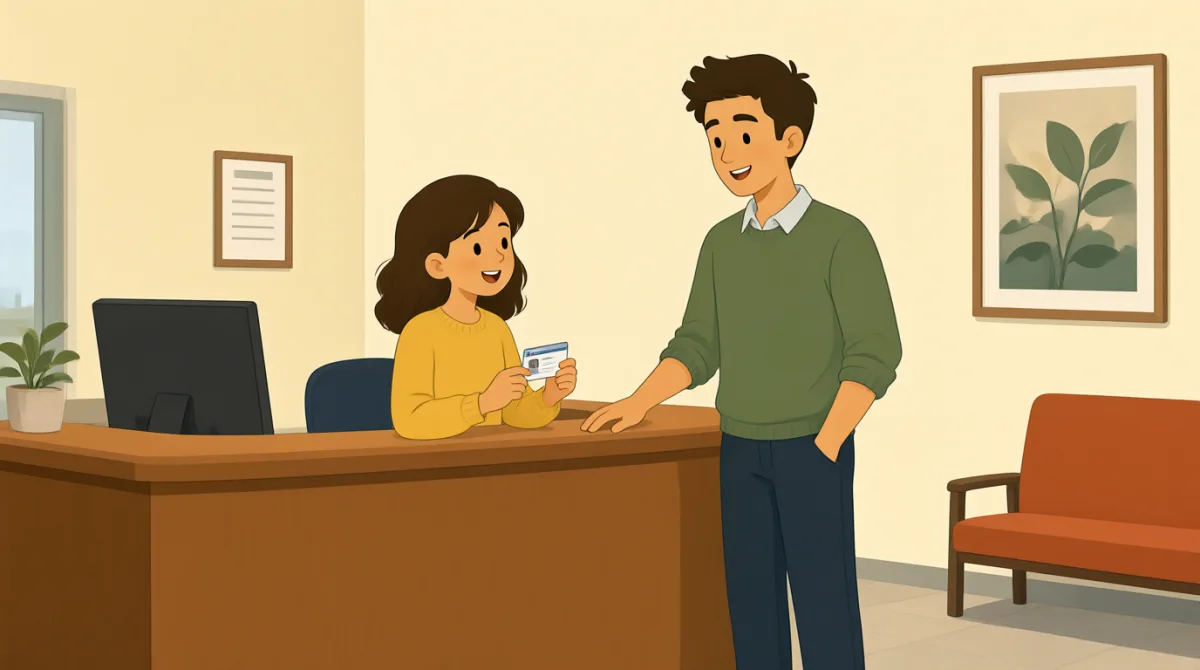

Hi, I’m here to get my student card. I’ve just finished registering. What do you need from me?
Bonjour, je viens récupérer ma carte étudiante. Je viens de terminer mon inscription. De quoi avez-vous besoin ?

Welcome! Could I see your passport and the registration confirmation email? I’ll also need to take a quick photo for the card.
Bienvenue ! Puis-je voir votre passeport et l’e-mail de confirmation de votre inscription ? Je vais aussi devoir prendre rapidement une photo pour la carte.
Sure, here they are. Is the card just for identification, or can I use it around campus too?
Bien sûr, les voilà. La carte sert seulement à m’identifier ou je peux aussi l’utiliser sur le campus ?
You can use it to borrow books, enter the gym, and pay for meals at campus cafés. Just tap it on the reader.
Vous pouvez l’utiliser pour emprunter des livres, entrer dans la salle de sport et payer vos repas dans les cafés du campus. Il suffit de la passer devant le lecteur.
That’s handy. Do I need to add money to it before I can buy food, or is payment linked to my student account?
C’est pratique. Est-ce que je dois la recharger avant de pouvoir acheter à manger, ou le paiement est-il lié à mon compte étudiant ?
You’ll need to add money through the student portal or at a kiosk. It usually shows up on your card within a few minutes.
Vous devrez ajouter de l’argent sur votre compte via le portail étudiant ou à une borne. Le solde apparaît généralement sur votre carte en quelques minutes.
Got it. And if I lose the card, what should I do? I’d rather not have someone else using it.
D’accord. Et si je perds ma carte, que dois-je faire ? Je préférerais éviter que quelqu’un d’autre puisse l’utiliser.
Report it through the portal or call this desk right away. We can block the old card, then make you a replacement.
Signalez-le sur le portail ou appelez immédiatement ce bureau. Nous pouvons bloquer l’ancienne carte, puis vous en faire une nouvelle.
Great, thanks! How long does the replacement take? And can I still use the library while I wait?
Super, merci ! Combien de temps faut-il pour obtenir une nouvelle carte ? Et est-ce que je peux quand même utiliser la bibliothèque en attendant ?
It usually takes one business day. Bring your passport to the library desk in the meantime, and they can check your account.
En général, il faut un jour ouvrable. En attendant, présentez votre passeport à l’accueil de la bibliothèque ; ils pourront consulter votre compte.
Vocabulaire7
- registration confirmation emaile-mail de confirmation d’inscription
An email that proves you have completed registration. You may need to show it when requesting a student card.
Un e-mail qui prouve que vous avez terminé votre inscription. On peut vous demander de le présenter pour obtenir une carte étudiante.
- borrow booksemprunter des livres
To take books from a library for a period of time and return them later. You can use your student card to do this.
Prendre des livres à la bibliothèque pour une certaine durée, puis les rendre. Vous pouvez utiliser votre carte étudiante pour les emprunter.
- tap it on the readerpasser la carte devant le lecteur
To touch the card briefly against a machine that reads it. This is a common way to enter a building or pay.
Présenter brièvement la carte contre un appareil qui la lit. C’est une façon courante d’entrer dans un bâtiment ou de payer.
- add moneyajouter de l’argent
To put funds onto an account or card so you can spend them. Here, you can do this through the student portal or at a kiosk.
Verser de l’argent sur un compte ou une carte pour pouvoir le dépenser. Ici, vous pouvez le faire sur le portail étudiant ou à une borne.
- right awayimmédiatement
Immediately or as soon as possible. Use it when something needs quick attention.
Sans attendre, ou dès que possible. Cette expression s’emploie quand quelque chose doit être pris en charge rapidement.
- block the old cardbloquer l’ancienne carte
To stop a card from being used. This is useful if your card is lost or stolen.
Empêcher l’utilisation d’une carte. C’est utile si vous l’avez perdue ou si on vous l’a volée.
- in the meantimeen attendant
During the time before something else happens. You can use it to explain what to do while waiting.
Pendant la période qui précède un autre événement. Cette expression permet d’expliquer quoi faire pendant qu’on attend.
Phrases clés7
- 1
What do you need from me?
De quoi avez-vous besoin ?
Use this to ask what documents or information someone needs. It works well when checking in for a service or appointment.
Utilisez cette question pour demander quels documents ou renseignements sont nécessaires. Elle convient bien quand vous vous présentez à un service ou à un rendez-vous.
- 2
Is the card just for identification, or can I use it around campus too?
La carte sert seulement à m’identifier ou je peux aussi l’utiliser sur le campus ?
This asks whether something has only one purpose or can be used for other things as well. You can reuse the pattern: “Is it just for X, or can I also use it for Y?”
Cette question permet de demander si quelque chose n’a qu’un seul usage ou si on peut aussi s’en servir autrement. Vous pouvez reprendre ce modèle : “Is it just for X, or can I also use it for Y?” (Est-ce seulement pour X ou puis-je aussi m’en servir pour Y ?).
- 3
Do I need to add money to it before I can buy food, or is payment linked to my student account?
Est-ce que je dois ajouter de l’argent sur la carte avant de pouvoir acheter à manger, ou le paiement est-il lié à mon compte étudiant ?
This is a useful way to ask about payment options. Replace “add money” and “student account” with the options you want to compare.
C’est une façon pratique de demander quelles sont les options de paiement. Remplacez “add money” et “student account” par les options que vous voulez comparer.
- 4
And if I lose the card, what should I do?
Et si je perds ma carte, que dois-je faire ?
Use this to ask what steps to take if a problem happens. You can replace “lose the card” with another possible situation.
Utilisez cette question pour demander quelles démarches suivre en cas de problème. Vous pouvez remplacer “lose the card” par une autre situation possible.
- 5
I’d rather not have someone else using it.
Je préférerais éviter que quelqu’un d’autre l’utilise.
This politely explains why you want to take action. “I’d rather not” is useful for expressing a preference or concern.
Cette phrase explique poliment pourquoi vous souhaitez agir. “I’d rather not” permet d’exprimer une préférence ou une inquiétude.
- 6
How long does the replacement take?
Combien de temps faut-il pour obtenir une nouvelle carte ?
Use this to ask how much time a replacement or repair will need. You can also ask, “How long does the application take?”
Utilisez cette question pour demander combien de temps prendra un remplacement ou une réparation. Vous pouvez aussi demander : “How long does the application take?” (Combien de temps prend la demande ?).
- 7
Bring your passport to the library desk in the meantime, and they can check your account.
En attendant, présentez votre passeport à l’accueil de la bibliothèque ; ils pourront consulter votre compte.
This gives practical instructions for what to do while waiting. Use “in the meantime” to connect a temporary solution to a later one.
Cette phrase donne des instructions pratiques sur ce qu’il faut faire pendant l’attente. Utilisez “in the meantime” pour relier une solution temporaire à ce qui se passera ensuite.