Parking by the Curb
Se garer le long du trottoir
David guides Emma as she pulls over and parks by the curb. Emma checks whether the car is close enough and asks how to straighten the wheels.
David guide Emma pendant qu’elle se range sur le côté et se gare le long du trottoir. Emma vérifie si la voiture est assez près et demande comment remettre les roues droites.
Dialogue9
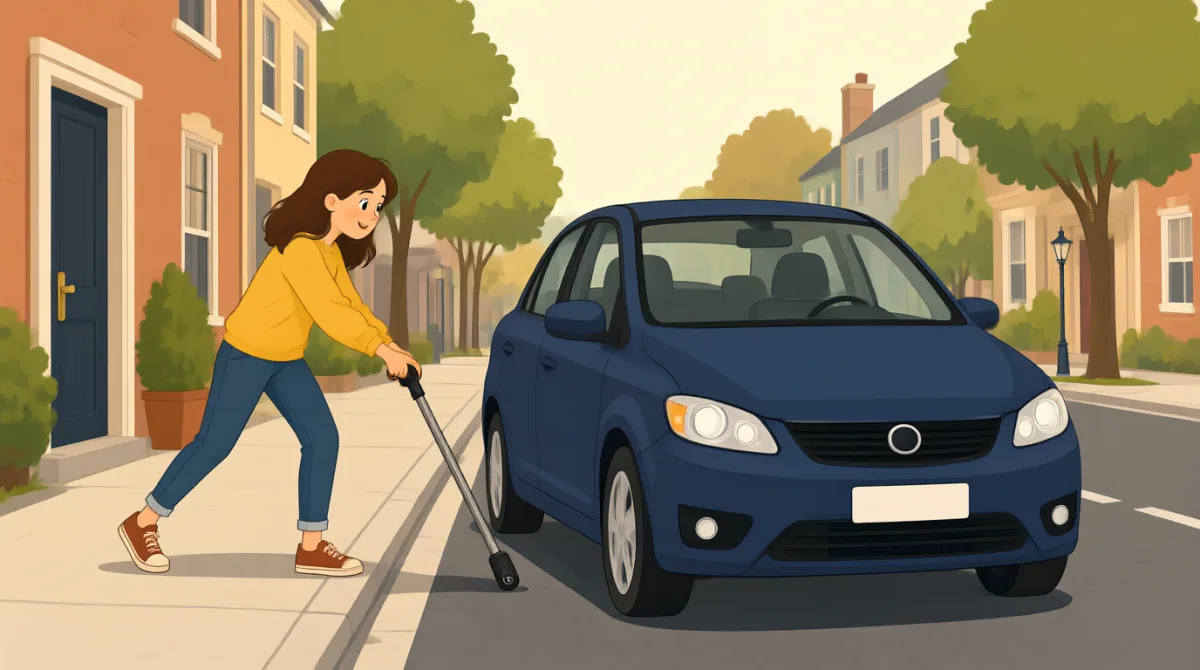

When it’s safe, pull over slowly and stop beside the curb.
Quand tu peux le faire sans danger, range-toi lentement et arrête-toi le long du trottoir.

Okay. Should I turn on my signal now?
D’accord. Je mets mon clignotant maintenant ?
Yes, signal right. Check your mirror, then move closer to the curb.
Oui, mets ton clignotant à droite. Vérifie ton rétroviseur, puis rapproche-toi du trottoir.
I’m stopped. Is the car close enough to the curb?
Je suis arrêtée. La voiture est assez près du trottoir ?
A little closer, please. Move forward slowly and stop when I say.
Un peu plus près, s’il te plaît. Avance lentement et arrête-toi quand je te le dis.
Is this good? I don’t want to hit the curb.
C’est bon comme ça ? Je ne veux pas toucher le trottoir.
That’s good. Now straighten the wheels by turning the steering wheel back.
C’est bien. Maintenant, remets les roues droites en tournant le volant dans l’autre sens.
Like this? The car is straight now, right?
Comme ça ? La voiture est bien droite maintenant, c’est ça ?
Yes, nice work. You parked safely and left enough space from the curb.
Oui, bravo. Tu t’es garée sans danger et tu as laissé assez d’espace par rapport au trottoir.
Vocabulaire8
- pull overse ranger sur le côté
To move your car to the side of the road and stop. Here, David asks Emma to stop beside the curb.
Déplacer sa voiture sur le côté de la route et s’arrêter. Ici, David demande à Emma de s’arrêter le long du trottoir.
- beside the curble long du trottoir
Next to the raised edge of the road. Use this phrase to describe where you want to park.
À côté du bord surélevé de la chaussée. Utilise cette expression pour indiquer où tu veux te garer.
- signal rightmettre son clignotant à droite
To use your right turn signal to show that you are moving right. You can say this when giving a driver a simple instruction.
Utiliser son clignotant droit pour signaler qu’on va se déplacer vers la droite. Tu peux dire ça pour donner une consigne simple à un conducteur.
- mirrorrétroviseur
A mirror in the car that helps you see behind you. Check it before moving closer to the curb.
Un miroir dans la voiture qui permet de voir derrière soi. Vérifie-le avant de te rapprocher du trottoir.
- move closerse rapprocher
To go nearer to something. You can use this phrase to tell someone to approach a place or object carefully.
Aller plus près de quelque chose. Tu peux utiliser cette expression pour demander à quelqu’un de s’approcher prudemment d’un endroit ou d’un objet.
- steering wheelvolant
The wheel you turn to guide a car. Turning it helps you change the direction of the car.
La roue que tu tournes pour diriger une voiture. En le tournant, tu changes la direction de la voiture.
- straighten the wheelsremettre les roues droites
To turn the front wheels so they point straight ahead. This is useful after turning or parking.
Tourner les roues avant pour qu’elles pointent droit devant. C’est utile après avoir tourné ou s’être garé.
- left enough spacelaisser assez d’espace
Kept a suitable distance from something. Use this phrase to say there is room between the car and the curb.
Garder une distance suffisante par rapport à quelque chose. Utilise cette expression pour dire qu’il y a assez de place entre la voiture et le trottoir.
Phrases clés7
- 1
When it’s safe, pull over slowly and stop beside the curb.
Quand tu peux le faire sans danger, range-toi lentement et arrête-toi le long du trottoir.
This is a clear instruction for stopping a car by the side of the road. You can reuse “When it’s safe” before giving another driving instruction.
C’est une consigne claire pour arrêter une voiture sur le bord de la route. Tu peux réutiliser “When it’s safe” (quand tu peux le faire sans danger) avant de donner une autre consigne de conduite.
- 2
Should I turn on my signal now?
Je mets mon clignotant maintenant ?
This is a useful way to check when to use a car signal. Replace “my signal” with another action to ask when to do it.
C’est une façon pratique de demander quand utiliser son clignotant. Remplace “my signal” par une autre action pour demander quand la faire.
- 3
Check your mirror, then move closer to the curb.
Vérifie ton rétroviseur, puis rapproche-toi du trottoir.
This sentence gives two simple driving instructions in order. Use “then” to show what action comes next.
Cette phrase donne deux consignes simples de conduite, dans l’ordre. Utilise “then” pour indiquer quelle action vient ensuite.
- 4
Is the car close enough to the curb?
La voiture est assez près du trottoir ?
This question checks whether the car is at a good distance from the curb. You can use “close enough to” to ask about distance from other things.
Cette question permet de vérifier si la voiture est à la bonne distance du trottoir. Tu peux utiliser “close enough to” pour demander si quelque chose est assez près d’un autre élément.
- 5
I don’t want to hit the curb.
Je ne veux pas toucher le trottoir.
This explains a concern about getting too close while parking. Use “I don’t want to” to talk about something you want to avoid.
Cette phrase exprime la crainte de s’approcher trop près du trottoir en se garant. Utilise “I don’t want to” pour parler de quelque chose que tu veux éviter.
- 6
Now straighten the wheels by turning the steering wheel back.
Maintenant, remets les roues droites en tournant le volant dans l’autre sens.
This explains how to make the wheels point straight after parking. Use “by” plus an action to explain how to do something.
Cette phrase explique comment orienter les roues droit devant après s’être garé. Utilise “by” suivi d’une action pour expliquer comment faire quelque chose.
- 7
You parked safely and left enough space from the curb.
Tu t’es garée sans danger et tu as laissé assez d’espace par rapport au trottoir.
This sentence gives positive feedback about how someone parked. You can use “left enough space” to describe keeping a good distance from something.
Cette phrase félicite quelqu’un pour sa façon de se garer. Tu peux utiliser “left enough space” pour dire qu’on a gardé une bonne distance par rapport à quelque chose.