Parking by the Curb
Estacionar junto al bordillo
David guides Emma as she pulls over and parks by the curb. Emma checks whether the car is close enough and asks how to straighten the wheels.
David guía a Emma mientras se orilla y estaciona junto al bordillo. Emma comprueba si el auto está lo bastante cerca y pregunta cómo enderezar las ruedas.
Diálogo9
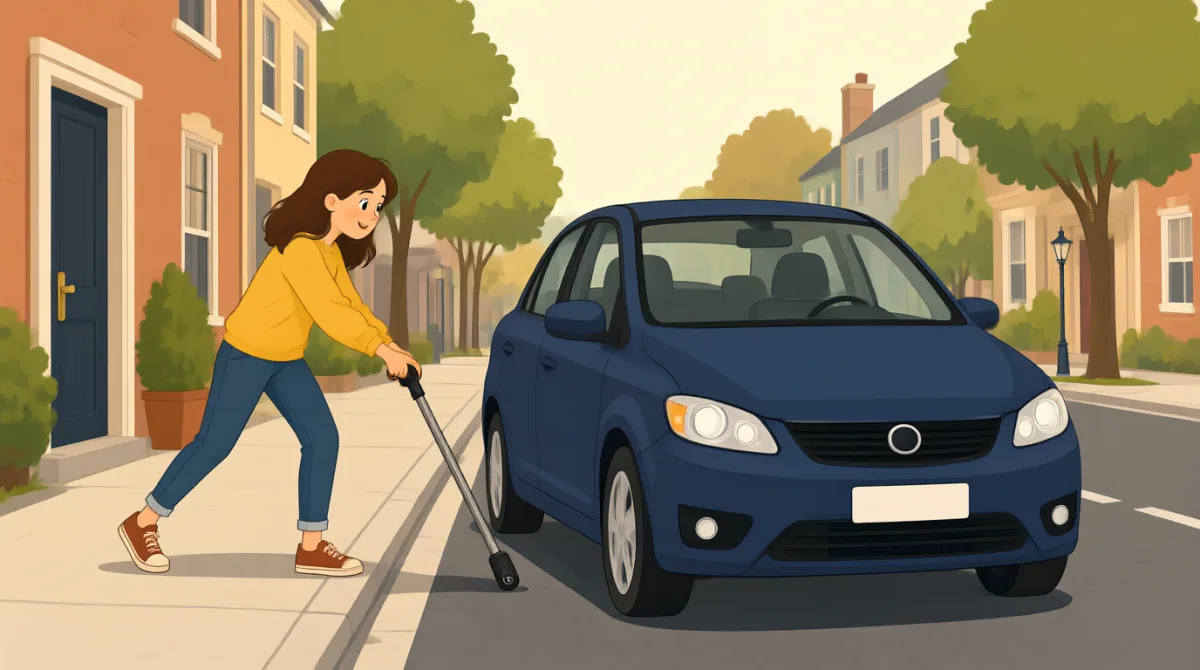

When it’s safe, pull over slowly and stop beside the curb.
Cuando sea seguro, oríllate despacio y detente junto al bordillo.

Okay. Should I turn on my signal now?
Está bien. ¿Pongo la direccional ahora?
Yes, signal right. Check your mirror, then move closer to the curb.
Sí, pon la direccional derecha. Revisa el espejo y luego acércate al bordillo.
I’m stopped. Is the car close enough to the curb?
Ya me detuve. ¿Está el auto lo bastante cerca del bordillo?
A little closer, please. Move forward slowly and stop when I say.
Un poco más cerca, por favor. Avanza despacio y detente cuando te lo diga.
Is this good? I don’t want to hit the curb.
¿Así está bien? No quiero golpear el bordillo.
That’s good. Now straighten the wheels by turning the steering wheel back.
Así está bien. Ahora endereza las ruedas girando el volante de vuelta.
Like this? The car is straight now, right?
¿Así? El auto ya está derecho, ¿verdad?
Yes, nice work. You parked safely and left enough space from the curb.
Sí, muy bien. Estacionaste con cuidado y dejaste suficiente espacio entre el auto y el bordillo.
Vocabulario8
- pull overorillarse
To move your car to the side of the road and stop. Here, David asks Emma to stop beside the curb.
Mover el auto hacia un lado de la carretera y detenerse. Aquí, David le pide a Emma que se detenga junto al bordillo.
- beside the curbjunto al bordillo
Next to the raised edge of the road. Use this phrase to describe where you want to park.
Al lado del borde elevado de la carretera. Usa esta expresión para describir dónde quieres estacionar.
- signal rightponer la direccional derecha
To use your right turn signal to show that you are moving right. You can say this when giving a driver a simple instruction.
Usar la direccional derecha para indicar que te vas a mover hacia la derecha. Puedes decirlo para darle una instrucción sencilla a alguien que conduce.
- mirrorespejo
A mirror in the car that helps you see behind you. Check it before moving closer to the curb.
Un espejo del auto que te ayuda a ver lo que hay detrás. Revísalo antes de acercarte al bordillo.
- move closeracercarse
To go nearer to something. You can use this phrase to tell someone to approach a place or object carefully.
Ir más cerca de algo. Puedes usar esta expresión para decirle a alguien que se acerque con cuidado a un lugar o a un objeto.
- steering wheelvolante
The wheel you turn to guide a car. Turning it helps you change the direction of the car.
La rueda que giras para dirigir el auto. Al girarla, cambias la dirección del auto.
- straighten the wheelsenderezar las ruedas
To turn the front wheels so they point straight ahead. This is useful after turning or parking.
Girar las ruedas delanteras para que apunten recto hacia adelante. Esto sirve después de girar o estacionar.
- left enough spacedejar suficiente espacio
Kept a suitable distance from something. Use this phrase to say there is room between the car and the curb.
Mantener una distancia adecuada de algo. Usa esta expresión para decir que hay espacio entre el auto y el bordillo.
Frases clave7
- 1
When it’s safe, pull over slowly and stop beside the curb.
Cuando sea seguro, oríllate despacio y detente junto al bordillo.
This is a clear instruction for stopping a car by the side of the road. You can reuse “When it’s safe” before giving another driving instruction.
Esta es una instrucción clara para detener el auto al lado de la carretera. Puedes volver a usar “When it’s safe” antes de dar otra instrucción para conducir.
- 2
Should I turn on my signal now?
¿Pongo la direccional ahora?
This is a useful way to check when to use a car signal. Replace “my signal” with another action to ask when to do it.
Esta es una forma útil de preguntar cuándo usar la direccional. Cambia “my signal” por otra acción para preguntar cuándo hacerla.
- 3
Check your mirror, then move closer to the curb.
Revisa el espejo y luego acércate al bordillo.
This sentence gives two simple driving instructions in order. Use “then” to show what action comes next.
Esta oración da dos instrucciones sencillas para conducir en orden. Usa “then” para indicar qué acción sigue.
- 4
Is the car close enough to the curb?
¿Está el auto lo bastante cerca del bordillo?
This question checks whether the car is at a good distance from the curb. You can use “close enough to” to ask about distance from other things.
Esta pregunta sirve para comprobar si el auto está a una buena distancia del bordillo. Puedes usar “close enough to” para preguntar por la distancia respecto de otras cosas.
- 5
I don’t want to hit the curb.
No quiero golpear el bordillo.
This explains a concern about getting too close while parking. Use “I don’t want to” to talk about something you want to avoid.
Esto expresa la preocupación de acercarse demasiado al estacionar. Usa “I don’t want to” para hablar de algo que quieres evitar.
- 6
Now straighten the wheels by turning the steering wheel back.
Ahora endereza las ruedas girando el volante de vuelta.
This explains how to make the wheels point straight after parking. Use “by” plus an action to explain how to do something.
Esto explica cómo hacer que las ruedas queden rectas después de estacionar. Usa “by” seguido de una acción para explicar cómo hacer algo.
- 7
You parked safely and left enough space from the curb.
Estacionaste con cuidado y dejaste suficiente espacio entre el auto y el bordillo.
This sentence gives positive feedback about how someone parked. You can use “left enough space” to describe keeping a good distance from something.
Esta oración felicita a alguien por cómo estacionó. Puedes usar “left enough space” para describir que se mantuvo una distancia adecuada de algo.