Parking by the Curb
Estacionando junto ao meio-fio
David guides Emma as she pulls over and parks by the curb. Emma checks whether the car is close enough and asks how to straighten the wheels.
David orienta Emma enquanto ela encosta e estaciona junto ao meio-fio. Emma confere se o carro está perto o suficiente e pergunta como alinhar as rodas.
Diálogo9
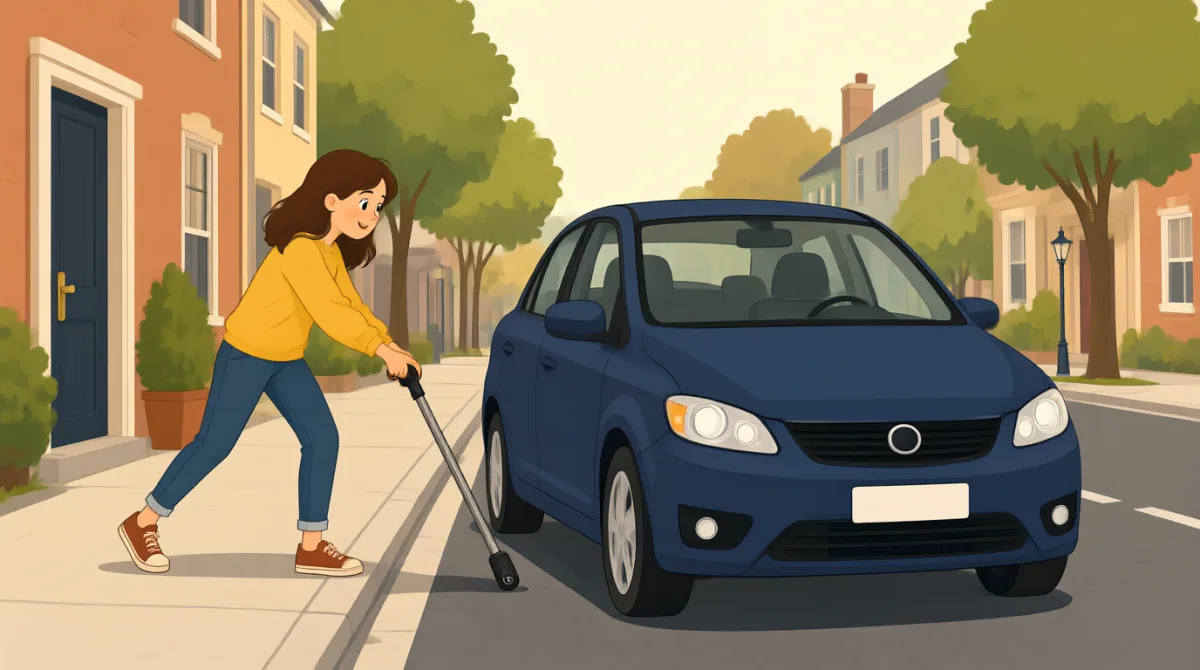

When it’s safe, pull over slowly and stop beside the curb.
Quando for seguro, encoste devagar e pare junto ao meio-fio.

Okay. Should I turn on my signal now?
Tá bom. Já devo ligar a seta?
Yes, signal right. Check your mirror, then move closer to the curb.
Sim, dê seta para a direita. Confira o retrovisor e depois chegue mais perto do meio-fio.
I’m stopped. Is the car close enough to the curb?
Parei. O carro está perto o suficiente do meio-fio?
A little closer, please. Move forward slowly and stop when I say.
Um pouquinho mais perto, por favor. Avance devagar e pare quando eu avisar.
Is this good? I don’t want to hit the curb.
Assim está bom? Não quero bater no meio-fio.
That’s good. Now straighten the wheels by turning the steering wheel back.
Assim está bom. Agora alinhe as rodas, girando o volante de volta.
Like this? The car is straight now, right?
Assim? O carro está reto agora, né?
Yes, nice work. You parked safely and left enough space from the curb.
Sim, muito bem. Você estacionou com segurança e deixou espaço suficiente do meio-fio.
Vocabulário8
- pull overencostar
To move your car to the side of the road and stop. Here, David asks Emma to stop beside the curb.
Levar o carro para o lado da estrada e parar. Aqui, David pede a Emma que pare junto ao meio-fio.
- beside the curbjunto ao meio-fio
Next to the raised edge of the road. Use this phrase to describe where you want to park.
Ao lado da parte elevada na borda da rua. Use essa expressão para dizer onde você quer estacionar.
- signal rightdar seta para a direita
To use your right turn signal to show that you are moving right. You can say this when giving a driver a simple instruction.
Usar a seta da direita para indicar que você vai virar ou se deslocar para a direita. Você pode dizer isso ao dar uma instrução simples a quem está dirigindo.
- mirrorretrovisor
A mirror in the car that helps you see behind you. Check it before moving closer to the curb.
Espelho do carro que ajuda você a ver o que está atrás. Confira o retrovisor antes de chegar mais perto do meio-fio.
- move closerchegar mais perto
To go nearer to something. You can use this phrase to tell someone to approach a place or object carefully.
Aproximar-se de alguma coisa. Você pode usar essa expressão para pedir a alguém que se aproxime de um lugar ou objeto com cuidado.
- steering wheelvolante
The wheel you turn to guide a car. Turning it helps you change the direction of the car.
A roda que você gira para conduzir o carro. Girá-la ajuda a mudar a direção do veículo.
- straighten the wheelsalinhar as rodas
To turn the front wheels so they point straight ahead. This is useful after turning or parking.
Girar as rodas dianteiras para que apontem em linha reta. Isso é útil depois de virar ou estacionar.
- left enough spacedeixar espaço suficiente
Kept a suitable distance from something. Use this phrase to say there is room between the car and the curb.
Manter uma distância adequada de alguma coisa. Use essa expressão para dizer que há espaço entre o carro e o meio-fio.
Frases-chave7
- 1
When it’s safe, pull over slowly and stop beside the curb.
Quando for seguro, encoste devagar e pare junto ao meio-fio.
This is a clear instruction for stopping a car by the side of the road. You can reuse “When it’s safe” before giving another driving instruction.
Esta é uma instrução clara para parar o carro ao lado da estrada. Você pode reutilizar “When it’s safe” (“Quando for seguro”) antes de dar outra instrução de direção.
- 2
Should I turn on my signal now?
Já devo ligar a seta?
This is a useful way to check when to use a car signal. Replace “my signal” with another action to ask when to do it.
Esta é uma forma útil de perguntar quando usar a seta do carro. Troque “my signal” (“minha seta”) por outra ação para perguntar quando fazê-la.
- 3
Check your mirror, then move closer to the curb.
Confira o retrovisor e depois chegue mais perto do meio-fio.
This sentence gives two simple driving instructions in order. Use “then” to show what action comes next.
Esta frase dá duas instruções simples de direção em sequência. Use “then” (“depois”) para indicar qual ação vem em seguida.
- 4
Is the car close enough to the curb?
O carro está perto o suficiente do meio-fio?
This question checks whether the car is at a good distance from the curb. You can use “close enough to” to ask about distance from other things.
Esta pergunta verifica se o carro está a uma boa distância do meio-fio. Você pode usar “close enough to” (“perto o suficiente de”) para perguntar sobre a distância em relação a outras coisas.
- 5
I don’t want to hit the curb.
Não quero bater no meio-fio.
This explains a concern about getting too close while parking. Use “I don’t want to” to talk about something you want to avoid.
Esta frase explica a preocupação de chegar perto demais ao estacionar. Use “I don’t want to” (“Não quero”) para falar de algo que você quer evitar.
- 6
Now straighten the wheels by turning the steering wheel back.
Agora alinhe as rodas, girando o volante de volta.
This explains how to make the wheels point straight after parking. Use “by” plus an action to explain how to do something.
Esta frase explica como deixar as rodas retas depois de estacionar. Use “by” mais uma ação para explicar como fazer algo.
- 7
You parked safely and left enough space from the curb.
Você estacionou com segurança e deixou espaço suficiente do meio-fio.
This sentence gives positive feedback about how someone parked. You can use “left enough space” to describe keeping a good distance from something.
Esta frase elogia a forma como alguém estacionou. Você pode usar “left enough space” (“deixou espaço suficiente”) para dizer que alguém manteve uma boa distância de alguma coisa.