Parking by the Curb
David guides Emma as she pulls over and parks by the curb. Emma checks whether the car is close enough and asks how to straighten the wheels.
Dialogue9
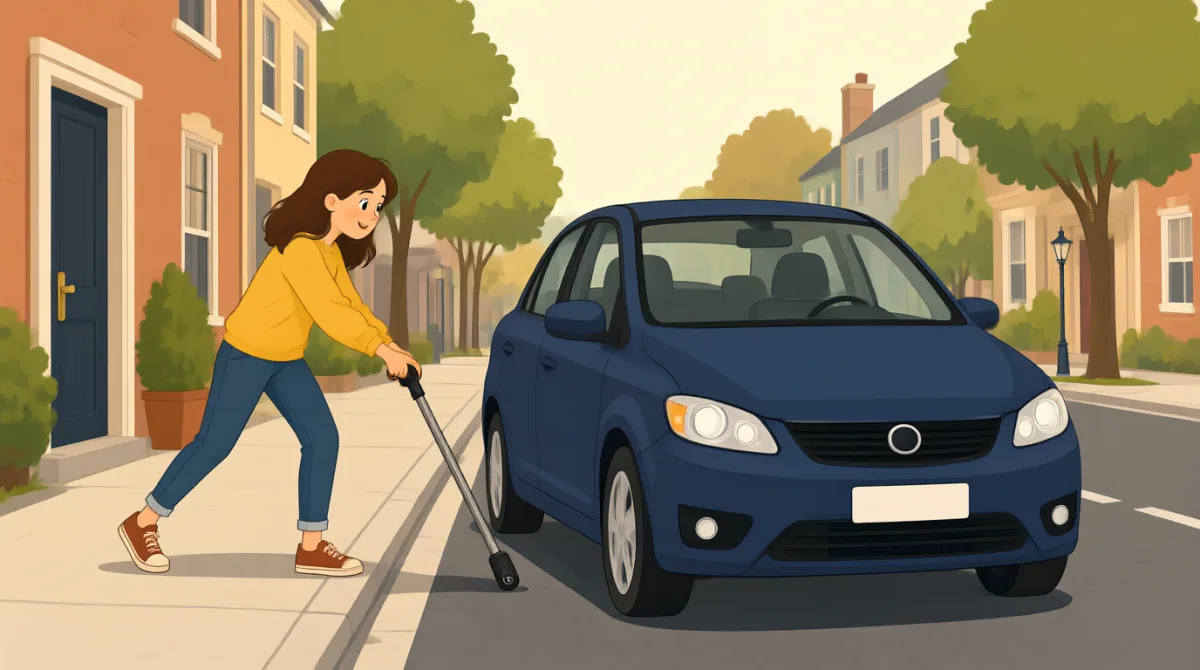

When it’s safe, pull over slowly and stop beside the curb.

Okay. Should I turn on my signal now?
Yes, signal right. Check your mirror, then move closer to the curb.
I’m stopped. Is the car close enough to the curb?
A little closer, please. Move forward slowly and stop when I say.
Is this good? I don’t want to hit the curb.
That’s good. Now straighten the wheels by turning the steering wheel back.
Like this? The car is straight now, right?
Yes, nice work. You parked safely and left enough space from the curb.
Vocabulary8
- pull over
To move your car to the side of the road and stop. Here, David asks Emma to stop beside the curb.
- beside the curb
Next to the raised edge of the road. Use this phrase to describe where you want to park.
- signal right
To use your right turn signal to show that you are moving right. You can say this when giving a driver a simple instruction.
- mirror
A mirror in the car that helps you see behind you. Check it before moving closer to the curb.
- move closer
To go nearer to something. You can use this phrase to tell someone to approach a place or object carefully.
- steering wheel
The wheel you turn to guide a car. Turning it helps you change the direction of the car.
- straighten the wheels
To turn the front wheels so they point straight ahead. This is useful after turning or parking.
- left enough space
Kept a suitable distance from something. Use this phrase to say there is room between the car and the curb.
Key Sentences7
- 1
When it’s safe, pull over slowly and stop beside the curb.
This is a clear instruction for stopping a car by the side of the road. You can reuse “When it’s safe” before giving another driving instruction.
- 2
Should I turn on my signal now?
This is a useful way to check when to use a car signal. Replace “my signal” with another action to ask when to do it.
- 3
Check your mirror, then move closer to the curb.
This sentence gives two simple driving instructions in order. Use “then” to show what action comes next.
- 4
Is the car close enough to the curb?
This question checks whether the car is at a good distance from the curb. You can use “close enough to” to ask about distance from other things.
- 5
I don’t want to hit the curb.
This explains a concern about getting too close while parking. Use “I don’t want to” to talk about something you want to avoid.
- 6
Now straighten the wheels by turning the steering wheel back.
This explains how to make the wheels point straight after parking. Use “by” plus an action to explain how to do something.
- 7
You parked safely and left enough space from the curb.
This sentence gives positive feedback about how someone parked. You can use “left enough space” to describe keeping a good distance from something.