Finding The Old Card
Retrouver l’ancienne carte
Emma finds her old card in a coat pocket. She tells Mia, but the card is already blocked and cannot be used.
Emma retrouve son ancienne carte dans la poche d’un manteau. Elle le dit à Mia, mais la carte est déjà bloquée et ne peut plus être utilisée.
Dialogue8
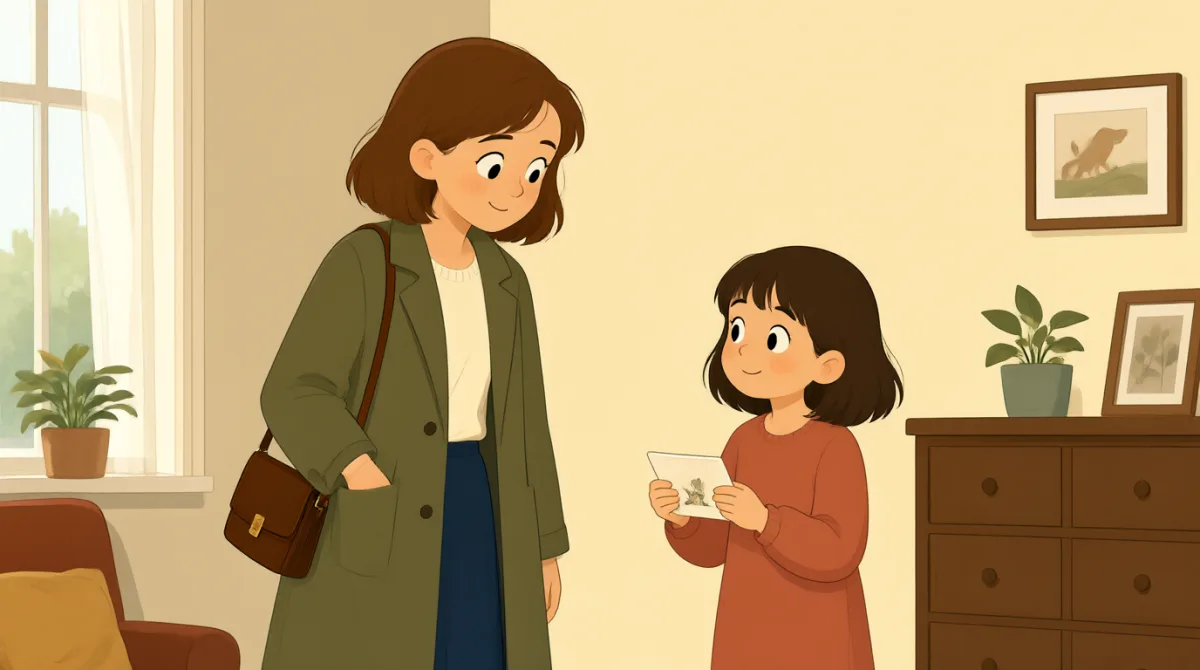

Mia, I found my bank card in the pocket of my blue coat.
Mia, j’ai retrouvé ma carte bancaire dans la poche de mon manteau bleu.

Oh, good! You must feel relieved. When did you find it?
Ah, super ! Tu dois être soulagée. Tu l’as retrouvée quand ?
Just now. I wore that coat yesterday and forgot to check the pockets.
À l’instant. J’ai porté ce manteau hier et j’ai oublié de vérifier les poches.
But you already called the bank and asked them to block it, right?
Mais tu as déjà appelé la banque pour leur demander de la bloquer, non ?
Yes, they blocked it this morning, so I can't use it now.
Oui, ils l’ont bloquée ce matin, alors je ne peux plus l’utiliser.
That's okay. Keep the old card somewhere safe until you get the new one.
Ce n’est pas grave. Garde l’ancienne carte dans un endroit sûr jusqu’à ce que tu reçoives la nouvelle.
I will. I ordered a new card, and it should arrive next week.
D’accord. J’ai commandé une nouvelle carte, elle devrait arriver la semaine prochaine.
Great. Don't try to pay with the old one by mistake!
Super. Ne paie pas par erreur avec l’ancienne !
Vocabulaire7
- bank cardcarte bancaire
A card you use to pay for things or get money from a bank. Here, Emma found her bank card in her coat pocket.
Une carte qui sert à payer des achats ou à retirer de l’argent à la banque. Ici, Emma retrouve sa carte bancaire dans la poche de son manteau.
- feel relievedêtre soulagé(e)
To feel less worried because a problem is over or has improved. You can use this phrase to ask how someone feels after a stressful event.
Se sentir moins inquiet parce qu’un problème est réglé ou s’est amélioré. Cette expression permet de demander à quelqu’un comment il se sent après un événement stressant.
- check the pocketsvérifier les poches
To look inside the pockets of your clothes for something. Use this phrase when you want to make sure you have not left anything behind.
Regarder dans les poches de ses vêtements pour voir si quelque chose s’y trouve. Utilise cette expression pour dire que tu veux t’assurer de ne rien avoir oublié.
- block itla bloquer
To stop a bank card from being used. You can ask a bank to block a card if it is lost or stolen.
Empêcher qu’une carte bancaire soit utilisée. Tu peux demander à la banque de bloquer une carte si tu l’as perdue ou si on te l’a volée.
- somewhere safedans un endroit sûr
In a place where something will not get lost, damaged, or taken. Use this phrase when giving advice about where to keep an important item.
Dans un endroit où l’objet ne risque pas d’être perdu, abîmé ou pris. Cette expression est utile pour conseiller à quelqu’un où ranger un objet important.
- get the new onerecevoir la nouvelle
To receive or obtain a replacement. Here, “the new one” means Emma’s new bank card.
Recevoir ou obtenir un objet de remplacement. Ici, « the new one » (« la nouvelle ») désigne la nouvelle carte bancaire d’Emma.
- by mistakepar erreur
Without meaning to do something. Use this phrase when someone might do something accidentally.
Sans le vouloir. Utilise cette expression pour parler de quelque chose que quelqu’un pourrait faire accidentellement.
Phrases clés8
- 1
I found my bank card in the pocket of my blue coat.
J’ai retrouvé ma carte bancaire dans la poche de mon manteau bleu.
Use this sentence to say where you found something. You can change “my bank card” and “my blue coat” to name other items and places.
Utilise cette phrase pour dire où tu as retrouvé quelque chose. Tu peux remplacer « my bank card » et « my blue coat » par d’autres objets et endroits.
- 2
You must feel relieved.
Tu dois être soulagée.
This is a way to show understanding when someone is less worried. You can say “You must feel [feeling]” to make a friendly guess about how they feel.
Cette phrase permet de montrer que tu comprends que quelqu’un est moins inquiet. Tu peux dire « You must feel [feeling] » pour deviner avec bienveillance ce que la personne ressent.
- 3
I wore that coat yesterday and forgot to check the pockets.
J’ai porté ce manteau hier et j’ai oublié de vérifier les poches.
Use this sentence to explain how you may have left something behind. “Forgot to check” is useful for describing something you did not remember to do.
Utilise cette phrase pour expliquer comment tu as pu oublier quelque chose quelque part. « Forgot to check » est utile pour parler de quelque chose que tu as oublié de faire.
- 4
But you already called the bank and asked them to block it, right?
Mais tu as déjà appelé la banque pour leur demander de la bloquer, non ?
This is a way to check that someone has already taken an important step. Add “right?” at the end to ask for confirmation.
Cette phrase permet de vérifier que quelqu’un a déjà pris une mesure importante. Ajoute « right? » à la fin pour demander confirmation.
- 5
They blocked it this morning, so I can't use it now.
Ils l’ont bloquée ce matin, alors je ne peux plus l’utiliser.
Use “so” to explain the result of an action. You can change the time and the reason to talk about other situations.
Utilise « so » pour expliquer le résultat d’une action. Tu peux changer le moment et la raison pour parler d’autres situations.
- 6
Keep the old card somewhere safe until you get the new one.
Garde l’ancienne carte dans un endroit sûr jusqu’à ce que tu reçoives la nouvelle.
This sentence gives simple advice and explains how long to follow it. Use “Keep [item] somewhere safe until…” when someone is waiting for a replacement.
Cette phrase donne un conseil simple et précise combien de temps le suivre. Utilise « Keep [item] somewhere safe until… » quand quelqu’un attend un objet de remplacement.
- 7
I ordered a new card, and it should arrive next week.
J’ai commandé une nouvelle carte, elle devrait arriver la semaine prochaine.
Use this sentence to say you requested something and when you expect it to come. You can replace “a new card” and “next week” with other items and times.
Utilise cette phrase pour dire que tu as commandé quelque chose et quand tu penses le recevoir. Tu peux remplacer « a new card » et « next week » par d’autres objets et moments.
- 8
Don't try to pay with the old one by mistake!
Ne paie pas par erreur avec l’ancienne !
This is a friendly warning about doing something accidentally. Use “Don't try to [action] by mistake” to warn someone about a possible error.
C’est un avertissement amical pour éviter que quelqu’un fasse quelque chose par accident. Utilise « Don't try to [action] by mistake » pour prévenir quelqu’un d’une erreur possible.