Noticing Your Card Is Gone
Je me rends compte que ma carte a disparu
Emma looks in her bag but cannot find her bank card. She talks with Mia and tries to remember where she used it.
Emma fouille dans son sac, mais ne trouve pas sa carte bancaire. Elle en parle avec Mia et essaie de se rappeler où elle l’a utilisée.
Dialogue9
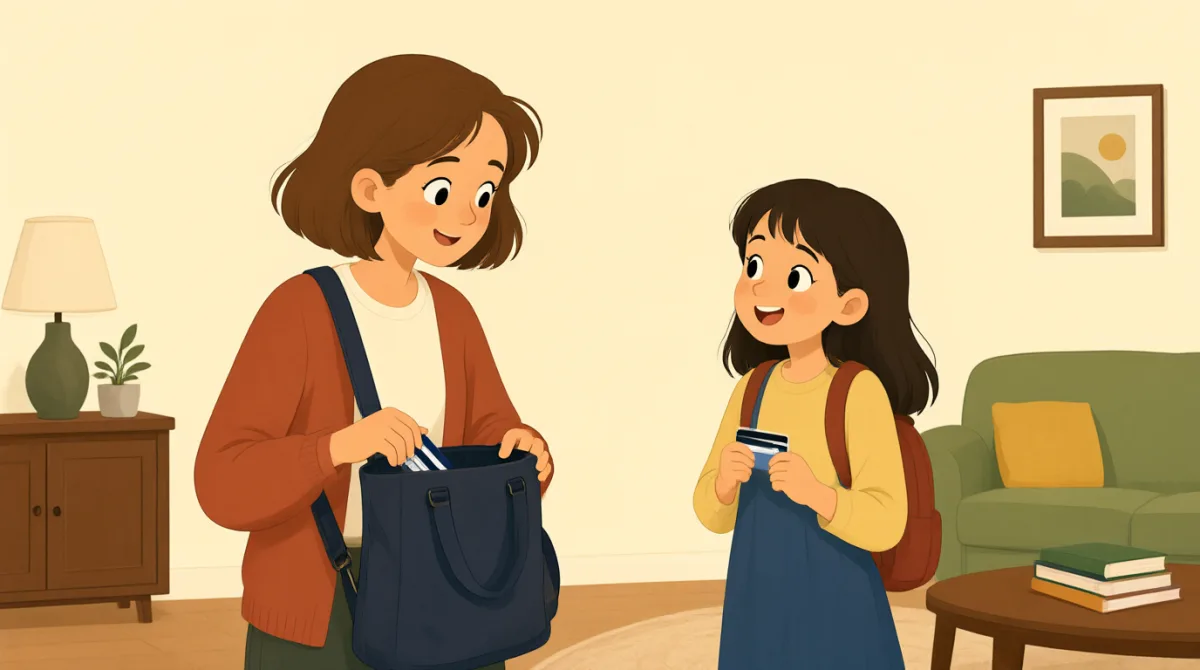

Mia, I can’t find my bank card. I looked in my bag twice.
Mia, je ne trouve pas ma carte bancaire. J’ai fouillé deux fois dans mon sac.

When did you last use it? Maybe you left it somewhere.
Tu l’as utilisée pour la dernière fois quand ? Tu l’as peut-être oubliée quelque part.
I used it at the grocery store yesterday, then I took the bus home.
Je l’ai utilisée à l’épicerie hier, puis j’ai pris le bus pour rentrer.
Did you take it out when you paid? Check your coat pockets, too.
Tu l’as sortie au moment de payer ? Vérifie aussi les poches de ton manteau.
I remember putting it back in my wallet. My coat pockets are empty.
Je me souviens l’avoir remise dans mon portefeuille. Les poches de mon manteau sont vides.
Could it be in another pocket in your bag? Look through it slowly.
Elle pourrait être dans une autre poche de ton sac ? Fouille-le lentement.
I checked every pocket. It’s not here. I’m getting worried.
J’ai vérifié toutes les poches. Elle n’est pas là. Je commence à m’inquiéter.
Let’s think. Did you use it anywhere after the grocery store?
Réfléchissons. Tu l’as utilisée quelque part après l’épicerie ?
No, I don’t think so. I’ll call the bank if I can’t find it.
Non, je ne crois pas. J’appellerai la banque si je ne la retrouve pas.
Vocabulaire8
- bank cardcarte bancaire
A card you use to pay for things or take money from your bank. Here, Emma cannot find hers.
Une carte qui sert à payer des achats ou à retirer de l’argent sur son compte bancaire. Ici, Emma n’arrive pas à retrouver la sienne.
- looked in my bagj’ai fouillé dans mon sac
Checked inside my bag to find something. You can say this when explaining where you have searched.
Tu as vérifié le contenu de ton sac pour trouver quelque chose. Tu peux dire cela pour expliquer où tu as cherché.
- left it somewherel’oublier quelque part
Forgot or lost something in a place. Use this when you think you may not have taken an item with you.
Oublier ou perdre quelque chose dans un endroit. Utilise cette expression si tu penses que tu n’as peut-être pas emporté un objet avec toi.
- take it outla sortir
Remove something from a bag, pocket, or wallet. Here, Mia asks if Emma removed her card to pay.
Retirer quelque chose d’un sac, d’une poche ou d’un portefeuille. Ici, Mia demande à Emma si elle a sorti sa carte pour payer.
- coat pocketsles poches du manteau
The small spaces in a coat where you can keep things. You can check them when you are looking for a lost item.
Les petits compartiments d’un manteau où l’on peut ranger des affaires. Tu peux les vérifier quand tu cherches un objet perdu.
- look through itfouille-le
Search inside something carefully. For example, you can look through a bag to find an item.
Chercher attentivement à l’intérieur de quelque chose. Par exemple, tu peux fouiller dans un sac pour retrouver un objet.
- getting worriedcommencer à s’inquiéter
Starting to feel anxious about a problem. Use this phrase to describe how you feel as a problem continues.
Commencer à ressentir de l’anxiété face à un problème. Utilise cette expression pour décrire ce que tu ressens quand un problème persiste.
- call the bankappeler la banque
Phone the bank to ask for help. You can use this phrase when you need to report a problem with a bank card.
Téléphoner à la banque pour demander de l’aide. Tu peux utiliser cette expression si tu dois signaler un problème avec une carte bancaire.
Phrases clés7
- 1
I can’t find my bank card.
Je ne trouve pas ma carte bancaire.
A simple way to say that something is missing. You can replace “bank card” with another item, such as “keys” or “phone.”
Une façon simple de dire qu’un objet a disparu. Tu peux remplacer “bank card” par un autre objet, comme “keys” ou “phone”.
- 2
When did you last use it?
Tu l’as utilisée pour la dernière fois quand ?
Ask this to find out the most recent time someone used something. Replace “it” with the item you are asking about.
Pose cette question pour savoir à quel moment quelqu’un a utilisé quelque chose pour la dernière fois. Remplace “it” par l’objet dont tu parles.
- 3
Maybe you left it somewhere.
Tu l’as peut-être oubliée quelque part.
This suggests a possible reason something is missing. Use “Maybe you left [item] somewhere” when helping someone look for it.
Cette phrase propose une explication possible à la disparition d’un objet. Utilise “Maybe you left [item] somewhere” pour aider quelqu’un à le chercher.
- 4
Did you take it out when you paid?
Tu l’as sortie au moment de payer ?
Ask whether someone removed an item while paying. The pattern “Did you take it out when you…?” works for other situations, too.
Demande si quelqu’un a sorti un objet en payant. La structure “Did you take it out when you…?” peut aussi servir dans d’autres situations.
- 5
Look through it slowly.
Fouille-le lentement.
A simple suggestion to search inside something carefully. Replace “it” with a bag, drawer, or another place.
Une suggestion simple pour chercher attentivement à l’intérieur de quelque chose. Remplace “it” par un sac, un tiroir ou un autre endroit.
- 6
I’m getting worried.
Je commence à m’inquiéter.
Use this to say that you are beginning to feel worried. You can use “I’m getting” with other feelings, such as “tired” or “hungry.”
Utilise cette phrase pour dire que tu commences à t’inquiéter. Tu peux aussi employer “I’m getting” avec d’autres états, comme “tired” ou “hungry.”
- 7
I’ll call the bank if I can’t find it.
J’appellerai la banque si je ne la retrouve pas.
This explains what you plan to do if you cannot find something. Use “I’ll [action] if I can’t [do something]” to talk about a future plan.
Cette phrase explique ce que tu comptes faire si tu ne retrouves pas quelque chose. Utilise “I’ll [action] if I can’t [do something]” pour parler d’un projet futur.