Getting a Little Lost
On s’est un peu perdus
Emma and Jack reach a fork in the trail and are not sure which way to go. They check the map and follow the trail markers to get back on the right path.
Emma et Jack arrivent à une bifurcation et ne savent pas trop quel chemin prendre. Ils consultent la carte et suivent les balises pour retrouver le bon sentier.
Dialogue8
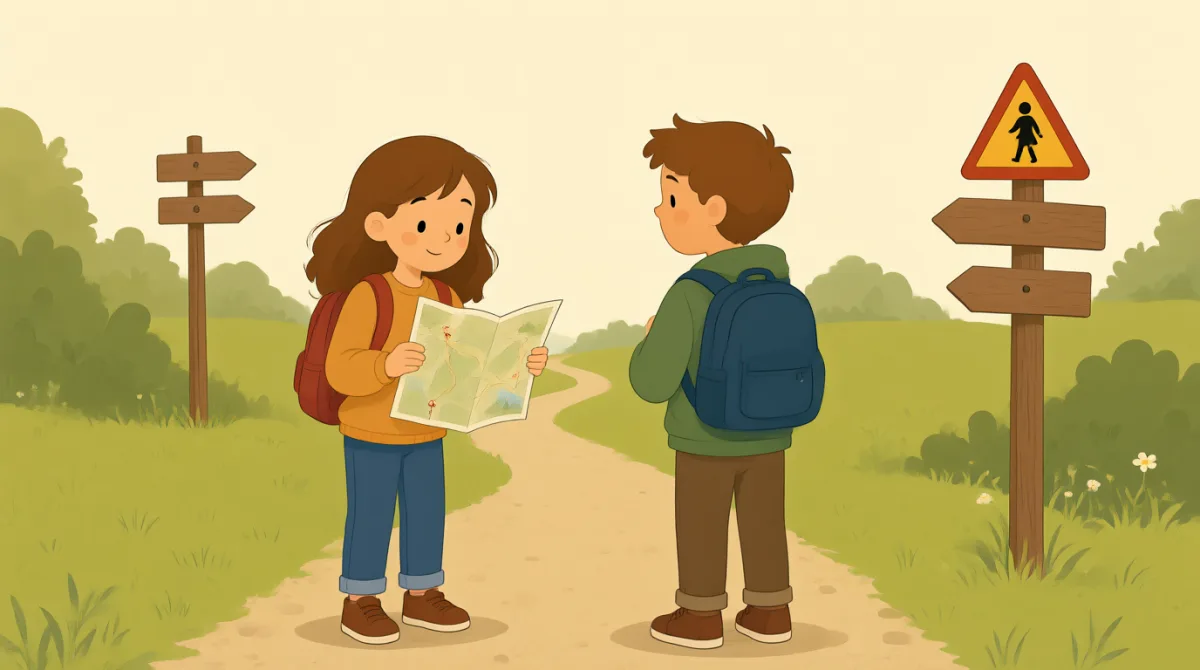

Jack, I think we took the wrong path. This trail looks different.
Jack, je crois qu’on s’est trompés de chemin. Ce sentier n’a pas l’air pareil.

Let's stop here and check the map. We don't want to walk farther.
Arrêtons-nous ici et regardons la carte. Inutile d’aller plus loin.
There are two paths at this fork. Which one did we take before?
Il y a deux chemins à cette bifurcation. Lequel avons-nous pris tout à l’heure ?
We came up from the left. But I can't see the trail sign.
On est arrivés par la gauche. Mais je ne vois pas le panneau du sentier.
The map shows a blue marker on the right path. Let's look around.
La carte indique une balise bleue sur le chemin de droite. Regardons autour de nous.
I see one on that tree! The blue marks lead back to our trail.
J’en vois une sur cet arbre ! Les marques bleues nous ramènent à notre sentier.
Great. Let's follow the markers and stay together this time.
Super. Suivons les balises et restons ensemble cette fois.
Good idea. We should keep the map out and watch for signs.
Bonne idée. On devrait garder la carte à portée de main et guetter les panneaux.
Vocabulaire8
- wrong pathle mauvais chemin
A path that does not take you where you want to go. You can say, “I think we took the wrong path,” when you may have gone the wrong way.
Un chemin qui ne vous mène pas là où vous voulez aller. Vous pouvez dire « I think we took the wrong path » (Je crois qu’on s’est trompés de chemin) si vous pensez avoir pris la mauvaise direction.
- check the mapconsulter la carte
Look at a map to find where you are or where to go. You can use this phrase when you need help finding your way.
Regarder une carte pour savoir où vous êtes ou où aller. Cette expression vous sera utile quand vous avez besoin d’aide pour trouver votre chemin.
- forkune bifurcation
A place where one path splits into two or more paths. You can ask, “Which path should we take at this fork?”
Un endroit où un chemin se divise en deux ou plusieurs chemins. Vous pouvez demander : « Which path should we take at this fork? » (Quel chemin devons-nous prendre à cette bifurcation ?)
- trail signun panneau de sentier
A sign that shows information about a walking trail. You can look for a trail sign to check that you are going the right way.
Un panneau qui donne des informations sur un sentier de randonnée. Vous pouvez chercher un panneau de sentier pour vérifier que vous êtes dans la bonne direction.
- look aroundregarder autour de soi
Look at the area nearby to find something. You can say this when you want to search for a sign or marker.
Regarder dans les environs pour trouver quelque chose. Vous pouvez dire cette expression quand vous voulez chercher un panneau ou une balise.
- lead back toramener à
Show the way back to a place. You can use it to explain where a path or set of markers goes.
Montrer le chemin du retour vers un endroit. Cette expression permet d’expliquer où mène un chemin ou un ensemble de balises.
- follow the markerssuivre les balises
Go in the direction shown by the trail markers. This phrase is useful when signs or marks show you which way to go.
Aller dans la direction indiquée par les balises du sentier. Cette expression est utile quand des panneaux ou des marques vous indiquent quelle direction prendre.
- stay togetherrester ensemble
Remain with the other people in your group. You can say this to help everyone stay safe and avoid getting lost.
Rester avec les autres personnes de votre groupe. Vous pouvez dire cela pour aider tout le monde à rester en sécurité et à ne pas se perdre.
Phrases clés8
- 1
I think we took the wrong path.
Je crois qu’on s’est trompés de chemin.
Use this sentence when you believe you may have gone the wrong way. You can replace “the wrong path” with another problem, such as “the wrong bus.”
Utilisez cette phrase si vous pensez avoir pris la mauvaise direction. Vous pouvez remplacer « the wrong path » par un autre problème, comme « the wrong bus ».
- 2
Let's stop here and check the map.
Arrêtons-nous ici et regardons la carte.
This is a simple way to suggest stopping to find out where you are. Replace “check the map” with another action, such as “ask for help.”
C’est une façon simple de proposer de s’arrêter pour savoir où vous êtes. Remplacez « check the map » par une autre action, comme « ask for help ».
- 3
Which one did we take before?
Lequel avons-nous pris tout à l’heure ?
Use this question when you need to remember which choice you made earlier. You can ask it about paths, roads, or other options.
Utilisez cette question quand vous essayez de vous rappeler quel choix vous avez fait plus tôt. Vous pouvez la poser à propos de chemins, de routes ou d’autres options.
- 4
But I can't see the trail sign.
Mais je ne vois pas le panneau du sentier.
Use this sentence when something you are looking for is not visible. Replace “the trail sign” with another thing, such as “the bus stop.”
Utilisez cette phrase quand vous ne voyez pas quelque chose que vous cherchez. Remplacez « the trail sign » par autre chose, comme « the bus stop ».
- 5
Let's look around.
Regardons autour de nous.
This is a short, friendly suggestion to search nearby. You can use it when you are trying to find something you have lost.
C’est une suggestion courte et amicale pour chercher dans les environs. Vous pouvez l’utiliser quand vous essayez de retrouver quelque chose que vous avez perdu.
- 6
The blue marks lead back to our trail.
Les marques bleues nous ramènent à notre sentier.
This sentence explains where the marks will take you. You can replace “The blue marks” with another guide, such as “These signs.”
Cette phrase explique où les marques vont vous mener. Vous pouvez remplacer « The blue marks » par un autre repère, comme « These signs ».
- 7
Let's follow the markers and stay together this time.
Suivons les balises et restons ensemble cette fois.
Use this sentence to suggest a plan and remind people to remain as a group. You can replace “the markers” with another guide, such as “the signs.”
Utilisez cette phrase pour proposer un plan et rappeler aux autres de rester groupés. Vous pouvez remplacer « the markers » par un autre repère, comme « the signs ».
- 8
We should keep the map out and watch for signs.
On devrait garder la carte à portée de main et guetter les panneaux.
This sentence gives two helpful actions to avoid getting lost. You can use “We should…” to suggest things to do in other situations.
Cette phrase propose deux actions utiles pour éviter de se perdre. Vous pouvez utiliser « We should… » pour suggérer quoi faire dans d’autres situations.