Getting a Little Lost
Emma and Jack reach a fork in the trail and are not sure which way to go. They check the map and follow the trail markers to get back on the right path.
Dialogue8
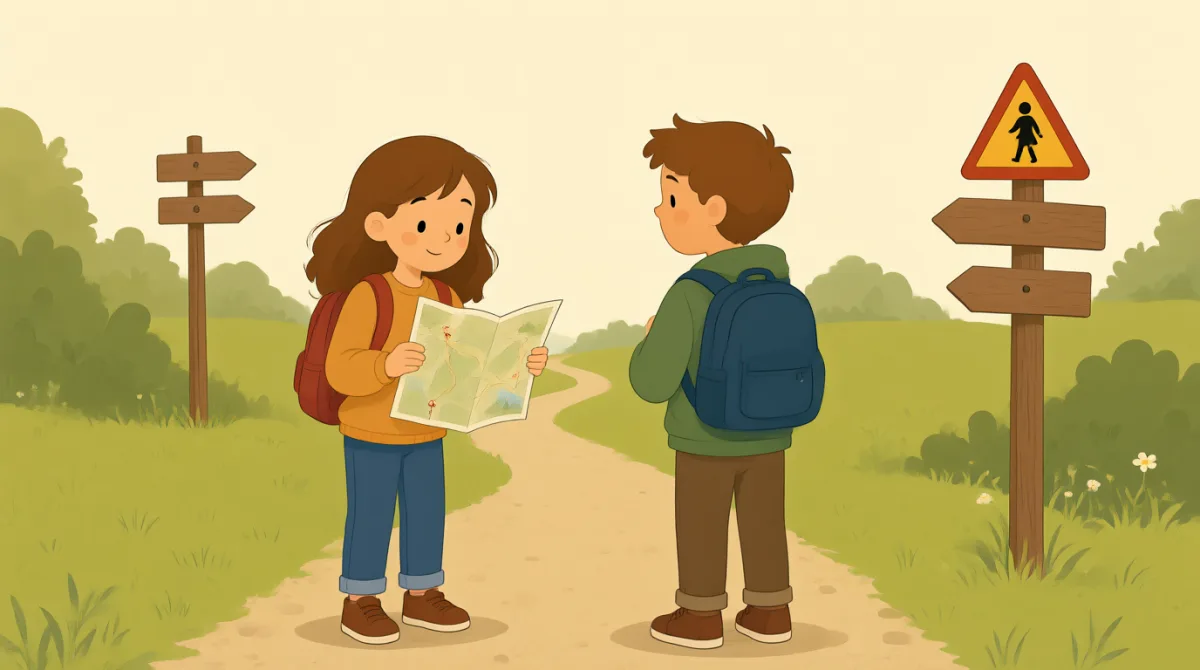

Jack, I think we took the wrong path. This trail looks different.

Let's stop here and check the map. We don't want to walk farther.
There are two paths at this fork. Which one did we take before?
We came up from the left. But I can't see the trail sign.
The map shows a blue marker on the right path. Let's look around.
I see one on that tree! The blue marks lead back to our trail.
Great. Let's follow the markers and stay together this time.
Good idea. We should keep the map out and watch for signs.
Vocabulary8
- wrong path
A path that does not take you where you want to go. You can say, “I think we took the wrong path,” when you may have gone the wrong way.
- check the map
Look at a map to find where you are or where to go. You can use this phrase when you need help finding your way.
- fork
A place where one path splits into two or more paths. You can ask, “Which path should we take at this fork?”
- trail sign
A sign that shows information about a walking trail. You can look for a trail sign to check that you are going the right way.
- look around
Look at the area nearby to find something. You can say this when you want to search for a sign or marker.
- lead back to
Show the way back to a place. You can use it to explain where a path or set of markers goes.
- follow the markers
Go in the direction shown by the trail markers. This phrase is useful when signs or marks show you which way to go.
- stay together
Remain with the other people in your group. You can say this to help everyone stay safe and avoid getting lost.
Key Sentences8
- 1
I think we took the wrong path.
Use this sentence when you believe you may have gone the wrong way. You can replace “the wrong path” with another problem, such as “the wrong bus.”
- 2
Let's stop here and check the map.
This is a simple way to suggest stopping to find out where you are. Replace “check the map” with another action, such as “ask for help.”
- 3
Which one did we take before?
Use this question when you need to remember which choice you made earlier. You can ask it about paths, roads, or other options.
- 4
But I can't see the trail sign.
Use this sentence when something you are looking for is not visible. Replace “the trail sign” with another thing, such as “the bus stop.”
- 5
Let's look around.
This is a short, friendly suggestion to search nearby. You can use it when you are trying to find something you have lost.
- 6
The blue marks lead back to our trail.
This sentence explains where the marks will take you. You can replace “The blue marks” with another guide, such as “These signs.”
- 7
Let's follow the markers and stay together this time.
Use this sentence to suggest a plan and remind people to remain as a group. You can replace “the markers” with another guide, such as “the signs.”
- 8
We should keep the map out and watch for signs.
This sentence gives two helpful actions to avoid getting lost. You can use “We should…” to suggest things to do in other situations.