Getting a Little Lost
Un poco perdidos
Emma and Jack reach a fork in the trail and are not sure which way to go. They check the map and follow the trail markers to get back on the right path.
Emma y Jack llegan a una bifurcación del sendero y no saben bien por dónde ir. Consultan el mapa y siguen las marcas del sendero para volver al camino correcto.
Diálogo8
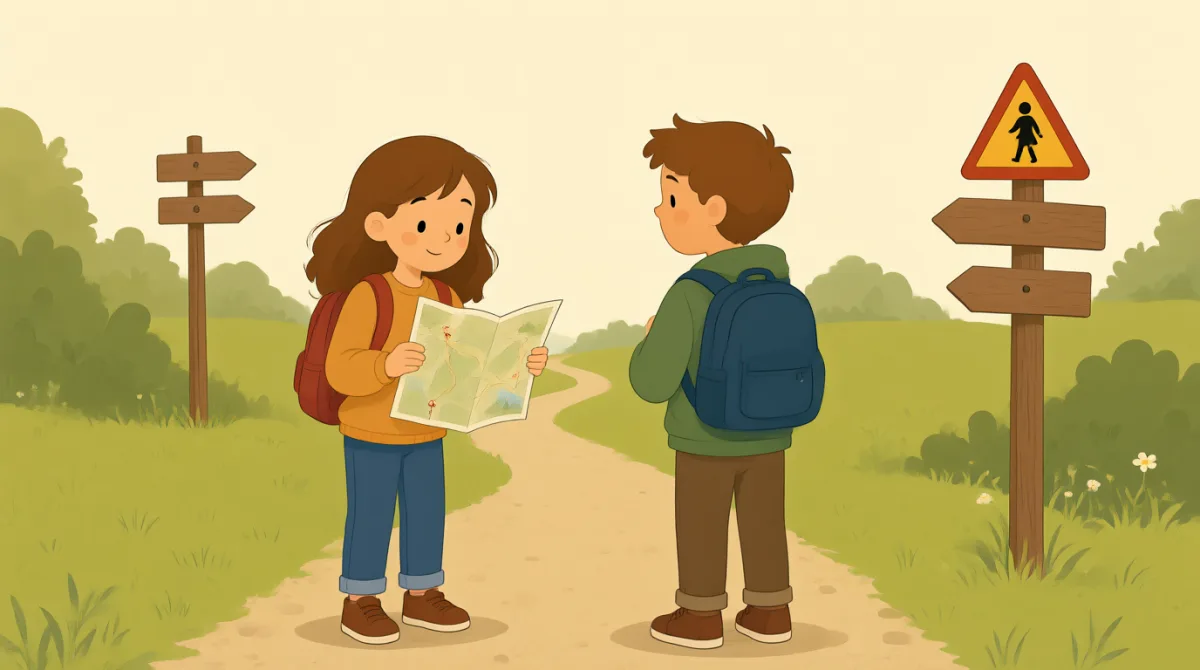

Jack, I think we took the wrong path. This trail looks different.
Jack, creo que nos hemos equivocado de camino. Este sendero se ve diferente.

Let's stop here and check the map. We don't want to walk farther.
Pare aquí y consultemos el mapa. No queremos seguir caminando más.
There are two paths at this fork. Which one did we take before?
Hay dos caminos en esta bifurcación. ¿Cuál tomamos antes?
We came up from the left. But I can't see the trail sign.
Venimos por la izquierda. Pero no veo el letrero del sendero.
The map shows a blue marker on the right path. Let's look around.
El mapa muestra una marca azul en el camino de la derecha. Echemos un vistazo por aquí.
I see one on that tree! The blue marks lead back to our trail.
¡Veo una en ese árbol! Las marcas azules nos llevan de vuelta a nuestro sendero.
Great. Let's follow the markers and stay together this time.
Genial. Sigamos las marcas y esta vez no nos separemos.
Good idea. We should keep the map out and watch for signs.
Buena idea. Deberíamos tener el mapa a mano y estar atentos a las señales.
Vocabulario8
- wrong pathcamino equivocado
A path that does not take you where you want to go. You can say, “I think we took the wrong path,” when you may have gone the wrong way.
Un camino que no te lleva adonde quieres ir. Puedes decir “I think we took the wrong path” (Creo que nos hemos equivocado de camino) cuando piensas que quizá has tomado la dirección equivocada.
- check the mapconsultar el mapa
Look at a map to find where you are or where to go. You can use this phrase when you need help finding your way.
Mirar un mapa para saber dónde estás o adónde ir. Puedes usar esta expresión cuando necesitas ayuda para orientarte.
- forkbifurcación
A place where one path splits into two or more paths. You can ask, “Which path should we take at this fork?”
Un lugar donde un camino se divide en dos o más. Puedes preguntar “Which path should we take at this fork?” (¿Qué camino deberíamos tomar en esta bifurcación?).
- trail signletrero del sendero
A sign that shows information about a walking trail. You can look for a trail sign to check that you are going the right way.
Un letrero con información sobre un sendero. Puedes buscar uno para comprobar si vas por el camino correcto.
- look aroundechar un vistazo por aquí
Look at the area nearby to find something. You can say this when you want to search for a sign or marker.
Mirar por los alrededores para encontrar algo. Puedes decirlo cuando quieras buscar un letrero o una marca.
- lead back tollevar de vuelta a
Show the way back to a place. You can use it to explain where a path or set of markers goes.
Mostrar el camino de regreso a un lugar. Puedes usar esta expresión para explicar adónde conduce un camino o un conjunto de marcas.
- follow the markersseguir las marcas
Go in the direction shown by the trail markers. This phrase is useful when signs or marks show you which way to go.
Ir en la dirección que indican las marcas del sendero. Esta expresión es útil cuando las señales o marcas te muestran por dónde ir.
- stay togetherno separarse
Remain with the other people in your group. You can say this to help everyone stay safe and avoid getting lost.
Permanecer con las demás personas del grupo. Puedes decirlo para que todos estén seguros y no se pierdan.
Frases clave8
- 1
I think we took the wrong path.
Creo que nos hemos equivocado de camino.
Use this sentence when you believe you may have gone the wrong way. You can replace “the wrong path” with another problem, such as “the wrong bus.”
Usa esta frase cuando pienses que quizá has tomado la dirección equivocada. Puedes cambiar “the wrong path” (el camino equivocado) por otro problema, como “the wrong bus” (el autobús equivocado).
- 2
Let's stop here and check the map.
Pare aquí y consultemos el mapa.
This is a simple way to suggest stopping to find out where you are. Replace “check the map” with another action, such as “ask for help.”
Esta es una forma sencilla de proponer que paren para averiguar dónde están. Puedes cambiar “check the map” (consultar el mapa) por otra acción, como “ask for help” (pedir ayuda).
- 3
Which one did we take before?
¿Cuál tomamos antes?
Use this question when you need to remember which choice you made earlier. You can ask it about paths, roads, or other options.
Usa esta pregunta cuando necesites recordar qué opción eligieron antes. Puedes preguntar por caminos, carreteras u otras opciones.
- 4
But I can't see the trail sign.
Pero no veo el letrero del sendero.
Use this sentence when something you are looking for is not visible. Replace “the trail sign” with another thing, such as “the bus stop.”
Usa esta frase cuando no puedas ver algo que estás buscando. Puedes cambiar “the trail sign” (el letrero del sendero) por otra cosa, como “the bus stop” (la parada del autobús).
- 5
Let's look around.
Echemos un vistazo por aquí.
This is a short, friendly suggestion to search nearby. You can use it when you are trying to find something you have lost.
Es una sugerencia breve y amistosa para buscar por los alrededores. Puedes usarla cuando intentas encontrar algo que has perdido.
- 6
The blue marks lead back to our trail.
Las marcas azules nos llevan de vuelta a nuestro sendero.
This sentence explains where the marks will take you. You can replace “The blue marks” with another guide, such as “These signs.”
Esta frase explica adónde te llevarán las marcas. Puedes cambiar “The blue marks” (las marcas azules) por otra guía, como “These signs” (estas señales).
- 7
Let's follow the markers and stay together this time.
Sigamos las marcas y esta vez no nos separemos.
Use this sentence to suggest a plan and remind people to remain as a group. You can replace “the markers” with another guide, such as “the signs.”
Usa esta frase para proponer un plan y recordarles a los demás que permanezcan juntos. Puedes cambiar “the markers” (las marcas) por otra guía, como “the signs” (las señales).
- 8
We should keep the map out and watch for signs.
Deberíamos tener el mapa a mano y estar atentos a las señales.
This sentence gives two helpful actions to avoid getting lost. You can use “We should…” to suggest things to do in other situations.
Esta frase propone dos acciones útiles para no perderse. Puedes usar “We should…” (Deberíamos…) para sugerir qué hacer en otras situaciones.