Asking a Ranger for Advice
Demander conseil à un garde forestier
At the trail entrance, Emma and Jack ask Grace, a park ranger, about the path and the weather. Grace gives them simple safety tips for the hike.
À l’entrée du sentier, Emma et Jack demandent à Grace, une garde forestière, des renseignements sur le chemin et la météo. Grace leur donne quelques conseils simples pour randonner en toute sécurité.
Dialogue9
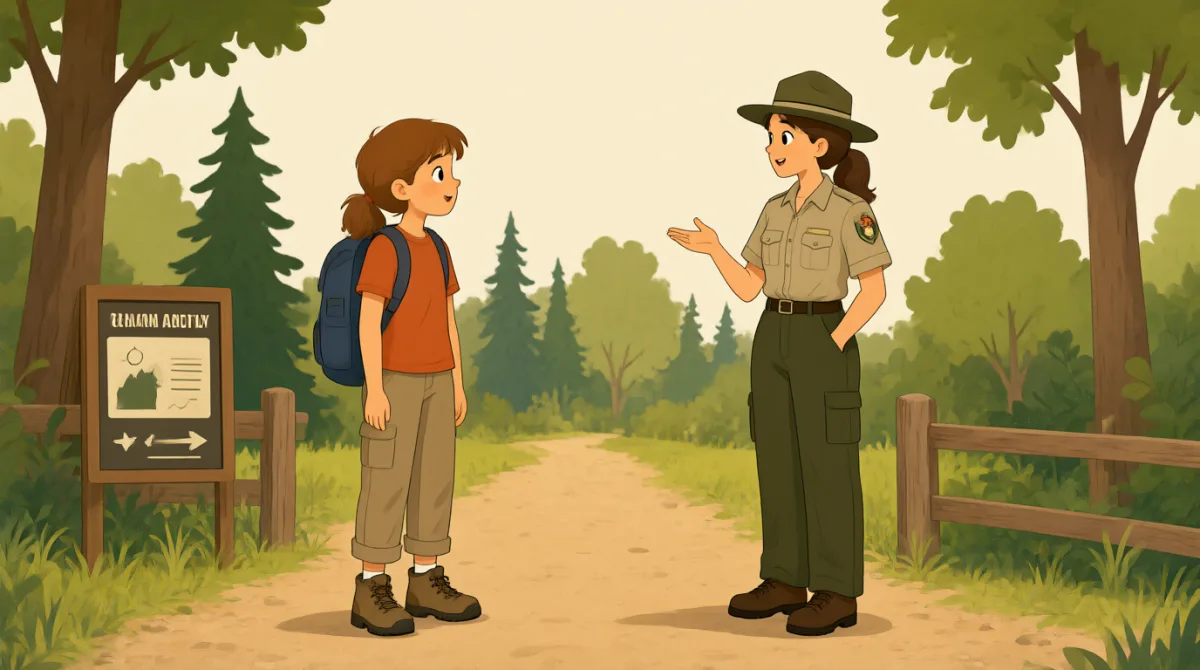

Hi, Grace. We’re planning to hike the Pine Loop. Is it open today?
Salut, Grace. On prévoit de faire la boucle des Pins. Elle est ouverte aujourd’hui ?

Yes, it’s open. It takes about two hours, and there are some steep parts.
Oui, elle est ouverte. Il faut environ deux heures, et il y a quelques passages escarpés.

Is the trail easy to follow? We haven’t hiked here before.
Le sentier est facile à suivre ? On n’a encore jamais randonné ici.
Yes. Follow the blue markers, and stay on the marked trail.
Oui. Suivez les balises bleues et restez sur le sentier balisé.
How’s the weather up there? Should we bring our rain jackets?
Quel temps fait-il là-haut ? On devrait prendre nos vestes de pluie ?
It may rain this afternoon, so bring them. Also, take plenty of water.
Il pourrait pleuvoir cet après-midi, alors prenez-les. Et prenez aussi beaucoup d’eau.
Got it. Is there anything else we should watch out for?
D’accord. Il y a autre chose à surveiller ?
Watch your step on the rocky parts, and come back before sunset.
Faites attention où vous mettez les pieds dans les passages rocheux et revenez avant le coucher du soleil.
Thanks, Grace. We’ll follow the markers and keep an eye on the time.
Merci, Grace. On suivra les balises et on surveillera l’heure.
Vocabulaire7
- steep partspassages escarpés
Sections of a path that go up or down sharply. They may be harder to walk on.
Des portions d’un chemin qui montent ou descendent fortement. Elles peuvent être plus difficiles à parcourir.
- blue markersbalises bleues
Blue signs or marks that show the way. Follow them to stay on the right path.
Des panneaux ou des marques bleus qui indiquent le chemin. Suivez-les pour rester sur le bon sentier.
- marked trailsentier balisé
The path shown by signs or markers. Stay on it to avoid getting lost.
Le chemin indiqué par des panneaux ou des balises. Restez dessus pour ne pas vous perdre.
- rain jacketsvestes de pluie
Jackets that help keep you dry in the rain. Bring them if rain is possible.
Des vestes qui vous protègent de la pluie. Prenez-en si la météo annonce un risque de pluie.
- plenty of waterbeaucoup d’eau
A large enough amount of water. Take enough to drink during your hike.
Une quantité d’eau suffisante. Emportez-en assez pour boire pendant votre randonnée.
- watch your stepfaire attention où l’on met les pieds
Be careful where you put your feet. This is useful on rocky or uneven ground.
Regardez où vous posez les pieds. C’est utile sur un terrain rocheux ou irrégulier.
- keep an eye on the timesurveiller l’heure
Check the time from time to time. This can help you return before sunset.
Vérifiez l’heure de temps en temps. Cela peut vous aider à rentrer avant le coucher du soleil.
Phrases clés8
- 1
Is it open today?
Elle est ouverte aujourd’hui ?
Use this question to check if a place or activity is available. Replace “it” with a trail, shop, or attraction.
Utilisez cette question pour vérifier si un lieu ou une activité est accessible. Remplacez “it” par un sentier, un magasin ou une attraction.
- 2
It takes about two hours, and there are some steep parts.
Il faut environ deux heures, et il y a quelques passages escarpés.
This gives the time needed and describes the route. You can use “It takes about…” to talk about how long a trip or activity lasts.
Cette phrase indique le temps nécessaire et décrit le parcours. Vous pouvez utiliser “It takes about…” pour parler de la durée d’un trajet ou d’une activité.
- 3
Follow the blue markers, and stay on the marked trail.
Suivez les balises bleues et restez sur le sentier balisé.
This gives two clear directions for staying on the right path. Replace “blue markers” with another sign or landmark.
Cette phrase donne deux consignes claires pour rester sur le bon chemin. Remplacez “blue markers” par un autre panneau ou un autre repère.
- 4
Should we bring our rain jackets?
On devrait prendre nos vestes de pluie ?
Use “Should we bring…?” to ask what to take with you. Replace “rain jackets” with another useful item.
Utilisez “Should we bring…?” pour demander quoi emporter. Remplacez “rain jackets” par un autre objet utile.
- 5
It may rain this afternoon, so bring them.
Il pourrait pleuvoir cet après-midi, alors prenez-les.
This warns someone about possible weather and gives advice. Use “It may…” for something that could happen.
Cette phrase avertit quelqu’un d’un risque lié à la météo et lui donne un conseil. Utilisez “It may…” pour parler de quelque chose qui pourrait arriver.
- 6
Take plenty of water.
Prenez beaucoup d’eau.
This is a simple way to advise someone to bring enough water. You can use “Take plenty of…” for other important supplies.
C’est une façon simple de conseiller à quelqu’un d’emporter assez d’eau. Vous pouvez utiliser “Take plenty of…” pour parler d’autres provisions importantes.
- 7
Watch your step on the rocky parts, and come back before sunset.
Faites attention où vous mettez les pieds dans les passages rocheux et revenez avant le coucher du soleil.
This gives safety advice and a time to return. You can use “Watch your step” when the ground is uneven.
Cette phrase donne un conseil de sécurité et indique une heure de retour. Vous pouvez utiliser “Watch your step” quand le terrain est irrégulier.
- 8
We’ll follow the markers and keep an eye on the time.
On suivra les balises et on surveillera l’heure.
Use this to say what you plan to do. “We’ll” introduces a future plan, and “keep an eye on” means check something regularly.
Utilisez cette phrase pour dire ce que vous prévoyez de faire. “We’ll” introduit un projet futur, et “keep an eye on” signifie vérifier quelque chose régulièrement.