At the Tire Shop
En el taller de neumáticos
Emma and Jack visit a tire shop to have the damaged tire checked. They ask the mechanic about repair options and the cost.
Emma y Jack van a un taller de neumáticos para que revisen el neumático dañado. Le preguntan al mecánico qué opciones de reparación hay y cuánto cuesta.
Diálogo8
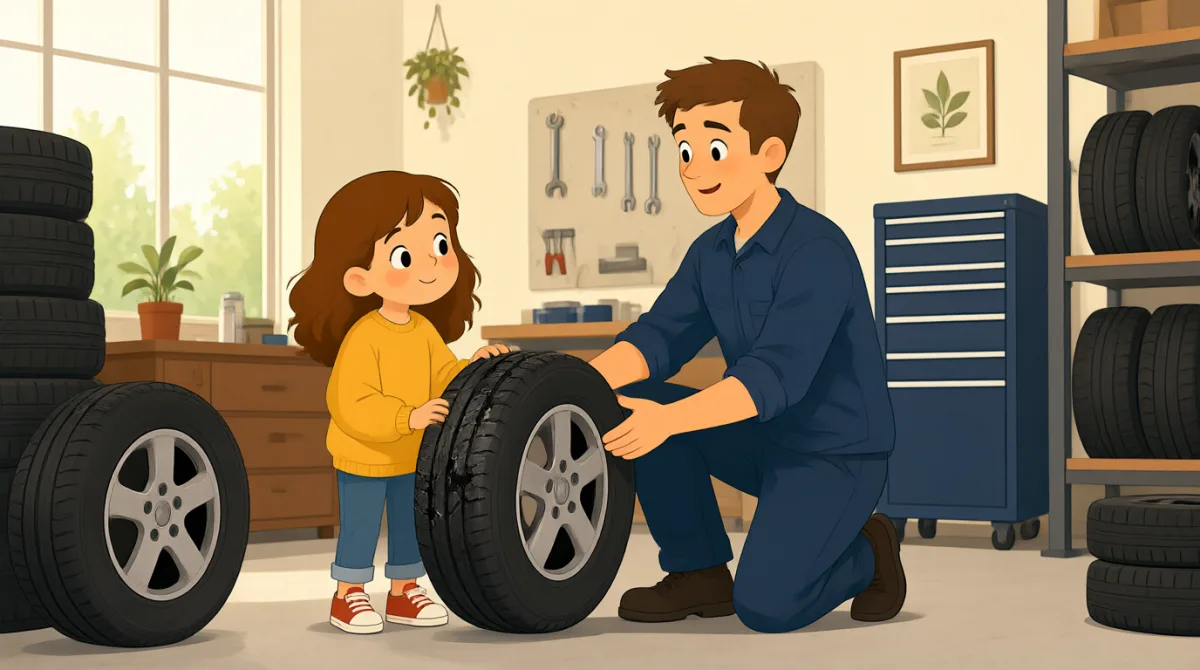

Hi, we have a flat tire. Could you check if you can repair it?
Hola, tenemos un neumático pinchado. ¿Podría revisar si se puede reparar?

Sure. I'll take a look. Did you hit anything on the road?
Claro. Voy a echarle un vistazo. ¿Golpearon algo en la carretera?

We heard a loud thump, then the tire went flat.
Oímos un golpe fuerte y luego se desinfló el neumático.
I see a nail in the tire. I'll check how deep the damage is.
Veo un clavo en el neumático. Voy a revisar qué tan profundo es el daño.
Can you patch it, or will we need a new tire?
¿Puede repararlo con un parche o vamos a necesitar un neumático nuevo?
The hole looks small, but I need to check the inside, too.
El agujero parece pequeño, pero también tengo que revisar el interior.
How long will the check take? We have the spare on now.
¿Cuánto tardará la revisión? Ahora tenemos puesta la rueda de repuesto.
About fifteen minutes. Please leave the car here, and I'll let you know.
Unos quince minutos. Por favor, deje aquí el auto y le aviso.
Vocabulario8
- flat tireneumático pinchado
A flat tire has lost its air and cannot work properly. You can use this phrase to explain a problem with a car tire.
Un “flat tire” es un neumático que ha perdido el aire y no puede funcionar correctamente. Puedes usar esta expresión para explicar que hay un problema con el neumático de un auto.
- take a lookechar un vistazo
This means to examine or check something. You can ask someone to take a look when you need help finding a problem.
“Take a look” significa examinar o revisar algo. Puedes pedirle a alguien que le eche un vistazo cuando necesites ayuda para encontrar un problema.
- hit anythinggolpear algo
Here, this means to bump or strike something while driving. You can ask, “Did you hit anything?” to find out what may have caused damage.
Aquí, “hit anything” significa chocar o golpear algo mientras se conduce. Puedes preguntar “Did you hit anything?” (¿Golpeaste algo?) para averiguar qué pudo haber causado el daño.
- went flatse desinfló
This means the tire lost its air. Use “went” to describe when it happened in the past.
“Went flat” significa que el neumático perdió el aire. Se usa “went” para describir algo que ocurrió en el pasado.
- check the insiderevisar el interior
This means to examine the inner part of something. At a tire shop, the mechanic may check inside the tire for damage.
“Check the inside” significa examinar la parte interior de algo. En un taller de neumáticos, el mecánico puede revisar el interior para ver si hay daños.
- patch itponerle un parche
To patch a tire means to cover and repair a small hole. You can ask if something can be patched instead of replaced.
“Patch it” significa tapar y reparar un agujero pequeño en un neumático. Puedes preguntar si se le puede poner un parche en vez de cambiarlo.
- sparerueda de repuesto
A spare is an extra tire kept for use when another tire is damaged. You can say, “We have the spare on” to explain that it is currently being used.
“Spare” es una rueda adicional que se lleva para usarla cuando otra está dañada. Puedes decir “We have the spare on” (Tenemos puesta la rueda de repuesto) para explicar que la están usando en ese momento.
- let you knowavisarte
This means to tell someone information when you have it. You can use it when you promise to give someone an update.
“Let you know” significa comunicarle algo a alguien cuando tengas la información. Puedes usar esta expresión cuando prometes mantener a alguien al tanto.
Frases clave7
- 1
Could you check if you can repair it?
¿Podría revisar si se puede reparar?
This is a polite way to ask someone to see whether something can be fixed. You can reuse “Could you check if you can [do something]?” for other requests.
Es una manera amable de pedirle a alguien que averigüe si algo se puede reparar. Puedes reutilizar “Could you check if you can [do something]?” (¿Podría revisar si puede [hacer algo]?) para otras peticiones.
- 2
Did you hit anything on the road?
¿Golpearon algo en la carretera?
This question asks if something caused damage while someone was driving. You can use “Did you hit anything?” to ask about a possible accident or bump.
Esta pregunta sirve para averiguar si algo causó daños mientras alguien conducía. Puedes usar “Did you hit anything?” (¿Golpeaste algo?) para preguntar por un posible accidente o golpe.
- 3
We heard a loud thump, then the tire went flat.
Oímos un golpe fuerte y luego se desinfló el neumático.
This sentence explains what happened and in what order. Use “We heard [sound], then [event]” to describe a problem.
Esta oración explica qué pasó y en qué orden. Usa “We heard [sound], then [event]” (Oímos [sonido] y luego [suceso]) para describir un problema.
- 4
I'll check how deep the damage is.
Voy a revisar qué tan profundo es el daño.
This is a useful way to say what you will examine next. You can use “I’ll check how [adjective] it is” when you need to measure or assess something.
Es una forma útil de decir qué vas a revisar a continuación. Puedes usar “I’ll check how [adjective] it is” (Voy a revisar qué tan [adjetivo] es) cuando necesites medir o evaluar algo.
- 5
Can you patch it, or will we need a new tire?
¿Puede repararlo con un parche o vamos a necesitar un neumático nuevo?
This asks about two possible solutions. You can reuse “Can you [repair it], or will we need [a replacement]?” when discussing a damaged item.
Esta pregunta plantea dos posibles soluciones. Puedes reutilizar “Can you [repair it], or will we need [a replacement]?” (¿Puede [repararlo] o vamos a necesitar [un reemplazo]?) cuando hables de un objeto dañado.
- 6
How long will the check take?
¿Cuánto tardará la revisión?
Use this question to ask how much time a task will need. You can change “the check” to another activity, such as “the repair.”
Usa esta pregunta para saber cuánto tiempo tomará una tarea. Puedes cambiar “the check” por otra actividad, como “the repair” (la reparación).
- 7
Please leave the car here, and I'll let you know.
Por favor, deje aquí el auto y le aviso.
This gives a polite instruction and explains that you will provide an update later. You can use “I’ll let you know” when you promise to share information.
Esta frase da una indicación amable y explica que más tarde le darás información a la otra persona. Puedes usar “I’ll let you know” (le aviso) cuando prometas compartir información.