The Plumber Explains the Problem
Le plombier explique le problème
David checks the sink and explains that a loose pipe is causing the leak. He tells Jack what he needs to do and how long the repair will take.
David vérifie l’évier et explique qu’un tuyau desserré est à l’origine de la fuite. Il indique à Jack ce qu’il doit faire et combien de temps la réparation prendra.
Dialogue8
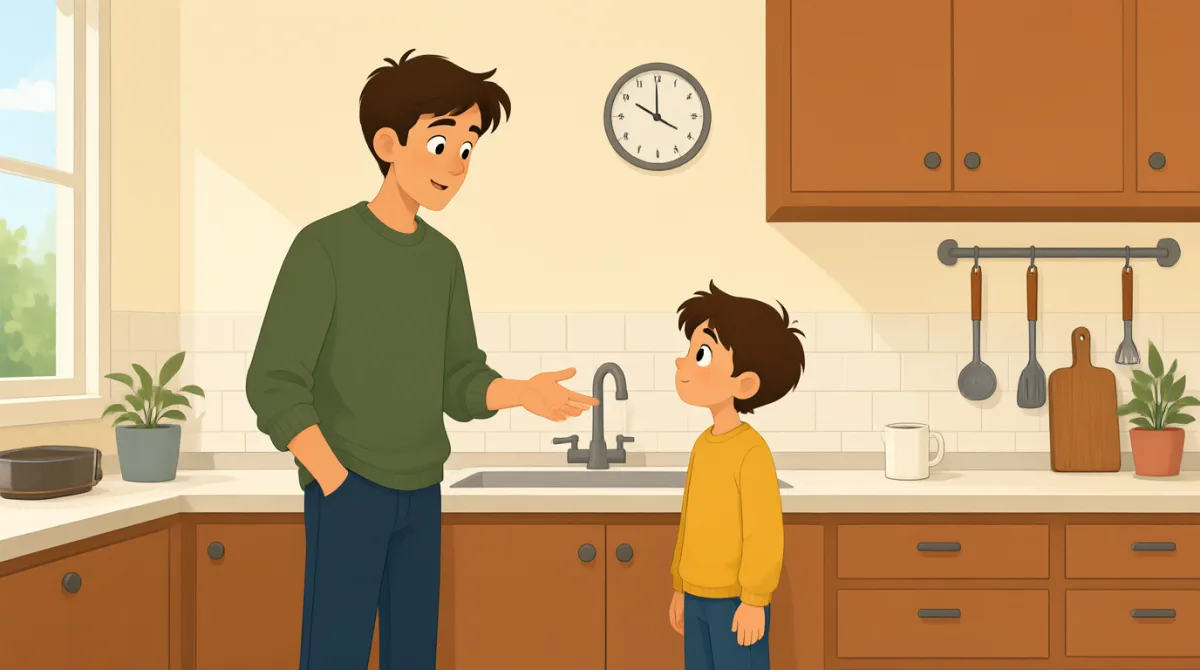

I found the problem. This pipe under the sink is loose.
J’ai trouvé le problème. Ce tuyau sous l’évier est desserré.

Is that why water was coming out onto the floor?
C’est pour ça que l’eau coulait sur le sol ?
Yes. Water leaks out when you turn on the tap.
Oui. L’eau fuit quand on ouvre le robinet.
Can you fix it today? I don’t want more water on the floor.
Vous pouvez le réparer aujourd’hui ? Je ne veux pas qu’il y ait encore de l’eau par terre.
Sure. I’ll tighten the pipe and check the other connections.
Bien sûr. Je vais resserrer le tuyau et vérifier les autres raccords.
How long will the repair take?
Combien de temps la réparation va-t-elle prendre ?
About thirty minutes, if nothing else is damaged.
Environ trente minutes, si rien d’autre n’est endommagé.
Great. Please tell me if you find another problem.
Très bien. Dites-moi, s’il vous plaît, si vous trouvez un autre problème.
Vocabulaire8
- under the sinksous l’évier
This means below the sink. Use it to say where a pipe or another object is located.
Cela signifie « en dessous de l’évier ». Cette expression sert à indiquer où se trouve un tuyau ou un autre objet.
- loosedesserré
Here, loose means not tight or firmly attached. A loose pipe can let water leak out.
Ici, « loose » signifie que quelque chose n’est pas serré ou bien fixé. Un tuyau desserré peut laisser fuir de l’eau.
- coming out onto the floorcouler sur le sol
This describes water moving from somewhere and spilling onto the floor. You can use “coming out” to describe something escaping from a container or pipe.
Cette expression décrit de l’eau qui sort de quelque part et se répand sur le sol. On peut utiliser “coming out” pour parler de quelque chose qui s’échappe d’un récipient ou d’un tuyau.
- turn on the tapouvrir le robinet
This means to start the flow of water by opening the tap. You can also say “turn on” for lights or machines.
Cela signifie faire couler l’eau en ouvrant le robinet. On peut aussi utiliser “turn on” pour allumer des lumières ou mettre des appareils en marche.
- fix it todayle réparer aujourd’hui
This means repair it today. Use “fix” to talk about repairing something that is broken or not working properly.
Cela signifie le réparer aujourd’hui. Utilisez “fix” pour parler de la réparation de quelque chose qui est cassé ou ne fonctionne pas correctement.
- tighten the piperesserrer le tuyau
This means make the pipe tight and secure. You can use “tighten” when something needs to be turned or fastened more firmly.
Cela signifie rendre le tuyau bien serré et solide. Vous pouvez utiliser “tighten” quand il faut tourner ou fixer quelque chose plus fermement.
- check the other connectionsvérifier les autres raccords
This means look at the other places where parts are joined to make sure they are secure. “Check” is a useful everyday verb for inspecting something.
Cela signifie examiner les autres endroits où des pièces sont assemblées pour s’assurer qu’ils tiennent bien. “Check” est un verbe courant et utile pour parler de la vérification de quelque chose.
- if nothing else is damagedsi rien d’autre n’est endommagé
This means the repair will take about thirty minutes as long as no other part is broken. Use “if” to explain a condition.
Cela signifie que la réparation prendra environ trente minutes, à condition qu’aucune autre pièce ne soit cassée. Utilisez “if” pour exprimer une condition.
Phrases clés8
- 1
I found the problem.
J’ai trouvé le problème.
This is a simple way to tell someone that you discovered what is wrong. You can reuse it when reporting the result of checking or investigating something.
C’est une façon simple de dire à quelqu’un que vous avez découvert ce qui ne va pas. Vous pouvez réutiliser cette phrase pour annoncer le résultat d’une vérification ou d’une enquête.
- 2
This pipe under the sink is loose.
Ce tuyau sous l’évier est desserré.
This sentence describes a problem and says where it is. Use “This [thing] is loose” to explain that something is not firmly attached.
Cette phrase décrit un problème et indique où il se trouve. Utilisez “This [thing] is loose” pour expliquer que quelque chose n’est pas bien fixé.
- 3
Is that why water was coming out onto the floor?
C’est pour ça que l’eau coulait sur le sol ?
Use this question to ask if one problem caused another. You can replace “water” and “coming out” with other things and actions.
Utilisez cette question pour demander si un problème en a causé un autre. Vous pouvez remplacer “water” et “coming out” par d’autres choses et actions.
- 4
Water leaks out when you turn on the tap.
L’eau fuit quand on ouvre le robinet.
This explains when the leak happens. Use “when you…” to describe what causes an event or when it occurs.
Cette phrase explique quand la fuite se produit. Utilisez “when you…” pour décrire ce qui provoque un événement ou le moment où il se produit.
- 5
Can you fix it today?
Vous pouvez le réparer aujourd’hui ?
This is a polite way to ask if someone can repair something today. You can replace “fix” with another task, such as “check” or “paint.”
C’est une façon polie de demander à quelqu’un s’il peut réparer quelque chose aujourd’hui. Vous pouvez remplacer “fix” par une autre tâche, comme “check” ou “paint.”
- 6
I’ll tighten the pipe and check the other connections.
Je vais resserrer le tuyau et vérifier les autres raccords.
This sentence explains what someone plans to do. Use “I’ll” followed by actions to describe a future plan or offer.
Cette phrase explique ce que quelqu’un prévoit de faire. Utilisez “I’ll” suivi d’actions pour exprimer un projet ou proposer de faire quelque chose.
- 7
About thirty minutes, if nothing else is damaged.
Environ trente minutes, si rien d’autre n’est endommagé.
This gives an approximate time and explains the condition that could affect it. You can use “About [time], if…” when estimating how long a task will take.
Cette phrase donne une durée approximative et précise la condition qui pourrait la modifier. Vous pouvez utiliser “About [time], if…” pour estimer combien de temps une tâche prendra.
- 8
Please tell me if you find another problem.
Dites-moi, s’il vous plaît, si vous trouvez un autre problème.
This is a polite way to ask someone to keep you informed. Use “Please tell me if…” to request an update when something happens.
C’est une façon polie de demander à quelqu’un de vous tenir au courant. Utilisez “Please tell me if…” pour demander à être informé si quelque chose se produit.