The Plumber Explains the Problem
Der Klempner erklärt das Problem
David checks the sink and explains that a loose pipe is causing the leak. He tells Jack what he needs to do and how long the repair will take.
David überprüft das Spülbecken und erklärt, dass ein lockeres Rohr das Leck verursacht. Er sagt Jack, was er tun muss und wie lange die Reparatur dauern wird.
Dialog8
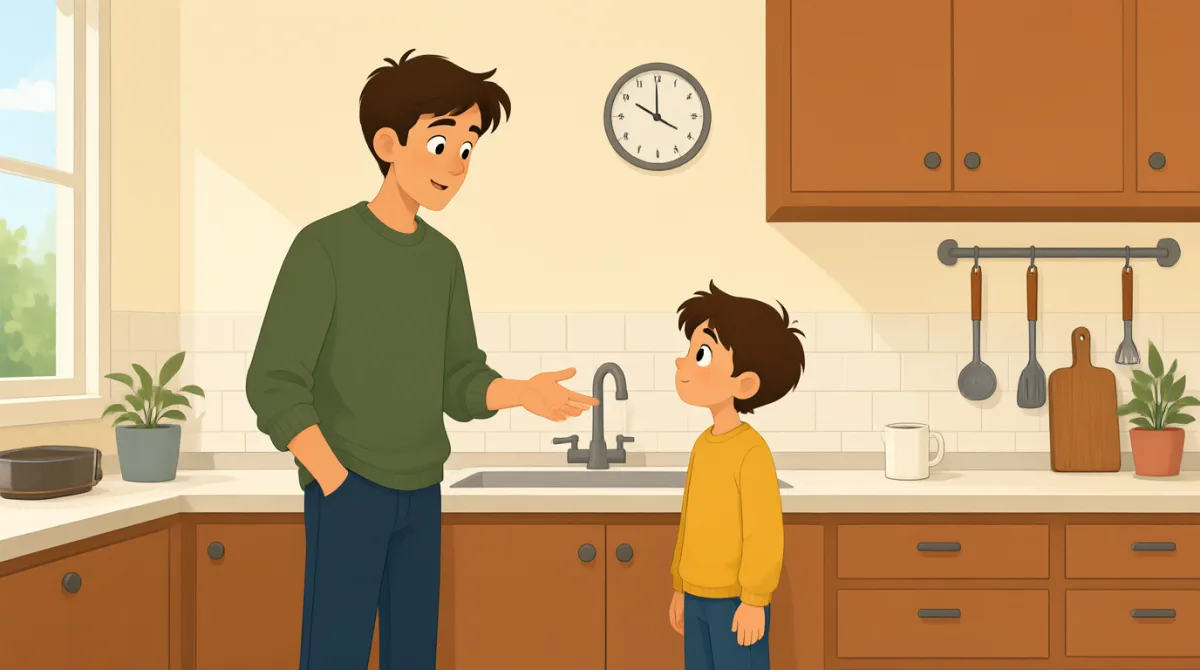

I found the problem. This pipe under the sink is loose.
Ich habe das Problem gefunden. Dieses Rohr unter dem Spülbecken ist locker.

Is that why water was coming out onto the floor?
Ist das der Grund, warum Wasser auf den Boden gelaufen ist?
Yes. Water leaks out when you turn on the tap.
Ja. Wasser tritt aus, wenn Sie den Wasserhahn aufdrehen.
Can you fix it today? I don’t want more water on the floor.
Können Sie das heute reparieren? Ich möchte nicht, dass noch mehr Wasser auf den Boden läuft.
Sure. I’ll tighten the pipe and check the other connections.
Natürlich. Ich ziehe das Rohr fest und überprüfe die anderen Anschlüsse.
How long will the repair take?
Wie lange dauert die Reparatur?
About thirty minutes, if nothing else is damaged.
Ungefähr dreißig Minuten, wenn sonst nichts beschädigt ist.
Great. Please tell me if you find another problem.
Gut. Sagen Sie mir bitte Bescheid, wenn Sie noch ein Problem finden.
Wortschatz8
- under the sinkunter dem Spülbecken
This means below the sink. Use it to say where a pipe or another object is located.
Das bedeutet, dass etwas unterhalb des Spülbeckens ist. Damit kannst du sagen, wo sich ein Rohr oder ein anderer Gegenstand befindet.
- looselocker
Here, loose means not tight or firmly attached. A loose pipe can let water leak out.
Hier bedeutet „loose“, dass etwas nicht fest sitzt oder befestigt ist. Durch ein lockeres Rohr kann Wasser austreten.
- coming out onto the floorauf den Boden laufen
This describes water moving from somewhere and spilling onto the floor. You can use “coming out” to describe something escaping from a container or pipe.
Damit wird beschrieben, wie Wasser von irgendwoher kommt und auf den Boden läuft. Du kannst „coming out“ verwenden, wenn etwas aus einem Behälter oder Rohr austritt.
- turn on the tapden Wasserhahn aufdrehen
This means to start the flow of water by opening the tap. You can also say “turn on” for lights or machines.
Das bedeutet, den Wasserhahn zu öffnen, damit Wasser fließt. „Turn on“ kannst du auch bei Lichtern oder Maschinen verwenden.
- fix it todayes heute reparieren
This means repair it today. Use “fix” to talk about repairing something that is broken or not working properly.
Das bedeutet, es noch heute zu reparieren. „Fix“ verwendest du, wenn etwas kaputt ist oder nicht richtig funktioniert und repariert werden muss.
- tighten the pipedas Rohr festziehen
This means make the pipe tight and secure. You can use “tighten” when something needs to be turned or fastened more firmly.
Das bedeutet, das Rohr fest und sicher zu befestigen. „Tighten“ kannst du verwenden, wenn etwas gedreht oder fester angezogen werden muss.
- check the other connectionsdie anderen Anschlüsse überprüfen
This means look at the other places where parts are joined to make sure they are secure. “Check” is a useful everyday verb for inspecting something.
Das bedeutet, die anderen Stellen anzusehen, an denen Teile miteinander verbunden sind, um sicherzugehen, dass alles fest sitzt. „Check“ ist ein nützliches Alltagsverb für „überprüfen“.
- if nothing else is damagedwenn sonst nichts beschädigt ist
This means the repair will take about thirty minutes as long as no other part is broken. Use “if” to explain a condition.
Das bedeutet, dass die Reparatur ungefähr dreißig Minuten dauert, sofern kein anderes Teil kaputt ist. Mit „if“ kannst du eine Bedingung ausdrücken.
Wichtige Sätze8
- 1
I found the problem.
Ich habe das Problem gefunden.
This is a simple way to tell someone that you discovered what is wrong. You can reuse it when reporting the result of checking or investigating something.
So kannst du jemandem einfach sagen, dass du herausgefunden hast, was nicht stimmt. Du kannst den Satz auch verwenden, wenn du das Ergebnis einer Überprüfung oder Untersuchung mitteilst.
- 2
This pipe under the sink is loose.
Dieses Rohr unter dem Spülbecken ist locker.
This sentence describes a problem and says where it is. Use “This [thing] is loose” to explain that something is not firmly attached.
Dieser Satz beschreibt ein Problem und sagt, wo es sich befindet. Mit „This [thing] is loose“ erklärst du, dass etwas nicht fest sitzt.
- 3
Is that why water was coming out onto the floor?
Ist das der Grund, warum Wasser auf den Boden gelaufen ist?
Use this question to ask if one problem caused another. You can replace “water” and “coming out” with other things and actions.
Mit dieser Frage möchtest du wissen, ob ein Problem ein anderes verursacht hat. Du kannst „water“ und „coming out“ durch andere Dinge und Vorgänge ersetzen.
- 4
Water leaks out when you turn on the tap.
Wasser tritt aus, wenn Sie den Wasserhahn aufdrehen.
This explains when the leak happens. Use “when you…” to describe what causes an event or when it occurs.
Dieser Satz erklärt, wann das Leck auftritt. Mit „when you…“ beschreibst du, wodurch etwas passiert oder wann es geschieht.
- 5
Can you fix it today?
Können Sie das heute reparieren?
This is a polite way to ask if someone can repair something today. You can replace “fix” with another task, such as “check” or “paint.”
So kannst du höflich fragen, ob jemand etwas heute reparieren kann. Du kannst „fix“ durch eine andere Tätigkeit ersetzen, zum Beispiel durch „check“ oder „paint“.
- 6
I’ll tighten the pipe and check the other connections.
Ich ziehe das Rohr fest und überprüfe die anderen Anschlüsse.
This sentence explains what someone plans to do. Use “I’ll” followed by actions to describe a future plan or offer.
Dieser Satz erklärt, was jemand vorhat. Auf „I’ll“ können Handlungen folgen, um einen zukünftigen Plan oder ein Angebot auszudrücken.
- 7
About thirty minutes, if nothing else is damaged.
Ungefähr dreißig Minuten, wenn sonst nichts beschädigt ist.
This gives an approximate time and explains the condition that could affect it. You can use “About [time], if…” when estimating how long a task will take.
Damit gibst du eine ungefähre Zeit an und erklärst, welche Bedingung sie beeinflussen könnte. Mit „About [time], if…“ kannst du schätzen, wie lange eine Aufgabe dauert.
- 8
Please tell me if you find another problem.
Sagen Sie mir bitte Bescheid, wenn Sie noch ein Problem finden.
This is a polite way to ask someone to keep you informed. Use “Please tell me if…” to request an update when something happens.
So kannst du höflich darum bitten, auf dem Laufenden gehalten zu werden. Mit „Please tell me if…“ bittest du um eine Nachricht, falls etwas passiert.