Calling the Plumber
Appeler le plombier
Jack calls plumber David and describes the leak. David asks a few simple questions to understand the problem.
Jack appelle David, le plombier, et lui décrit la fuite. David lui pose quelques questions simples pour comprendre le problème.
Dialogue9
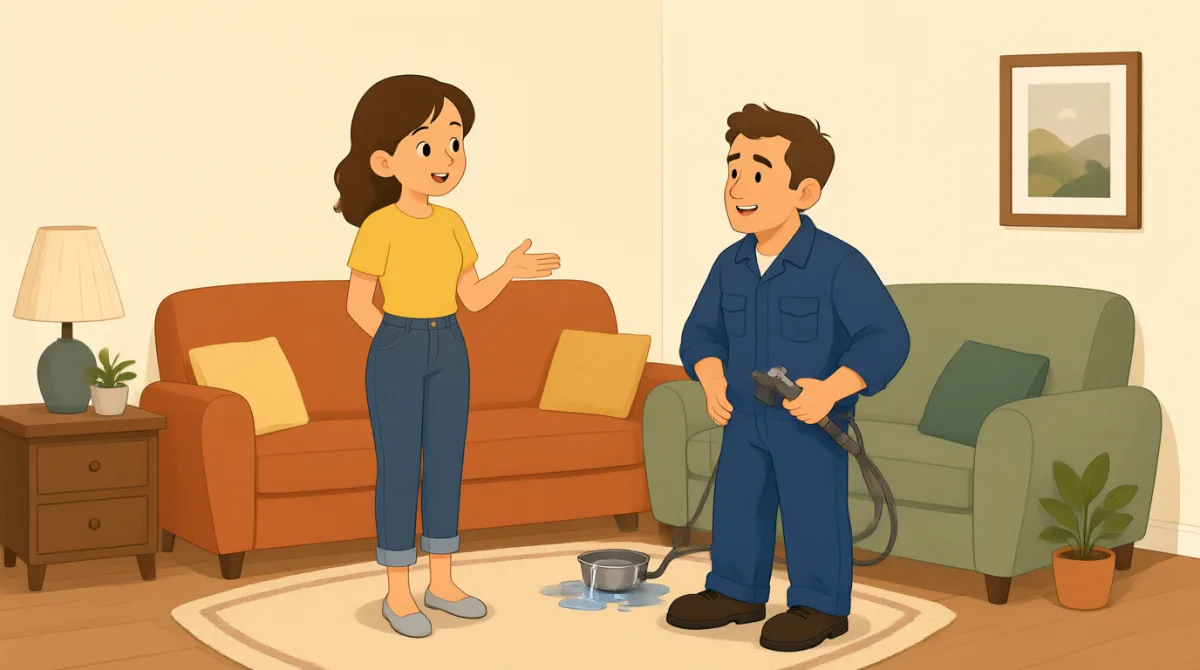

Hi, David. I’m calling about a leak under my kitchen sink.
Bonjour, David. Je vous appelle au sujet d’une fuite sous l’évier de ma cuisine.

I can help. When did you first notice the leak?
Je peux vous aider. Quand avez-vous remarqué la fuite pour la première fois ?
I saw water on the floor this morning. It’s still leaking.
J’ai vu de l’eau par terre ce matin. Ça fuit toujours.
Is the water coming from a pipe or the sink itself?
L’eau vient d’un tuyau ou de l’évier lui-même ?
I’m not sure. It looks like it’s coming from a pipe.
Je ne suis pas sûr. On dirait que ça vient d’un tuyau.
Is it a small leak, or is a lot of water coming out?
C’est une petite fuite ou beaucoup d’eau s’écoule ?
It’s a small leak, but the cabinet is getting wet.
C’est une petite fuite, mais le meuble sous l’évier est en train de prendre l’eau.
Can you turn off the water under the sink for now?
Pouvez-vous couper l’arrivée d’eau sous l’évier pour le moment ?
Yes, I can. I’ll turn it off now. Can you come take a look?
Oui, je peux. Je vais la couper tout de suite. Vous pouvez venir jeter un coup d’œil ?
Vocabulaire8
- a leakune fuite
A leak is water that escapes from a pipe or another place. Here, water is coming from under the kitchen sink.
Une fuite, c’est de l’eau qui s’échappe d’un tuyau ou d’un autre endroit. Ici, l’eau vient de sous l’évier de la cuisine.
- under my kitchen sinksous l’évier de ma cuisine
This phrase tells where the leak is. Use “under my [place]” to describe a location below something.
Cette expression indique où se trouve la fuite. Utilisez “under my [place]” pour parler d’un endroit situé sous quelque chose.
- notice the leakremarquer la fuite
To notice something means to see or become aware of it. Use “When did you first notice…?” to ask when someone became aware of a problem.
Remarquer quelque chose, c’est le voir ou en prendre conscience. Utilisez “When did you first notice…?” pour demander quand une personne a remarqué un problème.
- on the floorpar terre
This phrase describes where the water was. Use “on the floor” to talk about something lying or spilling on a floor.
Cette expression indique où se trouvait l’eau. Utilisez “on the floor” pour parler de quelque chose qui se trouve ou se renverse sur le sol.
- coming from a pipevenir d’un tuyau
This phrase describes the source of the water. You can use “coming from” to say where something is coming from.
Cette expression indique d’où vient l’eau. Vous pouvez utiliser “coming from” pour dire d’où vient quelque chose.
- a small leakune petite fuite
A small leak means only a little water is escaping. Use “small” to describe a problem that is not serious or large.
Une petite fuite signifie que seule une petite quantité d’eau s’échappe. Utilisez “small” pour décrire un problème qui n’est pas grave ou important.
- turn off the watercouper l’arrivée d’eau
To turn off the water means to stop it from flowing. Use “turn off” with a device or supply that can be stopped.
“Turn off the water” signifie arrêter l’écoulement de l’eau. Utilisez “turn off” avec un appareil ou une alimentation qu’on peut arrêter.
- take a lookjeter un coup d’œil
To take a look means to examine or check something. You can ask someone to “take a look” when you want them to inspect a problem.
“Take a look” signifie examiner ou vérifier quelque chose. Vous pouvez demander à quelqu’un de “take a look” pour qu’il vérifie un problème.
Phrases clés8
- 1
I’m calling about a leak under my kitchen sink.
Je vous appelle au sujet d’une fuite sous l’évier de ma cuisine.
This is a clear way to explain why you are calling. Replace “a leak under my kitchen sink” with the problem you need help with.
C’est une façon claire d’expliquer la raison de votre appel. Remplacez “a leak under my kitchen sink” par le problème pour lequel vous avez besoin d’aide.
- 2
When did you first notice the leak?
Quand avez-vous remarqué la fuite pour la première fois ?
This question asks when someone first became aware of a problem. You can use “When did you first notice…?” to ask about other issues too.
Cette question demande quand une personne a pris conscience d’un problème pour la première fois. Vous pouvez aussi utiliser “When did you first notice…?” pour parler d’autres problèmes.
- 3
I saw water on the floor this morning.
J’ai vu de l’eau par terre ce matin.
This sentence describes what you saw and when you saw it. Use “I saw [something] [time]” to report what happened.
Cette phrase décrit ce que vous avez vu et quand vous l’avez vu. Utilisez “I saw [something] [time]” pour raconter ce qui s’est passé.
- 4
Is the water coming from a pipe or the sink itself?
L’eau vient-elle d’un tuyau ou de l’évier lui-même ?
This question asks someone to choose between two possible sources. Use “Is it coming from… or…?” when trying to identify a problem.
Cette question demande à quelqu’un de choisir entre deux sources possibles. Utilisez “Is it coming from… or…?” pour essayer d’identifier un problème.
- 5
I’m not sure.
Je ne suis pas sûr.
This is a simple way to say you do not know the answer. You can use it before giving your best guess or asking for help.
C’est une façon simple de dire que vous ne connaissez pas la réponse. Vous pouvez l’utiliser avant de donner votre meilleure hypothèse ou de demander de l’aide.
- 6
It’s a small leak, but the cabinet is getting wet.
C’est une petite fuite, mais le meuble sous l’évier est en train de prendre l’eau.
This sentence describes the problem and adds a detail with “but.” Use “It’s…, but…” to explain a contrast.
Cette phrase décrit le problème et ajoute un détail avec “but”. Utilisez “It’s…, but…” pour exprimer un contraste.
- 7
Can you turn off the water under the sink for now?
Pouvez-vous couper l’arrivée d’eau sous l’évier pour le moment ?
This is a polite way to ask someone to stop the water temporarily. Use “Can you… for now?” to request a short-term action.
C’est une façon polie de demander à quelqu’un d’arrêter temporairement l’arrivée d’eau. Utilisez “Can you… for now?” pour demander une action provisoire.
- 8
Can you come take a look?
Vous pouvez venir jeter un coup d’œil ?
This is a natural way to ask someone to come and check a problem. Use “Can you come take a look?” when you need someone to inspect something.
C’est une façon naturelle de demander à quelqu’un de venir vérifier un problème. Utilisez “Can you come take a look?” quand vous avez besoin que quelqu’un examine quelque chose.