Calling the Plumber
Den Klempner anrufen
Jack calls plumber David and describes the leak. David asks a few simple questions to understand the problem.
Jack ruft den Klempner David an und beschreibt das Leck. David stellt ein paar einfache Fragen, um das Problem besser zu verstehen.
Dialog9
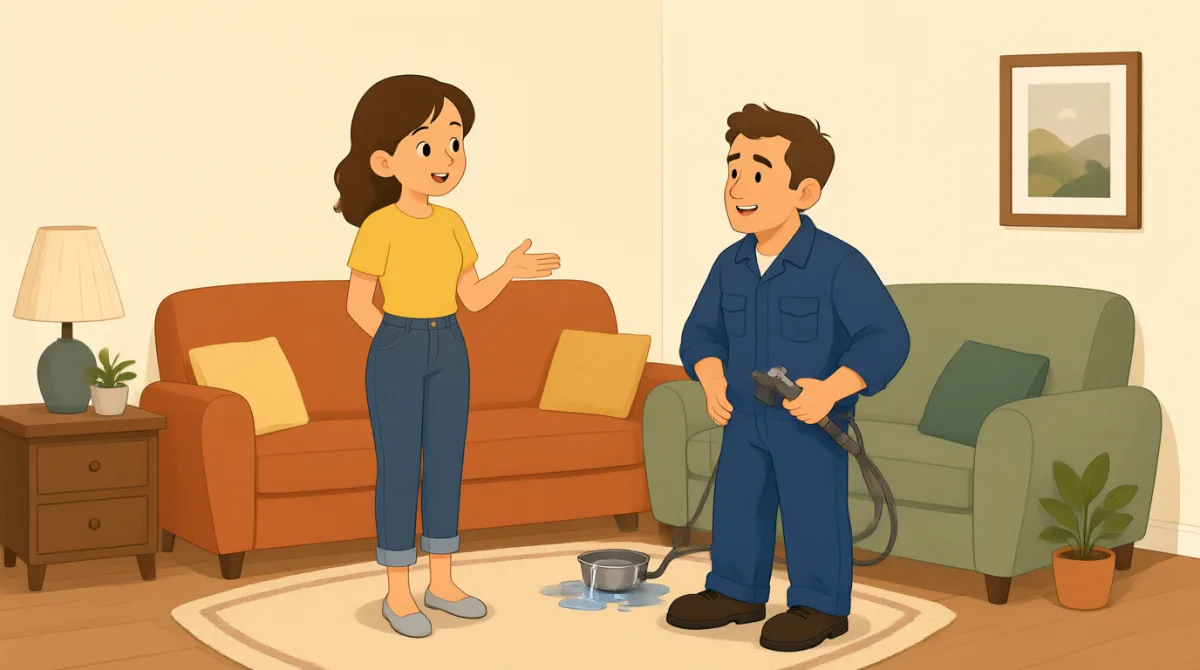

Hi, David. I’m calling about a leak under my kitchen sink.
Hallo, David. Ich rufe wegen eines Lecks unter meiner Küchenspüle an.

I can help. When did you first notice the leak?
Ich kann Ihnen helfen. Wann ist Ihnen das Leck zum ersten Mal aufgefallen?
I saw water on the floor this morning. It’s still leaking.
Heute Morgen habe ich Wasser auf dem Boden gesehen. Es läuft immer noch aus.
Is the water coming from a pipe or the sink itself?
Kommt das Wasser aus einem Rohr oder direkt aus der Spüle?
I’m not sure. It looks like it’s coming from a pipe.
Ich bin mir nicht sicher. Es sieht so aus, als käme es aus einem Rohr.
Is it a small leak, or is a lot of water coming out?
Ist es ein kleines Leck, oder läuft viel Wasser heraus?
It’s a small leak, but the cabinet is getting wet.
Es ist ein kleines Leck, aber der Schrank wird nass.
Can you turn off the water under the sink for now?
Können Sie vorerst das Wasser unter der Spüle abstellen?
Yes, I can. I’ll turn it off now. Can you come take a look?
Ja, das kann ich. Ich stelle es jetzt ab. Können Sie vorbeikommen und sich das ansehen?
Wortschatz8
- a leakein Leck
A leak is water that escapes from a pipe or another place. Here, water is coming from under the kitchen sink.
Ein „leak“ ist Wasser, das aus einem Rohr oder einer anderen Stelle austritt. Hier kommt das Wasser unter der Küchenspüle hervor.
- under my kitchen sinkunter meiner Küchenspüle
This phrase tells where the leak is. Use “under my [place]” to describe a location below something.
Diese Wendung sagt, wo sich das Leck befindet. Mit „under my [place]“ beschreibst du einen Ort unter etwas.
- notice the leakdas Leck bemerken
To notice something means to see or become aware of it. Use “When did you first notice…?” to ask when someone became aware of a problem.
„To notice“ bedeutet, etwas zu sehen oder darauf aufmerksam zu werden. Mit „When did you first notice…?“ fragst du, wann jemand ein Problem zum ersten Mal bemerkt hat.
- on the floorauf dem Boden
This phrase describes where the water was. Use “on the floor” to talk about something lying or spilling on a floor.
Diese Wendung beschreibt, wo das Wasser war. Mit „on the floor“ sprichst du über etwas, das auf dem Boden liegt oder darauf verschüttet wurde.
- coming from a pipeaus einem Rohr kommen
This phrase describes the source of the water. You can use “coming from” to say where something is coming from.
Diese Wendung beschreibt, woher das Wasser kommt. Mit „coming from“ kannst du sagen, woher etwas kommt.
- a small leakein kleines Leck
A small leak means only a little water is escaping. Use “small” to describe a problem that is not serious or large.
Ein „small leak“ bedeutet, dass nur wenig Wasser austritt. Mit „small“ beschreibst du ein Problem, das nicht schwerwiegend oder groß ist.
- turn off the waterdas Wasser abstellen
To turn off the water means to stop it from flowing. Use “turn off” with a device or supply that can be stopped.
„To turn off the water“ bedeutet, den Wasserfluss zu stoppen. „Turn off“ verwendest du bei einem Gerät oder einer Versorgung, die man abstellen kann.
- take a looksich etwas ansehen
To take a look means to examine or check something. You can ask someone to “take a look” when you want them to inspect a problem.
„To take a look“ bedeutet, etwas zu untersuchen oder zu überprüfen. Du kannst jemanden bitten, „take a look“, wenn die Person ein Problem begutachten soll.
Wichtige Sätze8
- 1
I’m calling about a leak under my kitchen sink.
Ich rufe wegen eines Lecks unter meiner Küchenspüle an.
This is a clear way to explain why you are calling. Replace “a leak under my kitchen sink” with the problem you need help with.
So kannst du klar erklären, warum du anrufst. Ersetze „a leak under my kitchen sink“ durch das Problem, bei dem du Hilfe brauchst.
- 2
When did you first notice the leak?
Wann ist Ihnen das Leck zum ersten Mal aufgefallen?
This question asks when someone first became aware of a problem. You can use “When did you first notice…?” to ask about other issues too.
Mit dieser Frage fragst du, wann jemand ein Problem zum ersten Mal bemerkt hat. Mit „When did you first notice…?“ kannst du auch nach anderen Problemen fragen.
- 3
I saw water on the floor this morning.
Heute Morgen habe ich Wasser auf dem Boden gesehen.
This sentence describes what you saw and when you saw it. Use “I saw [something] [time]” to report what happened.
Dieser Satz beschreibt, was du gesehen hast und wann du es gesehen hast. Mit „I saw [something] [time]“ erzählst du, was passiert ist.
- 4
Is the water coming from a pipe or the sink itself?
Kommt das Wasser aus einem Rohr oder direkt aus der Spüle?
This question asks someone to choose between two possible sources. Use “Is it coming from… or…?” when trying to identify a problem.
Mit dieser Frage bittest du jemanden, zwischen zwei möglichen Ursachen zu wählen. Mit „Is it coming from… or…?“ versuchst du, die Ursache eines Problems herauszufinden.
- 5
I’m not sure.
Ich bin mir nicht sicher.
This is a simple way to say you do not know the answer. You can use it before giving your best guess or asking for help.
So kannst du einfach sagen, dass du die Antwort nicht weißt. Du kannst den Satz verwenden, bevor du deine Vermutung äußerst oder um Hilfe bittest.
- 6
It’s a small leak, but the cabinet is getting wet.
Es ist ein kleines Leck, aber der Schrank wird nass.
This sentence describes the problem and adds a detail with “but.” Use “It’s…, but…” to explain a contrast.
Dieser Satz beschreibt das Problem und fügt mit „but“ ein weiteres Detail hinzu. Mit „It’s…, but…“ kannst du einen Gegensatz ausdrücken.
- 7
Can you turn off the water under the sink for now?
Können Sie vorerst das Wasser unter der Spüle abstellen?
This is a polite way to ask someone to stop the water temporarily. Use “Can you… for now?” to request a short-term action.
So bittest du höflich darum, das Wasser vorübergehend abzustellen. Mit „Can you… for now?“ bittest du um etwas, das nur für kurze Zeit gelten soll.
- 8
Can you come take a look?
Können Sie vorbeikommen und sich das ansehen?
This is a natural way to ask someone to come and check a problem. Use “Can you come take a look?” when you need someone to inspect something.
So bittest du auf natürliche Weise jemanden, vorbeizukommen und ein Problem zu überprüfen. Verwende „Can you come take a look?“, wenn jemand etwas begutachten soll.