Calling the Plumber
Tesisatçıyı Aramak
Jack calls plumber David and describes the leak. David asks a few simple questions to understand the problem.
Jack tesisatçı David’i arayıp sızıntıyı anlatır. David, sorunu anlamak için birkaç basit soru sorar.
Diyalog9
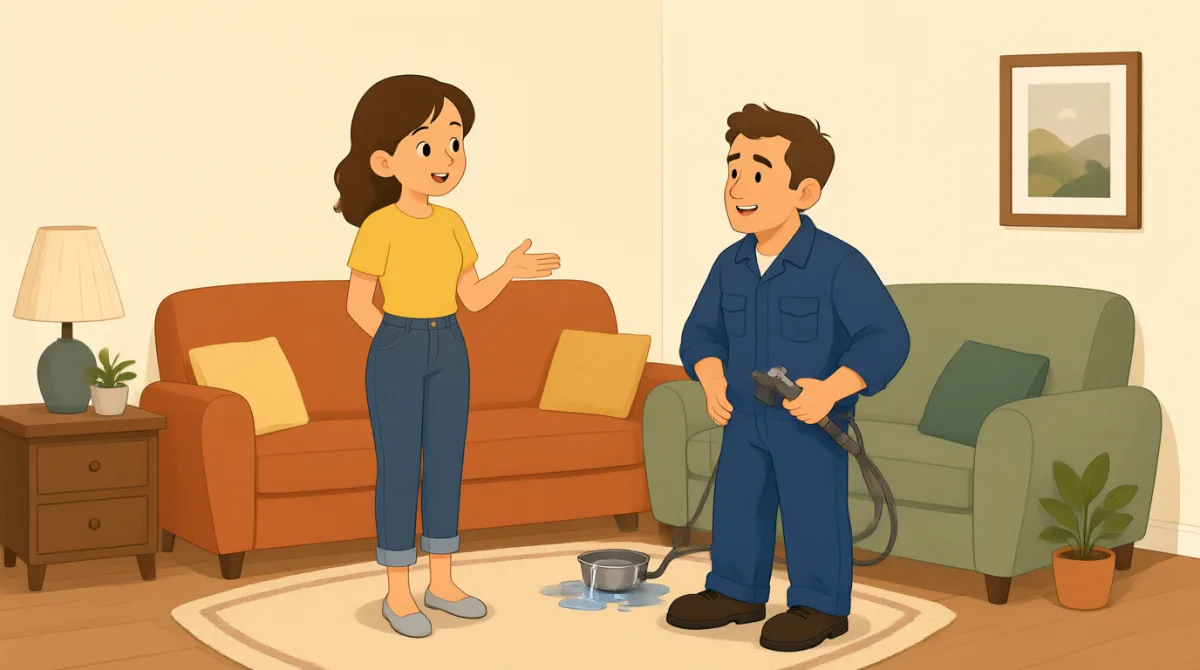

Hi, David. I’m calling about a leak under my kitchen sink.
Merhaba David. Mutfağımın evyesinin altındaki sızıntı için arıyorum.

I can help. When did you first notice the leak?
Yardımcı olabilirim. Sızıntıyı ilk ne zaman fark ettiniz?
I saw water on the floor this morning. It’s still leaking.
Bu sabah yerde su gördüm. Hâlâ sızıyor.
Is the water coming from a pipe or the sink itself?
Su bir borudan mı geliyor, yoksa doğrudan evyenin kendisinden mi?
I’m not sure. It looks like it’s coming from a pipe.
Emin değilim. Bir borudan geliyor gibi görünüyor.
Is it a small leak, or is a lot of water coming out?
Sızıntı az mı, yoksa çok su mu geliyor?
It’s a small leak, but the cabinet is getting wet.
Sızıntı az ama dolap ıslanıyor.
Can you turn off the water under the sink for now?
Şimdilik evyenin altındaki suyu kapatabilir misiniz?
Yes, I can. I’ll turn it off now. Can you come take a look?
Evet, kapatabilirim. Şimdi kapatacağım. Gelip bir bakabilir misiniz?
Kelime Bilgisi8
- a leaksızıntı
A leak is water that escapes from a pipe or another place. Here, water is coming from under the kitchen sink.
Sızıntı, bir borudan ya da başka bir yerden kaçan sudur. Burada su mutfak evyesinin altından geliyor.
- under my kitchen sinkmutfak evyemin altında
This phrase tells where the leak is. Use “under my [place]” to describe a location below something.
Bu ifade sızıntının nerede olduğunu belirtir. Bir şeyin altındaki konumu anlatmak için “under my [place]” kalıbını kullanabilirsiniz.
- notice the leaksızıntıyı fark etmek
To notice something means to see or become aware of it. Use “When did you first notice…?” to ask when someone became aware of a problem.
Bir şeyi fark etmek, onu görmek ya da varlığından haberdar olmak demektir. Birinin bir sorunu ne zaman fark ettiğini sormak için “When did you first notice…?” kalıbını kullanabilirsiniz.
- on the flooryerde
This phrase describes where the water was. Use “on the floor” to talk about something lying or spilling on a floor.
Bu ifade suyun nerede olduğunu anlatır. Yerde duran ya da yere dökülen bir şeyden söz ederken “on the floor” ifadesini kullanabilirsiniz.
- coming from a pipebir borudan geliyor
This phrase describes the source of the water. You can use “coming from” to say where something is coming from.
Bu ifade suyun kaynağını anlatır. Bir şeyin nereden geldiğini söylemek için “coming from” kalıbını kullanabilirsiniz.
- a small leakküçük bir sızıntı
A small leak means only a little water is escaping. Use “small” to describe a problem that is not serious or large.
“A small leak”, yalnızca az miktarda suyun sızdığı anlamına gelir. Ciddi ya da büyük olmayan bir sorunu anlatmak için “small” kelimesini kullanabilirsiniz.
- turn off the watersuyu kapatmak
To turn off the water means to stop it from flowing. Use “turn off” with a device or supply that can be stopped.
Suyu kapatmak, suyun akmasını durdurmak demektir. Durdurulabilen bir cihaz ya da su kaynağından söz ederken “turn off” kullanılır.
- take a lookbir göz atmak
To take a look means to examine or check something. You can ask someone to “take a look” when you want them to inspect a problem.
Bir şeye göz atmak, onu incelemek ya da kontrol etmek demektir. Birinden bir sorunu incelemesini isterken “take a look” diyebilirsiniz.
Önemli Cümleler8
- 1
I’m calling about a leak under my kitchen sink.
Mutfağımın evyesinin altındaki bir sızıntı için arıyorum.
This is a clear way to explain why you are calling. Replace “a leak under my kitchen sink” with the problem you need help with.
Arama nedeninizi açıklamanın açık bir yoludur. Yardıma ihtiyaç duyduğunuz sorunu belirtmek için “a leak under my kitchen sink” ifadesinin yerine başka bir sorun yazabilirsiniz.
- 2
When did you first notice the leak?
Sızıntıyı ilk ne zaman fark ettiniz?
This question asks when someone first became aware of a problem. You can use “When did you first notice…?” to ask about other issues too.
Bu soru, birinin bir sorundan ilk ne zaman haberdar olduğunu sorar. Başka sorunların ne zaman fark edildiğini sormak için de “When did you first notice…?” kalıbını kullanabilirsiniz.
- 3
I saw water on the floor this morning.
Bu sabah yerde su gördüm.
This sentence describes what you saw and when you saw it. Use “I saw [something] [time]” to report what happened.
Bu cümle ne gördüğünüzü ve ne zaman gördüğünüzü anlatır. Olanları aktarmak için “I saw [something] [time]” kalıbını kullanabilirsiniz.
- 4
Is the water coming from a pipe or the sink itself?
Su bir borudan mı geliyor, yoksa doğrudan evyenin kendisinden mi?
This question asks someone to choose between two possible sources. Use “Is it coming from… or…?” when trying to identify a problem.
Bu soru, birinden iki olası kaynaktan birini seçmesini ister. Bir sorunun kaynağını belirlemeye çalışırken “Is it coming from… or…?” kalıbını kullanabilirsiniz.
- 5
I’m not sure.
Emin değilim.
This is a simple way to say you do not know the answer. You can use it before giving your best guess or asking for help.
Bu, cevabı bilmediğinizi söylemenin basit bir yoludur. Tahmininizi belirtmeden ya da yardım istemeden önce kullanabilirsiniz.
- 6
It’s a small leak, but the cabinet is getting wet.
Sızıntı az ama dolap ıslanıyor.
This sentence describes the problem and adds a detail with “but.” Use “It’s…, but…” to explain a contrast.
Bu cümle sorunu anlatır ve “but” ile ek bir ayrıntı verir. Bir karşıtlığı açıklamak için “It’s…, but…” kalıbını kullanabilirsiniz.
- 7
Can you turn off the water under the sink for now?
Şimdilik evyenin altındaki suyu kapatabilir misiniz?
This is a polite way to ask someone to stop the water temporarily. Use “Can you… for now?” to request a short-term action.
Bu, birinden suyu geçici olarak kesmesini kibarca istemenin bir yoludur. Kısa süreli bir eylem rica etmek için “Can you… for now?” kalıbını kullanabilirsiniz.
- 8
Can you come take a look?
Gelip bir bakabilir misiniz?
This is a natural way to ask someone to come and check a problem. Use “Can you come take a look?” when you need someone to inspect something.
Bu, birinden gelip bir sorunu kontrol etmesini istemenin doğal bir yoludur. Birinin bir şeyi incelemesine ihtiyaç duyduğunuzda “Can you come take a look?” diyebilirsiniz.