Calling the Plumber
Llamar al plomero
Jack calls plumber David and describes the leak. David asks a few simple questions to understand the problem.
Jack llama al plomero David y le describe la fuga. David le hace algunas preguntas sencillas para entender el problema.
Diálogo9
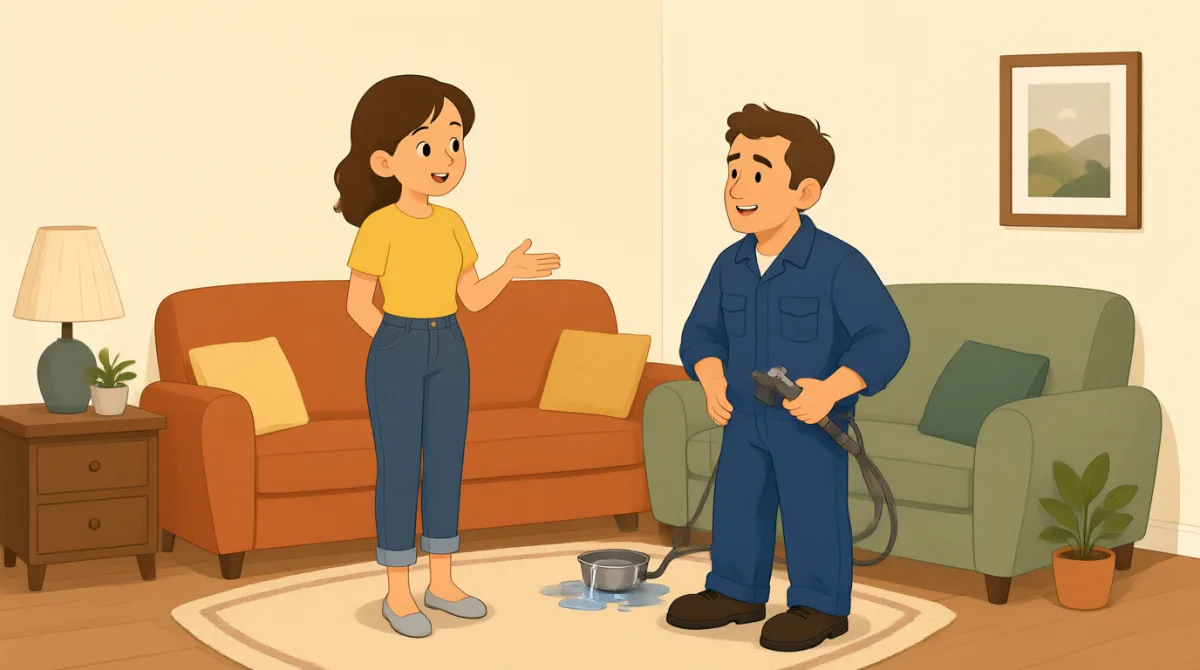

Hi, David. I’m calling about a leak under my kitchen sink.
Hola, David. Te llamo porque tengo una fuga debajo del fregadero de la cocina.

I can help. When did you first notice the leak?
Puedo ayudarte. ¿Cuándo notaste la fuga por primera vez?
I saw water on the floor this morning. It’s still leaking.
Vi agua en el suelo esta mañana. Sigue goteando.
Is the water coming from a pipe or the sink itself?
¿El agua sale de una tubería o del fregadero mismo?
I’m not sure. It looks like it’s coming from a pipe.
No estoy seguro. Parece que sale de una tubería.
Is it a small leak, or is a lot of water coming out?
¿Es una fuga pequeña o sale mucha agua?
It’s a small leak, but the cabinet is getting wet.
Es una fuga pequeña, pero el mueble se está mojando.
Can you turn off the water under the sink for now?
¿Puedes cerrar el agua debajo del fregadero por ahora?
Yes, I can. I’ll turn it off now. Can you come take a look?
Sí, puedo. La voy a cerrar ahora. ¿Puedes venir a echarle un vistazo?
Vocabulario8
- a leakuna fuga
A leak is water that escapes from a pipe or another place. Here, water is coming from under the kitchen sink.
Una fuga ocurre cuando el agua se escapa de una tubería o de otro lugar. En este caso, el agua sale de debajo del fregadero de la cocina.
- under my kitchen sinkdebajo del fregadero de mi cocina
This phrase tells where the leak is. Use “under my [place]” to describe a location below something.
Esta expresión indica dónde está la fuga. Usa “under my [place]” para describir algo que está debajo de un lugar.
- notice the leaknotar la fuga
To notice something means to see or become aware of it. Use “When did you first notice…?” to ask when someone became aware of a problem.
“To notice” significa ver algo o darse cuenta de ello. Usa “When did you first notice…?” para preguntar cuándo alguien se dio cuenta de un problema.
- on the flooren el suelo
This phrase describes where the water was. Use “on the floor” to talk about something lying or spilling on a floor.
Esta expresión indica dónde estaba el agua. Usa “on the floor” para hablar de algo que está en el suelo o se ha derramado sobre él.
- coming from a pipesalir de una tubería
This phrase describes the source of the water. You can use “coming from” to say where something is coming from.
Esta expresión describe de dónde viene el agua. Puedes usar “coming from” para decir de dónde viene algo.
- a small leakuna fuga pequeña
A small leak means only a little water is escaping. Use “small” to describe a problem that is not serious or large.
Una fuga pequeña significa que se escapa poca agua. Usa “small” para describir un problema que no es grave ni grande.
- turn off the watercerrar el agua
To turn off the water means to stop it from flowing. Use “turn off” with a device or supply that can be stopped.
“To turn off the water” significa detener el flujo de agua. Usa “turn off” con un aparato o suministro que se pueda apagar o cerrar.
- take a lookechar un vistazo
To take a look means to examine or check something. You can ask someone to “take a look” when you want them to inspect a problem.
“To take a look” significa examinar o revisar algo. Puedes pedirle a alguien que “take a look” cuando quieras que inspeccione un problema.
Frases clave8
- 1
I’m calling about a leak under my kitchen sink.
Te llamo porque tengo una fuga debajo del fregadero de la cocina.
This is a clear way to explain why you are calling. Replace “a leak under my kitchen sink” with the problem you need help with.
Esta es una forma clara de explicar por qué llamas. Sustituye “a leak under my kitchen sink” por el problema con el que necesitas ayuda.
- 2
When did you first notice the leak?
¿Cuándo notaste la fuga por primera vez?
This question asks when someone first became aware of a problem. You can use “When did you first notice…?” to ask about other issues too.
Esta pregunta sirve para saber cuándo alguien se dio cuenta de un problema por primera vez. También puedes usar “When did you first notice…?” para preguntar por otros problemas.
- 3
I saw water on the floor this morning.
Vi agua en el suelo esta mañana.
This sentence describes what you saw and when you saw it. Use “I saw [something] [time]” to report what happened.
Esta frase describe qué viste y cuándo lo viste. Usa “I saw [something] [time]” para contar lo que pasó.
- 4
Is the water coming from a pipe or the sink itself?
¿El agua sale de una tubería o del fregadero mismo?
This question asks someone to choose between two possible sources. Use “Is it coming from… or…?” when trying to identify a problem.
Esta pregunta pide elegir entre dos posibles fuentes. Usa “Is it coming from… or…?” cuando intentas averiguar cuál es el origen de un problema.
- 5
I’m not sure.
No estoy seguro.
This is a simple way to say you do not know the answer. You can use it before giving your best guess or asking for help.
Esta es una forma sencilla de decir que no sabes la respuesta. Puedes usarla antes de dar tu mejor idea o pedir ayuda.
- 6
It’s a small leak, but the cabinet is getting wet.
Es una fuga pequeña, pero el mueble se está mojando.
This sentence describes the problem and adds a detail with “but.” Use “It’s…, but…” to explain a contrast.
Esta frase describe el problema y añade un detalle con “but”. Usa “It’s…, but…” para explicar un contraste.
- 7
Can you turn off the water under the sink for now?
¿Puedes cerrar el agua debajo del fregadero por ahora?
This is a polite way to ask someone to stop the water temporarily. Use “Can you… for now?” to request a short-term action.
Esta es una forma educada de pedirle a alguien que detenga el agua temporalmente. Usa “Can you… for now?” para pedir que haga algo durante un tiempo.
- 8
Can you come take a look?
¿Puedes venir a echarle un vistazo?
This is a natural way to ask someone to come and check a problem. Use “Can you come take a look?” when you need someone to inspect something.
Esta es una forma natural de pedirle a alguien que venga a revisar un problema. Usa “Can you come take a look?” cuando necesites que alguien inspeccione algo.