Calling the Plumber
打电话给水管工
Jack calls plumber David and describes the leak. David asks a few simple questions to understand the problem.
Jack打电话给水管工David,描述漏水情况。David问了几个简单的问题来了解问题。
对话9
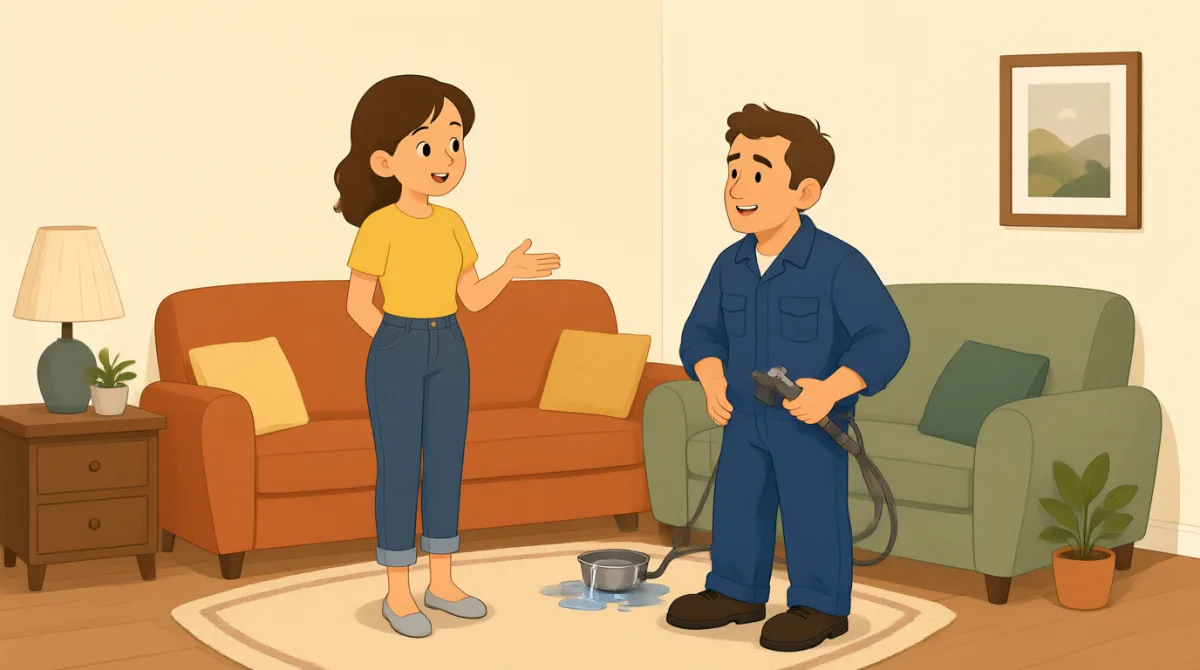

Hi, David. I’m calling about a leak under my kitchen sink.
你好,戴维。我打电话是想说一下我家厨房水槽下面漏水了。

I can help. When did you first notice the leak?
我可以帮你。你是什么时候发现漏水的?
I saw water on the floor this morning. It’s still leaking.
我今天早上看到地上有水。现在还在漏。
Is the water coming from a pipe or the sink itself?
水是从水管漏出来的,还是从水槽本身漏出来的?
I’m not sure. It looks like it’s coming from a pipe.
我不太确定。看起来像是从一根水管漏出来的。
Is it a small leak, or is a lot of water coming out?
漏得严重吗?是少量漏水,还是有很多水流出来?
It’s a small leak, but the cabinet is getting wet.
漏得不多,但橱柜里面已经湿了。
Can you turn off the water under the sink for now?
你现在能先把水槽下面的水阀关掉吗?
Yes, I can. I’ll turn it off now. Can you come take a look?
可以,我现在就把水阀关掉。你能过来看看吗?
词汇8
- a leak漏水
A leak is water that escapes from a pipe or another place. Here, water is coming from under the kitchen sink.
“Leak”指水从水管或其他地方漏出来。这里是指水从厨房水槽下面漏出来。
- under my kitchen sink我家厨房水槽下面
This phrase tells where the leak is. Use “under my [place]” to describe a location below something.
这个短语说明漏水的位置。可以用“under my [place]”来描述某个地方的下方。
- notice the leak发现漏水
To notice something means to see or become aware of it. Use “When did you first notice…?” to ask when someone became aware of a problem.
“Notice something”指看到或察觉到某件事。可以用“When did you first notice…?”来询问某人是什么时候发现问题的。
- on the floor在地上
This phrase describes where the water was. Use “on the floor” to talk about something lying or spilling on a floor.
这个短语说明水在哪里。可以用“on the floor”来描述某物在地板上或洒在地上。
- coming from a pipe从水管里漏出来
This phrase describes the source of the water. You can use “coming from” to say where something is coming from.
这个短语说明水的来源。可以用“coming from”来说明某物是从哪里来的。
- a small leak少量漏水
A small leak means only a little water is escaping. Use “small” to describe a problem that is not serious or large.
“A small leak”指只有少量水漏出来。可以用“small”来形容不严重或规模不大的问题。
- turn off the water关掉水
To turn off the water means to stop it from flowing. Use “turn off” with a device or supply that can be stopped.
“Turn off the water”指让水停止流动。可以用“turn off”搭配能够关闭或停止供应的设备或供给。
- take a look看一看
To take a look means to examine or check something. You can ask someone to “take a look” when you want them to inspect a problem.
“Take a look”指检查或查看某样东西。想请别人检查问题时,可以请对方“take a look”。
重点句子8
- 1
I’m calling about a leak under my kitchen sink.
我打电话是想说一下我家厨房水槽下面漏水了。
This is a clear way to explain why you are calling. Replace “a leak under my kitchen sink” with the problem you need help with.
这是清楚说明打电话原因的说法。可以把“a leak under my kitchen sink”换成你需要帮助解决的问题。
- 2
When did you first notice the leak?
你是什么时候发现漏水的?
This question asks when someone first became aware of a problem. You can use “When did you first notice…?” to ask about other issues too.
这个问题是在问某人最早什么时候发现了问题。也可以用“When did you first notice…?”来询问其他问题。
- 3
I saw water on the floor this morning.
我今天早上看到地上有水。
This sentence describes what you saw and when you saw it. Use “I saw [something] [time]” to report what happened.
这句话说明你看到了什么,以及是什么时候看到的。可以用“I saw [something] [time]”来描述发生的事情。
- 4
Is the water coming from a pipe or the sink itself?
水是从水管漏出来的,还是从水槽本身漏出来的?
This question asks someone to choose between two possible sources. Use “Is it coming from… or…?” when trying to identify a problem.
这个问题让对方在两个可能的来源中做出选择。想查明问题时,可以用“Is it coming from… or…?”来询问。
- 5
I’m not sure.
我不太确定。
This is a simple way to say you do not know the answer. You can use it before giving your best guess or asking for help.
这是简单表达自己不知道答案的说法。你可以先这么说,再给出自己的猜测,或向别人求助。
- 6
It’s a small leak, but the cabinet is getting wet.
漏得不多,但橱柜里面已经湿了。
This sentence describes the problem and adds a detail with “but.” Use “It’s…, but…” to explain a contrast.
这句话先描述问题,再用“but”补充一个细节。可以用“It’s…, but…”来表达转折。
- 7
Can you turn off the water under the sink for now?
你现在能先把水槽下面的水阀关掉吗?
This is a polite way to ask someone to stop the water temporarily. Use “Can you… for now?” to request a short-term action.
这是一种礼貌地请对方暂时关掉水的说法。可以用“Can you… for now?”来请求对方暂时采取某个行动。
- 8
Can you come take a look?
你能过来看看吗?
This is a natural way to ask someone to come and check a problem. Use “Can you come take a look?” when you need someone to inspect something.
这是请别人过来检查问题的自然说法。需要别人检查某样东西时,可以用“Can you come take a look?”。