Checking In at the Clinic
Anmeldung in der Klinik
Leo arrives at a clinic and checks in with the receptionist. He gives his name and explains that he has a cold.
Leo kommt in einer Klinik an und meldet sich am Empfang an. Er nennt seinen Namen und erklärt, dass er erkältet ist.
Dialog8
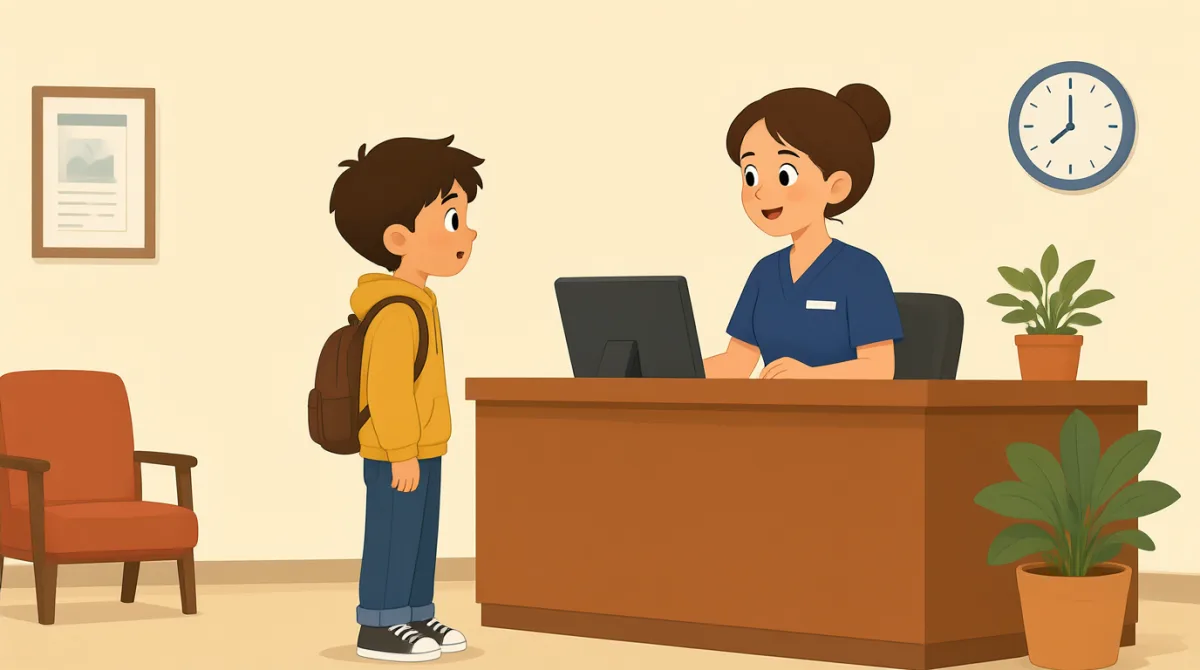

Good morning. I’m here because I have a bad cold.
Guten Morgen. Ich bin hier, weil ich eine starke Erkältung habe.

Good morning. Do you have an appointment today?
Guten Morgen. Haben Sie heute einen Termin?
Yes, I have an appointment at ten o’clock.
Ja, ich habe um zehn Uhr einen Termin.
What is your full name, please?
Wie lautet bitte Ihr vollständiger Name?
It’s Leo Martinez.
Leo Martinez.
Thank you, Mr. Martinez. Can I see your ID?
Vielen Dank, Herr Martinez. Darf ich Ihren Ausweis sehen?
Sure. Here it is. I’ve had a cough since yesterday.
Natürlich. Hier, bitte. Ich habe seit gestern Husten.
Thank you. Please fill out this form and take a seat.
Vielen Dank. Bitte füllen Sie dieses Formular aus und nehmen Sie Platz.
Wortschatz7
- bad coldstarke Erkältung
A bad cold is a cold with strong or unpleasant symptoms. You can use “I have a bad cold” to explain why you need to see a doctor.
Eine „bad cold“ ist eine Erkältung mit starken oder unangenehmen Symptomen. Mit „I have a bad cold“ kannst du erklären, warum du einen Arzt aufsuchen musst.
- appointmentTermin
An appointment is a planned time to meet someone, such as a doctor. You can ask, “Do you have an appointment today?”
Ein „appointment“ ist ein fest vereinbarter Zeitpunkt für ein Treffen, zum Beispiel mit einem Arzt. Du kannst fragen: „Do you have an appointment today?“ (Haben Sie heute einen Termin?)
- full namevollständiger Name
Your full name is your first and last name. A receptionist may ask for it when you check in.
Dein „full name“ besteht aus deinem Vor- und Nachnamen. Bei der Anmeldung kann dich jemand am Empfang danach fragen.
- IDAusweis
An ID is a card or document that shows who you are. At a clinic, you may be asked to show your ID.
Ein „ID“ ist eine Karte oder ein Dokument, das zeigt, wer du bist. In einer Klinik wirst du vielleicht gebeten, deinen Ausweis vorzuzeigen.
- I’ve had a cough since yesterday.I’ve had a cough since yesterday.
Use this sentence to say when your cough started. You can replace “a cough” with another symptom and “yesterday” with a different time.
Mit diesem Satz sagst du, wann dein Husten angefangen hat. Du kannst „a cough“ durch ein anderes Symptom und „yesterday“ durch einen anderen Zeitpunkt ersetzen.
- fill out this formdieses Formular ausfüllen
To fill out a form means to write the requested information on it. You may hear this when checking in at a clinic or office.
„To fill out a form“ bedeutet, die angefragten Informationen in ein Formular einzutragen. Das hörst du vielleicht, wenn du dich in einer Klinik oder einem Büro anmeldest.
- take a seatPlatz nehmen
To take a seat means to sit down. It is a polite way to ask someone to sit and wait.
„To take a seat“ bedeutet, sich hinzusetzen. Das ist eine höfliche Aufforderung, sich hinzusetzen und zu warten.
Wichtige Sätze7
- 1
I’m here because I have a bad cold.
Ich bin hier, weil ich eine starke Erkältung habe.
Use this to explain why you came to a place. You can replace “a bad cold” with another reason for your visit.
Damit erklärst du, warum du an einen bestimmten Ort gekommen bist. Du kannst „a bad cold“ durch einen anderen Grund für deinen Besuch ersetzen.
- 2
Do you have an appointment today?
Haben Sie heute einen Termin?
This is a useful question when someone arrives at a clinic or office. You can replace “today” with another day or time.
Diese Frage ist nützlich, wenn jemand in einer Klinik oder einem Büro ankommt. Du kannst „today“ durch einen anderen Tag oder Zeitpunkt ersetzen.
- 3
Yes, I have an appointment at ten o’clock.
Ja, ich habe um zehn Uhr einen Termin.
Use this to confirm that you have a scheduled visit and say the time. Replace “ten o’clock” with your appointment time.
Damit bestätigst du, dass du einen vereinbarten Termin hast, und nennst die Uhrzeit. Ersetze „ten o’clock“ durch die Uhrzeit deines Termins.
- 4
What is your full name, please?
Wie lautet bitte Ihr vollständiger Name?
This is a polite way to ask for someone’s first and last name. You can use it when checking in or making a reservation.
Das ist eine höfliche Art, nach Vor- und Nachnamen zu fragen. Du kannst die Frage bei einer Anmeldung oder einer Reservierung verwenden.
- 5
Can I see your ID?
Darf ich Ihren Ausweis sehen?
Use this polite question when you need to ask someone to show identification. You can replace “your ID” with another document.
Diese höfliche Frage verwendest du, wenn du jemanden bitten musst, einen Ausweis vorzuzeigen. Du kannst „your ID“ durch ein anderes Dokument ersetzen.
- 6
I’ve had a cough since yesterday.
Ich habe seit gestern Husten.
This sentence describes a symptom and when it began. You can use “I’ve had” with another symptom, such as a headache or a fever.
Dieser Satz beschreibt ein Symptom und wann es angefangen hat. Du kannst „I’ve had“ auch mit einem anderen Symptom verwenden, zum Beispiel mit Kopfschmerzen oder Fieber.
- 7
Please fill out this form and take a seat.
Bitte füllen Sie dieses Formular aus und nehmen Sie Platz.
This gives two polite instructions: complete the form, then sit down. You can use it when helping someone check in or wait.
Das sind zwei höfliche Anweisungen: erst das Formular ausfüllen, dann sich hinsetzen. Du kannst den Satz verwenden, wenn du jemandem bei der Anmeldung oder beim Warten hilfst.