Packing the Car
Arrumando o carro
Before leaving, Emma, Mia, and Jack pack the car and check that they have the essentials. They rearrange their bags to make room and keep important items easy to reach.
Antes de partir, Emma, Mia e Jack arrumam as coisas no carro e conferem se têm tudo o que precisam. Eles reorganizam as bolsas para abrir espaço e deixar os itens importantes ao alcance.
Diálogo9
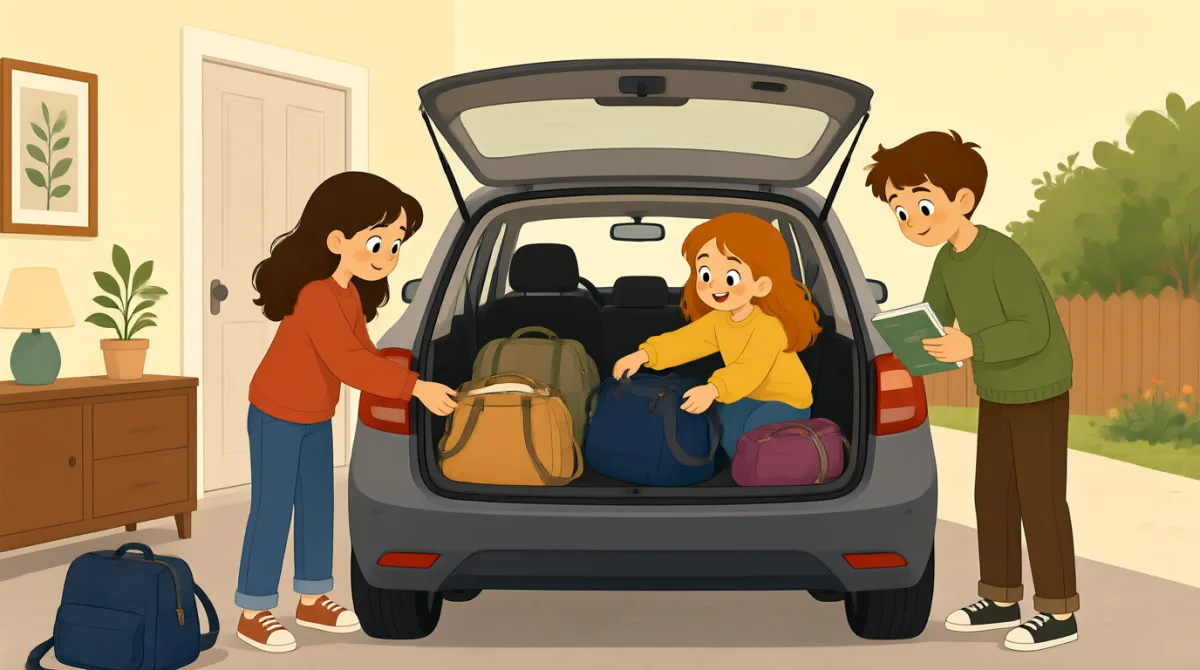

Okay, the trunk’s almost full already. Should we put the cooler in the back seat instead?
Bom, o porta-malas já está quase cheio. Será que a gente coloca a caixa térmica no banco de trás?

Maybe, but let’s keep the back seat clear if we can. We’ll need room for our jackets and snacks.
Talvez, mas vamos tentar deixar o banco de trás livre. Vamos precisar de espaço para as jaquetas e os lanches.

I can move my suitcase. It’s soft, so we could fit it beside the spare tire.
Posso mudar minha mala de lugar. Ela é maleável, então dá para encaixá-la ao lado do estepe.
Good idea. I’ll put the first-aid kit and water bottles up front, where we can reach them easily.
Boa ideia. Vou colocar o kit de primeiros socorros e as garrafas de água na frente, onde ficam fáceis de pegar.
Let’s not block the rear window, though. I want to be able to see clearly when I’m driving.
Mas vamos deixar o vidro traseiro livre. Quero conseguir enxergar bem enquanto estiver dirigindo.
Right. And the phone chargers and road map should stay in the glove box, not buried under bags.
Isso. E os carregadores de celular e o mapa rodoviário devem ficar no porta-luvas, não enterrados embaixo das bolsas.
There’s still a loose bag rolling around. Can we tuck it between the cooler and the seat?
Ainda tem uma bolsa solta rolando por aí. Dá para encaixá-la entre a caixa térmica e o banco?
Sure, but let’s check that everything’s secure before we go. I don’t want anything flying forward if I brake.
Claro, mas vamos conferir se está tudo bem preso antes de sair. Não quero que nada voe para a frente se eu frear.
Essentials are easy to reach, and the window’s clear. I think we’re all set.
O que precisamos está fácil de pegar, e o vidro está desobstruído. Acho que está tudo pronto.
Vocabulário8
- the trunk’s almost fullo porta-malas está quase cheio
The trunk is the storage space at the back of a car. This phrase means there is very little room left in it.
O porta-malas é o espaço de armazenamento na parte de trás do carro. Essa expressão quer dizer que quase não há mais espaço nele.
- keep the back seat cleardeixar o banco de trás livre
This means not putting things on the back seat so it remains open and available. You can use “keep [a space] clear” when you want an area to stay free of objects.
Isso significa não colocar coisas no banco de trás, para mantê-lo desocupado e disponível. Você pode usar “keep [a space] clear” (deixar [um espaço] livre) quando quiser que uma área fique sem objetos.
- fit it beside the spare tireencaixá-la ao lado do estepe
“Fit” means to put something into a space where it can be accommodated. “Beside” tells us the suitcase will go next to the spare tire.
“Fit” significa colocar algo em um espaço onde caiba. “Beside” indica que a mala ficará ao lado do estepe.
- reach them easilypegá-los com facilidade
This means being able to get or touch the items without difficulty. Use “easy to reach” for things you want to keep accessible.
Isso significa conseguir pegar ou tocar nos itens sem dificuldade. Use “easy to reach” (fácil de pegar) para falar de coisas que você quer deixar ao alcance.
- block the rear windowobstruir o vidro traseiro
To block the rear window means to cover or obstruct it so the driver cannot see through it clearly. The rear window is the back window of a car.
Obstruir o vidro traseiro significa cobri-lo ou bloqueá-lo, impedindo que o motorista enxergue bem através dele. O vidro traseiro é a janela de trás do carro.
- buried under bagsenterrados embaixo das bolsas
Here, “buried” means hidden beneath other things, so the items are difficult to find or get to. It can also describe something covered by a large amount of other objects.
Aqui, “buried” significa escondido sob outras coisas, de modo que seja difícil encontrar ou pegar os itens. A palavra também pode descrever algo coberto por muitos outros objetos.
- tuck it between the cooler and the seatencaixá-la entre a caixa térmica e o banco
“Tuck” means to put something neatly into a small or available space. Use “between” to describe a place in the space separating two things.
“Tuck” significa colocar algo com cuidado em um espaço pequeno ou disponível. Use “between” para descrever o espaço que fica entre duas coisas.
- flying forward if I brakevoar para a frente se eu frear
This describes loose items moving toward the front of the car when the driver stops suddenly. “Brake” means to slow down or stop a vehicle.
Isso descreve objetos soltos se deslocando para a parte da frente do carro quando o motorista freia de repente. “Brake” significa reduzir a velocidade ou parar um veículo.
Frases-chave8
- 1
Should we put the cooler in the back seat instead?
Será que a gente coloca a caixa térmica no banco de trás?
This is a natural way to suggest a different place for something. Use “Should we… instead?” to ask whether another option would be better.
Essa é uma forma natural de sugerir outro lugar para colocar alguma coisa. Use “Should we… instead?” (Será que a gente… em vez disso?) para perguntar se outra opção seria melhor.
- 2
We’ll need room for our jackets and snacks.
Vamos precisar de espaço para as jaquetas e os lanches.
This sentence gives a reason for keeping space available. Use “We’ll need room for…” when explaining what space is required for.
Essa frase explica por que é bom deixar espaço livre. Use “We’ll need room for…” (Vamos precisar de espaço para…) para explicar para que o espaço será necessário.
- 3
I can move my suitcase.
Posso mudar minha mala de lugar.
This is a simple, helpful offer to change where something is. Use “I can…” to offer to do a task or solve a small problem.
Essa é uma oferta simples e prestativa para mudar algo de lugar. Use “I can…” (Posso…) para se oferecer para fazer uma tarefa ou resolver um pequeno problema.
- 4
I’ll put the first-aid kit and water bottles up front, where we can reach them easily.
Vou colocar o kit de primeiros socorros e as garrafas de água na frente, onde ficam fáceis de pegar.
This explains both where items will go and why they will be placed there. You can use “I’ll put [items] [place], where…” to describe a plan and its purpose.
A frase explica onde os itens serão colocados e por que ficarão ali. Você pode usar “I’ll put [items] [place], where…” (Vou colocar [itens] [lugar], onde…) para descrever um plano e sua finalidade.
- 5
Let’s not block the rear window, though.
Mas vamos deixar o vidro traseiro livre.
This politely warns the group not to do something, while “though” adds a contrasting point. Use “Let’s not…” to suggest avoiding an action.
Essa frase alerta o grupo, de forma educada, para não fazer algo, enquanto “though” acrescenta uma ideia contrastante. Use “Let’s not…” (Vamos evitar…) para sugerir que não se faça alguma coisa.
- 6
The phone chargers and road map should stay in the glove box, not buried under bags.
Os carregadores de celular e o mapa rodoviário devem ficar no porta-luvas, não enterrados embaixo das bolsas.
This sentence states where important items should be kept and where they should not be. Use “should stay in…” to suggest a suitable place for something.
Essa frase diz onde os itens importantes devem ficar e onde não devem ficar. Use “should stay in…” (devem ficar em…) para sugerir um lugar adequado para alguma coisa.
- 7
Let’s check that everything’s secure before we go.
Vamos conferir se está tudo bem preso antes de sair.
This is a useful way to suggest a final safety check. Use “Let’s check that…” before leaving or starting an activity.
Essa é uma forma útil de sugerir uma última verificação de segurança. Use “Let’s check that…” (Vamos conferir se…) antes de sair ou começar uma atividade.
- 8
I don’t want anything flying forward if I brake.
Não quero que nada voe para a frente se eu frear.
This explains a safety concern and gives a reason for securing loose items. Use “I don’t want [something] happening if…” to describe an outcome you want to prevent.
Essa frase explica uma preocupação com a segurança e dá um motivo para prender os objetos soltos. Use “I don’t want [something] happening if…” (Não quero que [algo] aconteça se…) para descrever uma situação que você quer evitar.