Packing the Car
Arabayı Hazırlama
Before leaving, Emma, Mia, and Jack pack the car and check that they have the essentials. They rearrange their bags to make room and keep important items easy to reach.
Yola çıkmadan önce Emma, Mia ve Jack arabayı yükleyip gerekli her şeyi yanlarına aldıklarından emin olurlar. Yer açmak ve önemli eşyalara kolayca ulaşabilmek için çantalarının yerini değiştirirler.
Diyalog9
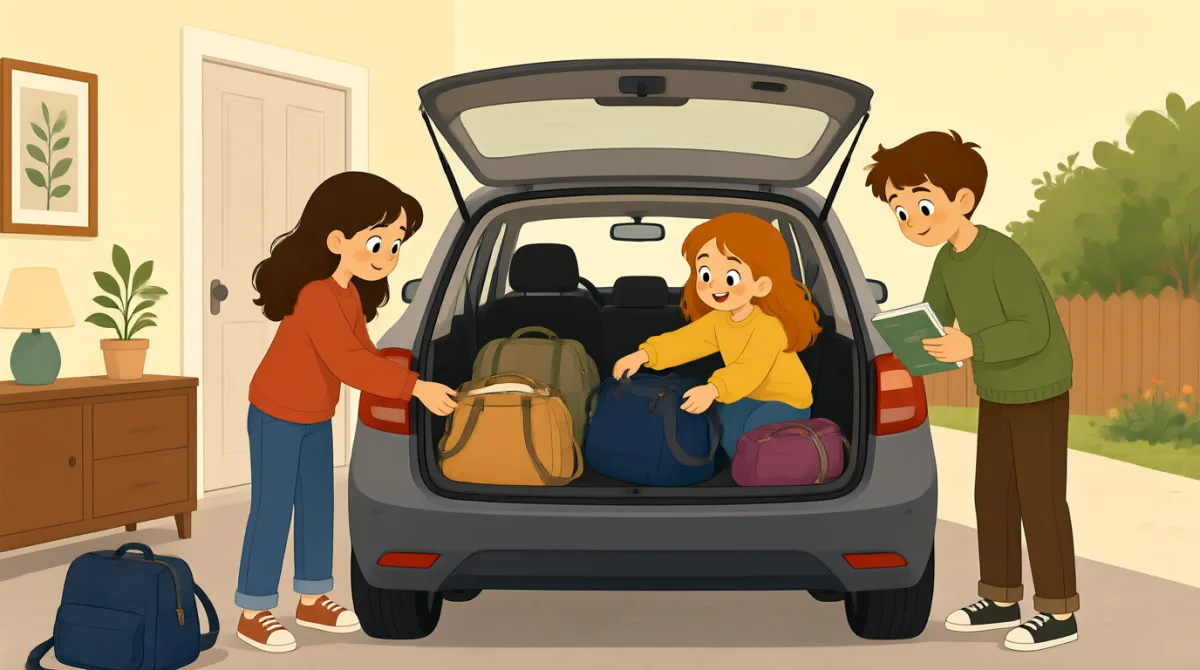

Okay, the trunk’s almost full already. Should we put the cooler in the back seat instead?
Tamam, bagaj şimdiden neredeyse dolu. Soğutucuyu onun yerine arka koltuğa mı koysak?

Maybe, but let’s keep the back seat clear if we can. We’ll need room for our jackets and snacks.
Belki, ama mümkünse arka koltuğu boş bırakalım. Ceketlerimiz ve atıştırmalıklar için yer gerekecek.

I can move my suitcase. It’s soft, so we could fit it beside the spare tire.
Bavulumu başka yere koyabilirim. Yumuşak olduğu için stepnenin yanına sığdırabiliriz.
Good idea. I’ll put the first-aid kit and water bottles up front, where we can reach them easily.
İyi fikir. İlk yardım çantasını ve su şişelerini öne koyacağım, böylece onlara kolayca ulaşabiliriz.
Let’s not block the rear window, though. I want to be able to see clearly when I’m driving.
Ama arka camı kapatmayalım. Araba kullanırken yolu net görmek istiyorum.
Right. And the phone chargers and road map should stay in the glove box, not buried under bags.
Doğru. Telefon şarj aletleriyle yol haritası da çantaların altına gömülmek yerine torpido gözünde durmalı.
There’s still a loose bag rolling around. Can we tuck it between the cooler and the seat?
Hâlâ etrafta yuvarlanan bir çanta var. Onu soğutucuyla koltuğun arasına sıkıştırsak olur mu?
Sure, but let’s check that everything’s secure before we go. I don’t want anything flying forward if I brake.
Olur, ama yola çıkmadan önce her şeyin sağlam durduğunu kontrol edelim. Fren yaparsam hiçbir şeyin öne fırlamasını istemiyorum.
Essentials are easy to reach, and the window’s clear. I think we’re all set.
Gerekli şeylere kolayca ulaşabiliyoruz, cam da açık. Sanırım her şey hazır.
Kelime Bilgisi8
- the trunk’s almost fullbagaj neredeyse dolu
The trunk is the storage space at the back of a car. This phrase means there is very little room left in it.
Bagaj, arabanın arkasındaki eşya koyma bölümüdür. Bu ifade, içinde çok az yer kaldığı anlamına gelir.
- keep the back seat cleararka koltuğu boş bırakmak
This means not putting things on the back seat so it remains open and available. You can use “keep [a space] clear” when you want an area to stay free of objects.
Bu, arka koltuğa eşya koymayıp onu boş ve kullanılabilir durumda tutmak demektir. Bir alanın eşyalardan arınmış kalmasını istediğinde “keep [a space] clear” kalıbını kullanabilirsin.
- fit it beside the spare tirestepnenin yanına sığdırmak
“Fit” means to put something into a space where it can be accommodated. “Beside” tells us the suitcase will go next to the spare tire.
“Fit”, bir şeyi sığabileceği bir yere koymak demektir. “Beside” ise bavulun stepnenin yanına konacağını belirtir.
- reach them easilyonlara kolayca ulaşmak
This means being able to get or touch the items without difficulty. Use “easy to reach” for things you want to keep accessible.
Bu, eşyalara zorlanmadan uzanabilmek ya da dokunabilmek demektir. El altında tutmak istediğin şeyler için “easy to reach” ifadesini kullanabilirsin.
- block the rear windowarka camı kapatmak
To block the rear window means to cover or obstruct it so the driver cannot see through it clearly. The rear window is the back window of a car.
Arka camı kapatmak, sürücünün camdan net bir şekilde göremeyeceği biçimde onu örtmek ya da görüşü engellemek demektir. Arka cam, arabanın arkasındaki camdır.
- buried under bagsçantaların altına gömülmüş
Here, “buried” means hidden beneath other things, so the items are difficult to find or get to. It can also describe something covered by a large amount of other objects.
Burada “buried”, başka eşyaların altında kalıp görünmez hâle gelmek anlamındadır; bu yüzden eşyalara ulaşmak ya da onları bulmak zorlaşır. Çok sayıda eşyanın altında kalmış şeyleri anlatmak için de kullanılabilir.
- tuck it between the cooler and the seatsoğutucuyla koltuğun arasına sıkıştırmak
“Tuck” means to put something neatly into a small or available space. Use “between” to describe a place in the space separating two things.
“Tuck”, bir şeyi küçük ya da boş bir yere düzgünce yerleştirmek demektir. “Between” ise iki şeyin arasındaki boşluğu anlatır.
- flying forward if I brakefren yaparsam öne fırlamak
This describes loose items moving toward the front of the car when the driver stops suddenly. “Brake” means to slow down or stop a vehicle.
Bu ifade, sürücü aniden durduğunda sabitlenmemiş eşyaların arabanın önüne doğru hareket etmesini anlatır. “Brake”, bir aracı yavaşlatmak ya da durdurmak demektir.
Önemli Cümleler8
- 1
Should we put the cooler in the back seat instead?
Soğutucuyu onun yerine arka koltuğa mı koysak?
This is a natural way to suggest a different place for something. Use “Should we… instead?” to ask whether another option would be better.
Bu, bir eşya için başka bir yer önermenin doğal bir yoludur. Başka bir seçeneğin daha iyi olup olmadığını sormak için “Should we… instead?” kalıbını kullanabilirsin.
- 2
We’ll need room for our jackets and snacks.
Ceketlerimiz ve atıştırmalıklar için yer gerekecek.
This sentence gives a reason for keeping space available. Use “We’ll need room for…” when explaining what space is required for.
Bu cümle, neden boş yer bırakılması gerektiğini açıklar. Ne için yer gerektiğini söylerken “We’ll need room for…” kalıbını kullanabilirsin.
- 3
I can move my suitcase.
Bavulumu başka yere koyabilirim.
This is a simple, helpful offer to change where something is. Use “I can…” to offer to do a task or solve a small problem.
Bu, bir şeyin yerini değiştirmeye yönelik basit ve yardımsever bir tekliftir. Bir işi yapmayı ya da küçük bir sorunu çözmeyi teklif etmek için “I can…” kalıbını kullanabilirsin.
- 4
I’ll put the first-aid kit and water bottles up front, where we can reach them easily.
İlk yardım çantasını ve su şişelerini öne koyacağım, böylece onlara kolayca ulaşabiliriz.
This explains both where items will go and why they will be placed there. You can use “I’ll put [items] [place], where…” to describe a plan and its purpose.
Bu cümle, eşyaların nereye konacağını ve oraya neden konacağını açıklar. Bir planı ve amacını anlatmak için “I’ll put [items] [place], where…” kalıbını kullanabilirsin.
- 5
Let’s not block the rear window, though.
Ama arka camı kapatmayalım.
This politely warns the group not to do something, while “though” adds a contrasting point. Use “Let’s not…” to suggest avoiding an action.
Bu cümle, “though” ile karşıt bir noktayı eklerken grubu bir şeyi yapmamaları konusunda nazikçe uyarır. Bir eylemden kaçınmayı önermek için “Let’s not…” kalıbını kullanabilirsin.
- 6
The phone chargers and road map should stay in the glove box, not buried under bags.
Telefon şarj aletleriyle yol haritası, çantaların altına gömülmek yerine torpido gözünde durmalı.
This sentence states where important items should be kept and where they should not be. Use “should stay in…” to suggest a suitable place for something.
Bu cümle, önemli eşyaların nerede tutulması ve nerede tutulmaması gerektiğini belirtir. Bir şey için uygun bir yer önermek amacıyla “should stay in…” kalıbını kullanabilirsin.
- 7
Let’s check that everything’s secure before we go.
Yola çıkmadan önce her şeyin sağlam durduğunu kontrol edelim.
This is a useful way to suggest a final safety check. Use “Let’s check that…” before leaving or starting an activity.
Bu, son bir güvenlik kontrolü önermenin kullanışlı bir yoludur. Yola çıkmadan ya da bir etkinliğe başlamadan önce “Let’s check that…” kalıbını kullanabilirsin.
- 8
I don’t want anything flying forward if I brake.
Fren yaparsam hiçbir şeyin öne fırlamasını istemiyorum.
This explains a safety concern and gives a reason for securing loose items. Use “I don’t want [something] happening if…” to describe an outcome you want to prevent.
Bu cümle, bir güvenlik kaygısını ve sabitlenmemiş eşyaları güvenceye alma nedenini açıklar. Önlemek istediğin bir durumu anlatmak için “I don’t want [something] happening if…” kalıbını kullanabilirsin.