Packing the Car
Das Auto packen
Before leaving, Emma, Mia, and Jack pack the car and check that they have the essentials. They rearrange their bags to make room and keep important items easy to reach.
Bevor sie losfahren, packen Emma, Mia und Jack das Auto und prüfen, ob sie alles Wichtige dabeihaben. Sie räumen ihre Taschen um, damit mehr Platz entsteht und wichtige Dinge griffbereit sind.
Dialog9
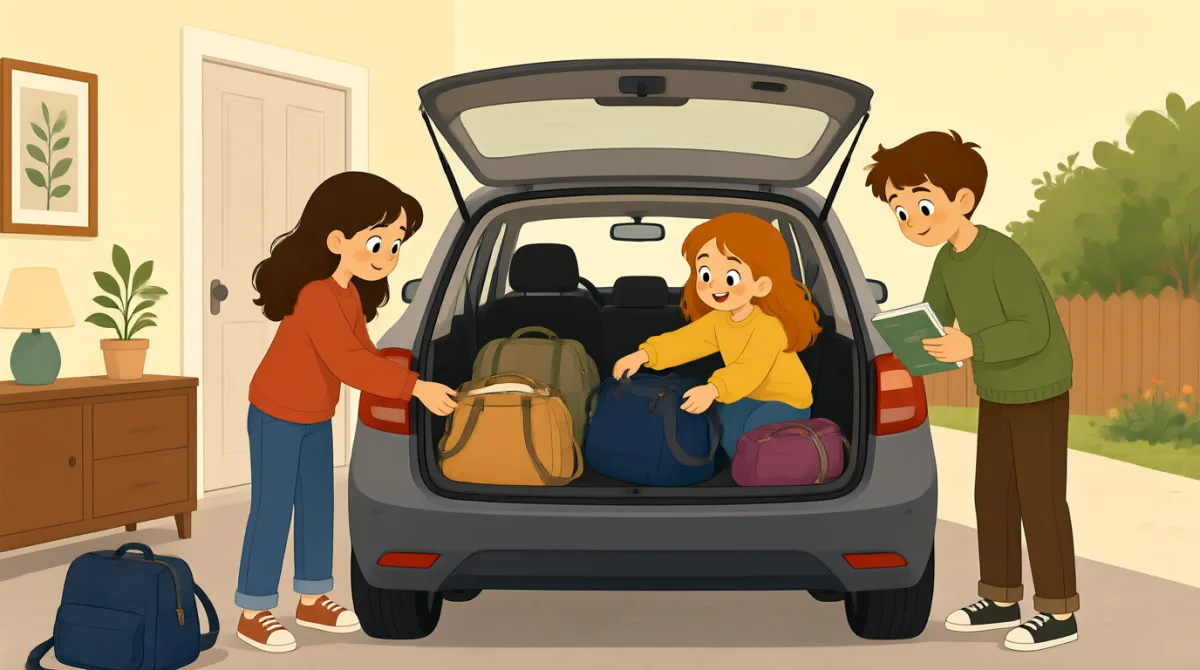

Okay, the trunk’s almost full already. Should we put the cooler in the back seat instead?
Okay, der Kofferraum ist jetzt schon fast voll. Sollen wir die Kühlbox stattdessen auf den Rücksitz stellen?

Maybe, but let’s keep the back seat clear if we can. We’ll need room for our jackets and snacks.
Vielleicht, aber wenn’s geht, lassen wir den Rücksitz frei. Wir brauchen Platz für unsere Jacken und Snacks.

I can move my suitcase. It’s soft, so we could fit it beside the spare tire.
Ich kann meinen Koffer umräumen. Der ist weich, vielleicht passt er neben das Ersatzrad.
Good idea. I’ll put the first-aid kit and water bottles up front, where we can reach them easily.
Gute Idee. Ich lege den Verbandskasten und die Wasserflaschen nach vorne, wo wir gut drankommen.
Let’s not block the rear window, though. I want to be able to see clearly when I’m driving.
Aber lasst uns die Heckscheibe nicht verdecken. Beim Fahren möchte ich freie Sicht haben.
Right. And the phone chargers and road map should stay in the glove box, not buried under bags.
Stimmt. Und die Handyladegeräte und die Straßenkarte sollten ins Handschuhfach und nicht unter den Taschen verschwinden.
There’s still a loose bag rolling around. Can we tuck it between the cooler and the seat?
Da ist noch eine Tasche, die lose herumrutscht. Können wir sie zwischen die Kühlbox und den Sitz stecken?
Sure, but let’s check that everything’s secure before we go. I don’t want anything flying forward if I brake.
Klar, aber lass uns vor der Abfahrt prüfen, ob alles sicher verstaut ist. Ich will nicht, dass etwas nach vorne fliegt, wenn ich bremse.
Essentials are easy to reach, and the window’s clear. I think we’re all set.
Das Wichtigste ist griffbereit, und die Heckscheibe ist frei. Ich glaube, wir sind startklar.
Wortschatz8
- the trunk’s almost fullder Kofferraum ist fast voll
The trunk is the storage space at the back of a car. This phrase means there is very little room left in it.
Der Kofferraum ist der Stauraum am Heck eines Autos. Diese Formulierung bedeutet, dass darin nur noch sehr wenig Platz ist.
- keep the back seat clearden Rücksitz frei lassen
This means not putting things on the back seat so it remains open and available. You can use “keep [a space] clear” when you want an area to stay free of objects.
Das bedeutet, nichts auf den Rücksitz zu legen, damit er frei und verfügbar bleibt. „Keep [a space] clear“ kannst du verwenden, wenn ein Bereich frei von Gegenständen bleiben soll.
- fit it beside the spare tireneben das Ersatzrad passen
“Fit” means to put something into a space where it can be accommodated. “Beside” tells us the suitcase will go next to the spare tire.
„Fit“ bedeutet, etwas so in einen Raum zu stellen, dass es hineinpasst. „Beside“ sagt, dass der Koffer neben dem Ersatzrad liegen wird.
- reach them easilygut an sie herankommen
This means being able to get or touch the items without difficulty. Use “easy to reach” for things you want to keep accessible.
Das bedeutet, dass man die Gegenstände ohne Mühe erreichen oder berühren kann. „Easy to reach“ verwendest du für Dinge, die griffbereit sein sollen.
- block the rear windowdie Heckscheibe verdecken
To block the rear window means to cover or obstruct it so the driver cannot see through it clearly. The rear window is the back window of a car.
Die Heckscheibe zu verdecken bedeutet, sie so abzudecken oder zu versperren, dass der Fahrer nicht klar hindurchsehen kann. Die Heckscheibe ist das hintere Fenster eines Autos.
- buried under bagsunter Taschen vergraben
Here, “buried” means hidden beneath other things, so the items are difficult to find or get to. It can also describe something covered by a large amount of other objects.
Hier bedeutet „buried“, dass etwas unter anderen Dingen verborgen ist und deshalb schwer zu finden oder zu erreichen ist. Das Wort kann auch beschreiben, dass etwas von vielen anderen Gegenständen bedeckt ist.
- tuck it between the cooler and the seatsie zwischen die Kühlbox und den Sitz stecken
“Tuck” means to put something neatly into a small or available space. Use “between” to describe a place in the space separating two things.
„Tuck“ bedeutet, etwas ordentlich in einen kleinen oder freien Platz zu stecken. Mit „between“ beschreibst du einen Platz zwischen zwei Dingen.
- flying forward if I brakebeim Bremsen nach vorne fliegen
This describes loose items moving toward the front of the car when the driver stops suddenly. “Brake” means to slow down or stop a vehicle.
Das beschreibt, wie lose Gegenstände nach vorne im Auto rutschen oder fliegen, wenn der Fahrer plötzlich anhält. „Brake“ bedeutet, ein Fahrzeug abzubremsen oder anzuhalten.
Wichtige Sätze8
- 1
Should we put the cooler in the back seat instead?
Sollen wir die Kühlbox stattdessen auf den Rücksitz stellen?
This is a natural way to suggest a different place for something. Use “Should we… instead?” to ask whether another option would be better.
Das ist eine natürliche Art, einen anderen Platz für etwas vorzuschlagen. Mit „Should we… instead?“ fragst du, ob eine andere Möglichkeit besser wäre.
- 2
We’ll need room for our jackets and snacks.
Wir brauchen Platz für unsere Jacken und Snacks.
This sentence gives a reason for keeping space available. Use “We’ll need room for…” when explaining what space is required for.
Dieser Satz erklärt, warum noch Platz frei bleiben soll. Mit „We’ll need room for…“ sagst du, wofür Platz benötigt wird.
- 3
I can move my suitcase.
Ich kann meinen Koffer umräumen.
This is a simple, helpful offer to change where something is. Use “I can…” to offer to do a task or solve a small problem.
Das ist ein einfaches, hilfreiches Angebot, etwas an einen anderen Platz zu stellen. Mit „I can…“ bietest du an, eine Aufgabe zu übernehmen oder ein kleines Problem zu lösen.
- 4
I’ll put the first-aid kit and water bottles up front, where we can reach them easily.
Ich lege den Verbandskasten und die Wasserflaschen nach vorne, wo wir gut drankommen.
This explains both where items will go and why they will be placed there. You can use “I’ll put [items] [place], where…” to describe a plan and its purpose.
Der Satz erklärt sowohl, wohin die Dinge kommen, als auch, warum sie dort hingelegt werden. Mit „I’ll put [items] [place], where…“ beschreibst du einen Plan und seinen Zweck.
- 5
Let’s not block the rear window, though.
Aber lasst uns die Heckscheibe nicht verdecken.
This politely warns the group not to do something, while “though” adds a contrasting point. Use “Let’s not…” to suggest avoiding an action.
Das ist eine höfliche Warnung an die Gruppe, etwas nicht zu tun. „Though“ fügt einen Gegensatz oder zusätzlichen Einwand hinzu. Mit „Let’s not…“ schlägst du vor, eine Handlung zu vermeiden.
- 6
The phone chargers and road map should stay in the glove box, not buried under bags.
Die Handyladegeräte und die Straßenkarte sollten im Handschuhfach bleiben und nicht unter den Taschen verschwinden.
This sentence states where important items should be kept and where they should not be. Use “should stay in…” to suggest a suitable place for something.
Der Satz sagt, wo wichtige Dinge aufbewahrt werden sollten und wo nicht. Mit „should stay in…“ schlägst du einen passenden Platz für etwas vor.
- 7
Let’s check that everything’s secure before we go.
Lasst uns prüfen, ob alles sicher verstaut ist, bevor wir losfahren.
This is a useful way to suggest a final safety check. Use “Let’s check that…” before leaving or starting an activity.
So kannst du eine abschließende Sicherheitskontrolle vorschlagen. Verwende „Let’s check that…“, bevor ihr losfahrt oder mit etwas beginnt.
- 8
I don’t want anything flying forward if I brake.
Ich will nicht, dass etwas nach vorne fliegt, wenn ich bremse.
This explains a safety concern and gives a reason for securing loose items. Use “I don’t want [something] happening if…” to describe an outcome you want to prevent.
Der Satz erklärt ein Sicherheitsbedenken und warum lose Gegenstände gesichert werden sollen. Mit „I don’t want [something] happening if…“ beschreibst du, was du verhindern möchtest.