Packing the Car
การจัดของใส่รถ
Before leaving, Emma, Mia, and Jack pack the car and check that they have the essentials. They rearrange their bags to make room and keep important items easy to reach.
ก่อนออกเดินทาง เอ็มมา มีอา และแจ็กช่วยกันจัดของใส่รถและตรวจดูว่ามีของจำเป็นครบ พวกเขาจัดกระเป๋าใหม่เพื่อให้มีที่ว่าง และเก็บของสำคัญไว้ในจุดที่หยิบได้ง่าย
บทสนทนา9
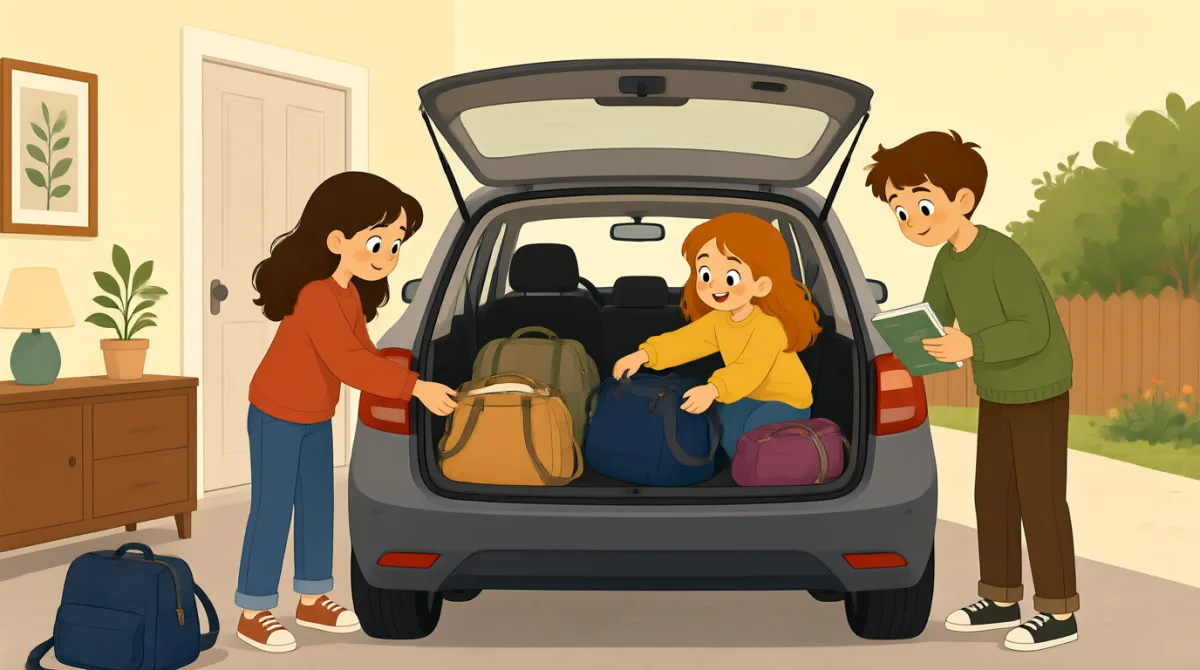

Okay, the trunk’s almost full already. Should we put the cooler in the back seat instead?
โอเค ท้ายรถเกือบเต็มแล้ว เราเอากล่องเก็บความเย็นไปไว้ที่เบาะหลังแทนดีไหม

Maybe, but let’s keep the back seat clear if we can. We’ll need room for our jackets and snacks.
ก็ดีนะ แต่ถ้าทำได้ เราอย่าวางของบนเบาะหลังดีกว่า เราต้องเผื่อที่ไว้สำหรับเสื้อแจ็กเก็ตกับขนมด้วย

I can move my suitcase. It’s soft, so we could fit it beside the spare tire.
ฉันย้ายกระเป๋าเดินทางของฉันได้นะ มันนิ่ม เราน่าจะยัดไว้ข้างยางอะไหล่ได้
Good idea. I’ll put the first-aid kit and water bottles up front, where we can reach them easily.
ไอเดียดี ฉันจะเอาชุดปฐมพยาบาลกับขวดน้ำไว้ด้านหน้า ตรงที่เราหยิบได้ง่าย
Let’s not block the rear window, though. I want to be able to see clearly when I’m driving.
แต่เราอย่าบังหน้าต่างด้านหลังนะ ฉันอยากมองเห็นชัด ๆ ตอนขับรถ
Right. And the phone chargers and road map should stay in the glove box, not buried under bags.
จริงด้วย แล้วที่ชาร์จโทรศัพท์กับแผนที่ถนนควรอยู่ในช่องเก็บของ ไม่ใช่ถูกฝังกองอยู่ใต้กระเป๋า
There’s still a loose bag rolling around. Can we tuck it between the cooler and the seat?
ยังมีกระเป๋าใบหนึ่งกลิ้งไปมาอยู่เลย เราสอดมันไว้ระหว่างกล่องเก็บความเย็นกับเบาะได้ไหม
Sure, but let’s check that everything’s secure before we go. I don’t want anything flying forward if I brake.
ได้สิ แต่ก่อนออกไป เรามาตรวจดูให้แน่ใจว่าทุกอย่างแน่นหนาดีก่อนนะ ฉันไม่อยากให้ของอะไรพุ่งไปข้างหน้าตอนเบรก
Essentials are easy to reach, and the window’s clear. I think we’re all set.
ของจำเป็นหยิบได้ง่าย หน้าต่างก็โล่งแล้ว ฉันว่าเราพร้อมกันหมดแล้วล่ะ
คำศัพท์8
- the trunk’s almost fullท้ายรถเกือบเต็มแล้ว
The trunk is the storage space at the back of a car. This phrase means there is very little room left in it.
ท้ายรถคือพื้นที่เก็บของด้านหลังรถ วลีนี้หมายความว่าเหลือที่ว่างในนั้นอยู่น้อยมาก
- keep the back seat clearอย่าวางของบนเบาะหลัง
This means not putting things on the back seat so it remains open and available. You can use “keep [a space] clear” when you want an area to stay free of objects.
หมายถึงไม่วางของบนเบาะหลัง เพื่อให้เบาะยังโล่งและใช้งานได้ คุณใช้ “keep [a space] clear” เมื่ออยากให้พื้นที่หนึ่งไม่มีสิ่งของกีดขวาง
- fit it beside the spare tireยัดไว้ข้างยางอะไหล่ได้
“Fit” means to put something into a space where it can be accommodated. “Beside” tells us the suitcase will go next to the spare tire.
“Fit” หมายถึงใส่บางสิ่งลงในพื้นที่ที่สามารถรองรับสิ่งนั้นได้ ส่วน “Beside” บอกว่ากระเป๋าเดินทางจะอยู่ข้าง ๆ ยางอะไหล่
- reach them easilyหยิบได้ง่าย
This means being able to get or touch the items without difficulty. Use “easy to reach” for things you want to keep accessible.
หมายถึงสามารถหยิบหรือสัมผัสสิ่งของได้โดยไม่ลำบาก ใช้ “easy to reach” กับสิ่งของที่คุณต้องการเก็บไว้ในจุดที่เข้าถึงได้ง่าย
- block the rear windowบังหน้าต่างด้านหลัง
To block the rear window means to cover or obstruct it so the driver cannot see through it clearly. The rear window is the back window of a car.
To block the rear window หมายถึงบังหรือกีดขวางหน้าต่างด้านหลังจนคนขับมองผ่านได้ไม่ชัด หน้าต่างด้านหลังคือกระจกบานหลังของรถ
- buried under bagsถูกฝังกองอยู่ใต้กระเป๋า
Here, “buried” means hidden beneath other things, so the items are difficult to find or get to. It can also describe something covered by a large amount of other objects.
ในที่นี้ “buried” หมายถึงถูกซ่อนอยู่ใต้สิ่งของอื่น ทำให้หาเจอหรือหยิบได้ยาก นอกจากนี้ยังใช้บรรยายสิ่งที่ถูกของจำนวนมากปกคลุมได้ด้วย
- tuck it between the cooler and the seatสอดไว้ระหว่างกล่องเก็บความเย็นกับเบาะ
“Tuck” means to put something neatly into a small or available space. Use “between” to describe a place in the space separating two things.
“Tuck” หมายถึงเก็บหรือสอดบางสิ่งอย่างเป็นระเบียบลงในพื้นที่เล็ก ๆ หรือพื้นที่ว่างที่มีอยู่ ใช้ “between” เพื่อบอกตำแหน่งที่อยู่ในช่องว่างระหว่างสิ่งของสองสิ่ง
- flying forward if I brakeพุ่งไปข้างหน้าตอนเบรก
This describes loose items moving toward the front of the car when the driver stops suddenly. “Brake” means to slow down or stop a vehicle.
วลีนี้บรรยายสิ่งของที่ไม่ได้ยึดไว้และเคลื่อนไปทางหน้ารถเมื่อคนขับหยุดรถกะทันหัน “Brake” หมายถึงชะลอหรือหยุดรถ
ประโยคสำคัญ8
- 1
Should we put the cooler in the back seat instead?
เราเอากล่องเก็บความเย็นไปไว้ที่เบาะหลังแทนดีไหม
This is a natural way to suggest a different place for something. Use “Should we… instead?” to ask whether another option would be better.
นี่เป็นวิธีธรรมชาติในการเสนอที่ใหม่สำหรับวางบางสิ่ง ใช้ “Should we… instead?” เพื่อถามว่าตัวเลือกอื่นน่าจะดีกว่าหรือไม่
- 2
We’ll need room for our jackets and snacks.
เราต้องเผื่อที่ไว้สำหรับเสื้อแจ็กเก็ตกับขนมด้วย
This sentence gives a reason for keeping space available. Use “We’ll need room for…” when explaining what space is required for.
ประโยคนี้บอกเหตุผลที่ควรเก็บพื้นที่ไว้ ใช้ “We’ll need room for…” เมื่อต้องการอธิบายว่าต้องใช้พื้นที่สำหรับอะไร
- 3
I can move my suitcase.
ฉันย้ายกระเป๋าเดินทางของฉันได้นะ
This is a simple, helpful offer to change where something is. Use “I can…” to offer to do a task or solve a small problem.
นี่เป็นการเสนอตัวอย่างง่าย ๆ และมีน้ำใจว่าจะเปลี่ยนที่วางบางสิ่ง ใช้ “I can…” เพื่อเสนอตัวทำงานบางอย่างหรือช่วยแก้ปัญหาเล็ก ๆ
- 4
I’ll put the first-aid kit and water bottles up front, where we can reach them easily.
ฉันจะเอาชุดปฐมพยาบาลกับขวดน้ำไว้ด้านหน้า ตรงที่เราหยิบได้ง่าย
This explains both where items will go and why they will be placed there. You can use “I’ll put [items] [place], where…” to describe a plan and its purpose.
ประโยคนี้อธิบายทั้งว่าสิ่งของจะถูกวางไว้ที่ไหนและเหตุผลที่วางไว้ตรงนั้น คุณใช้ “I’ll put [items] [place], where…” เพื่อบอกแผนและจุดประสงค์ของแผนนั้น
- 5
Let’s not block the rear window, though.
แต่เราอย่าบังหน้าต่างด้านหลังนะ
This politely warns the group not to do something, while “though” adds a contrasting point. Use “Let’s not…” to suggest avoiding an action.
ประโยคนี้เป็นการเตือนกลุ่มอย่างสุภาพว่าอย่าทำบางสิ่ง ขณะที่ “though” เพิ่มประเด็นที่ขัดแย้งกัน ใช้ “Let’s not…” เพื่อเสนอให้หลีกเลี่ยงการกระทำบางอย่าง
- 6
The phone chargers and road map should stay in the glove box, not buried under bags.
ที่ชาร์จโทรศัพท์กับแผนที่ถนนควรอยู่ในช่องเก็บของ ไม่ใช่ถูกฝังกองอยู่ใต้กระเป๋า
This sentence states where important items should be kept and where they should not be. Use “should stay in…” to suggest a suitable place for something.
ประโยคนี้บอกว่าสิ่งของสำคัญควรเก็บไว้ที่ไหน และไม่ควรเก็บไว้ที่ใด ใช้ “should stay in…” เพื่อเสนอพื้นที่ที่เหมาะสมสำหรับเก็บสิ่งของ
- 7
Let’s check that everything’s secure before we go.
เรามาตรวจดูให้แน่ใจว่าทุกอย่างแน่นหนาดีก่อนออกไปกันเถอะ
This is a useful way to suggest a final safety check. Use “Let’s check that…” before leaving or starting an activity.
นี่เป็นวิธีที่ใช้ได้ดีในการเสนอให้ตรวจสอบความปลอดภัยเป็นครั้งสุดท้าย ใช้ “Let’s check that…” ก่อนออกเดินทางหรือเริ่มกิจกรรม
- 8
I don’t want anything flying forward if I brake.
ฉันไม่อยากให้ของอะไรพุ่งไปข้างหน้าตอนเบรก
This explains a safety concern and gives a reason for securing loose items. Use “I don’t want [something] happening if…” to describe an outcome you want to prevent.
ประโยคนี้อธิบายข้อกังวลด้านความปลอดภัยและเหตุผลที่ควรยึดของที่ไม่ได้เก็บให้แน่น ใช้ “I don’t want [something] happening if…” เพื่อบอกผลลัพธ์ที่คุณต้องการป้องกัน