Packing the Car
Before leaving, Emma, Mia, and Jack pack the car and check that they have the essentials. They rearrange their bags to make room and keep important items easy to reach.
Dialogue9
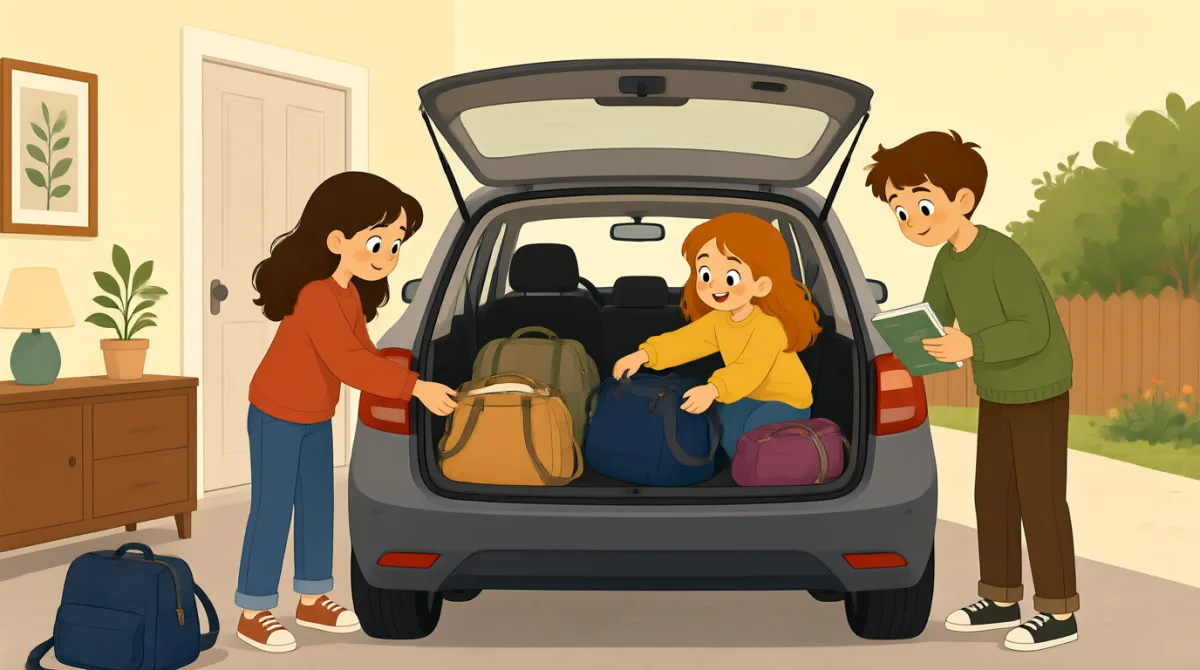

Okay, the trunk’s almost full already. Should we put the cooler in the back seat instead?

Maybe, but let’s keep the back seat clear if we can. We’ll need room for our jackets and snacks.

I can move my suitcase. It’s soft, so we could fit it beside the spare tire.
Good idea. I’ll put the first-aid kit and water bottles up front, where we can reach them easily.
Let’s not block the rear window, though. I want to be able to see clearly when I’m driving.
Right. And the phone chargers and road map should stay in the glove box, not buried under bags.
There’s still a loose bag rolling around. Can we tuck it between the cooler and the seat?
Sure, but let’s check that everything’s secure before we go. I don’t want anything flying forward if I brake.
Essentials are easy to reach, and the window’s clear. I think we’re all set.
Vocabulary8
- the trunk’s almost full
The trunk is the storage space at the back of a car. This phrase means there is very little room left in it.
- keep the back seat clear
This means not putting things on the back seat so it remains open and available. You can use “keep [a space] clear” when you want an area to stay free of objects.
- fit it beside the spare tire
“Fit” means to put something into a space where it can be accommodated. “Beside” tells us the suitcase will go next to the spare tire.
- reach them easily
This means being able to get or touch the items without difficulty. Use “easy to reach” for things you want to keep accessible.
- block the rear window
To block the rear window means to cover or obstruct it so the driver cannot see through it clearly. The rear window is the back window of a car.
- buried under bags
Here, “buried” means hidden beneath other things, so the items are difficult to find or get to. It can also describe something covered by a large amount of other objects.
- tuck it between the cooler and the seat
“Tuck” means to put something neatly into a small or available space. Use “between” to describe a place in the space separating two things.
- flying forward if I brake
This describes loose items moving toward the front of the car when the driver stops suddenly. “Brake” means to slow down or stop a vehicle.
Key Sentences8
- 1
Should we put the cooler in the back seat instead?
This is a natural way to suggest a different place for something. Use “Should we… instead?” to ask whether another option would be better.
- 2
We’ll need room for our jackets and snacks.
This sentence gives a reason for keeping space available. Use “We’ll need room for…” when explaining what space is required for.
- 3
I can move my suitcase.
This is a simple, helpful offer to change where something is. Use “I can…” to offer to do a task or solve a small problem.
- 4
I’ll put the first-aid kit and water bottles up front, where we can reach them easily.
This explains both where items will go and why they will be placed there. You can use “I’ll put [items] [place], where…” to describe a plan and its purpose.
- 5
Let’s not block the rear window, though.
This politely warns the group not to do something, while “though” adds a contrasting point. Use “Let’s not…” to suggest avoiding an action.
- 6
The phone chargers and road map should stay in the glove box, not buried under bags.
This sentence states where important items should be kept and where they should not be. Use “should stay in…” to suggest a suitable place for something.
- 7
Let’s check that everything’s secure before we go.
This is a useful way to suggest a final safety check. Use “Let’s check that…” before leaving or starting an activity.
- 8
I don’t want anything flying forward if I brake.
This explains a safety concern and gives a reason for securing loose items. Use “I don’t want [something] happening if…” to describe an outcome you want to prevent.