Packing the Car
Preparar el coche
Before leaving, Emma, Mia, and Jack pack the car and check that they have the essentials. They rearrange their bags to make room and keep important items easy to reach.
Antes de salir, Emma, Mia y Jack cargan el coche y comprueban que llevan todo lo necesario. Reorganizan las bolsas para hacer sitio y dejar a mano las cosas importantes.
Diálogo9
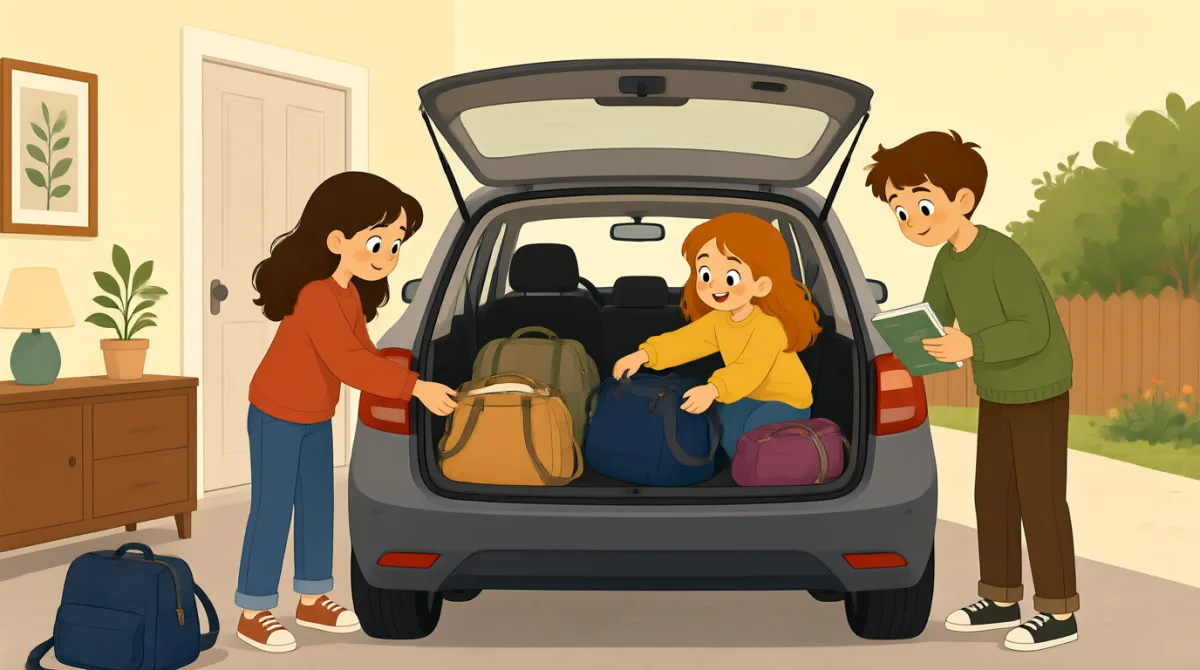

Okay, the trunk’s almost full already. Should we put the cooler in the back seat instead?
Bueno, el maletero ya está casi lleno. ¿Ponemos la nevera portátil en el asiento de atrás?

Maybe, but let’s keep the back seat clear if we can. We’ll need room for our jackets and snacks.
Puede ser, pero intentemos dejar libre el asiento de atrás si podemos. Necesitaremos sitio para las chaquetas y los aperitivos.

I can move my suitcase. It’s soft, so we could fit it beside the spare tire.
Puedo mover mi maleta. Es blanda, así que podríamos colocarla junto a la rueda de repuesto.
Good idea. I’ll put the first-aid kit and water bottles up front, where we can reach them easily.
Buena idea. Pondré el botiquín y las botellas de agua delante, donde podamos alcanzarlos fácilmente.
Let’s not block the rear window, though. I want to be able to see clearly when I’m driving.
Pero no tapemos la ventana trasera. Quiero poder ver bien cuando conduzca.
Right. And the phone chargers and road map should stay in the glove box, not buried under bags.
Eso. Y los cargadores del teléfono y el mapa de carreteras deberían quedarse en la guantera, no enterrados debajo de las bolsas.
There’s still a loose bag rolling around. Can we tuck it between the cooler and the seat?
Todavía hay una bolsa suelta dando vueltas. ¿Podemos meterla entre la nevera portátil y el asiento?
Sure, but let’s check that everything’s secure before we go. I don’t want anything flying forward if I brake.
Claro, pero comprobemos que todo esté bien sujeto antes de irnos. No quiero que nada salga disparado hacia delante si freno.
Essentials are easy to reach, and the window’s clear. I think we’re all set.
Tenemos todo lo necesario a mano y la ventana está despejada. Creo que ya está todo listo.
Vocabulario8
- the trunk’s almost fullel maletero está casi lleno
The trunk is the storage space at the back of a car. This phrase means there is very little room left in it.
El maletero es el espacio de almacenamiento que está en la parte trasera de un coche. Esta frase quiere decir que queda muy poco espacio.
- keep the back seat cleardejar libre el asiento de atrás
This means not putting things on the back seat so it remains open and available. You can use “keep [a space] clear” when you want an area to stay free of objects.
Quiere decir no poner cosas en el asiento de atrás para que quede despejado y disponible. Puedes usar “keep [a space] clear” (dejar [un espacio] libre) cuando quieras que una zona no tenga objetos.
- fit it beside the spare tirecolocarla junto a la rueda de repuesto
“Fit” means to put something into a space where it can be accommodated. “Beside” tells us the suitcase will go next to the spare tire.
“Fit” quiere decir colocar algo en un espacio donde quepa. “Beside” nos indica que la maleta irá al lado de la rueda de repuesto.
- reach them easilyalcanzarlos fácilmente
This means being able to get or touch the items without difficulty. Use “easy to reach” for things you want to keep accessible.
Quiere decir poder coger o tocar las cosas sin dificultad. Usa “easy to reach” (fácil de alcanzar) para hablar de cosas que quieres tener a mano.
- block the rear windowtapar la ventana trasera
To block the rear window means to cover or obstruct it so the driver cannot see through it clearly. The rear window is the back window of a car.
“Block the rear window” quiere decir cubrir u obstaculizar la ventana trasera para que quien conduce no pueda ver bien a través de ella. La ventana trasera es la que está en la parte de atrás del coche.
- buried under bagsenterrados debajo de las bolsas
Here, “buried” means hidden beneath other things, so the items are difficult to find or get to. It can also describe something covered by a large amount of other objects.
Aquí, “buried” quiere decir ocultos debajo de otras cosas, por lo que resulta difícil encontrarlos o acceder a ellos. También puede describir algo cubierto por muchos otros objetos.
- tuck it between the cooler and the seatmeterla entre la nevera portátil y el asiento
“Tuck” means to put something neatly into a small or available space. Use “between” to describe a place in the space separating two things.
“Tuck” quiere decir colocar algo bien en un espacio pequeño o disponible. Usa “between” para indicar que algo está en el espacio que separa dos cosas.
- flying forward if I brakesalir disparado hacia delante si freno
This describes loose items moving toward the front of the car when the driver stops suddenly. “Brake” means to slow down or stop a vehicle.
Describe cómo los objetos sueltos se mueven hacia la parte delantera del coche cuando quien conduce frena de repente. “Brake” quiere decir frenar o detener un vehículo.
Frases clave8
- 1
Should we put the cooler in the back seat instead?
¿Ponemos la nevera portátil en el asiento de atrás?
This is a natural way to suggest a different place for something. Use “Should we… instead?” to ask whether another option would be better.
Esta es una forma natural de proponer otro lugar para algo. Usa “Should we… instead?” (¿Y si… en su lugar?) para preguntar si otra opción sería mejor.
- 2
We’ll need room for our jackets and snacks.
Necesitaremos sitio para las chaquetas y los aperitivos.
This sentence gives a reason for keeping space available. Use “We’ll need room for…” when explaining what space is required for.
Esta frase explica por qué conviene dejar espacio libre. Usa “We’ll need room for…” (Necesitaremos sitio para…) para explicar qué requiere espacio.
- 3
I can move my suitcase.
Puedo mover mi maleta.
This is a simple, helpful offer to change where something is. Use “I can…” to offer to do a task or solve a small problem.
Es una oferta sencilla y amable para cambiar algo de sitio. Usa “I can…” (Puedo…) para ofrecerte a hacer una tarea o resolver un pequeño problema.
- 4
I’ll put the first-aid kit and water bottles up front, where we can reach them easily.
Pondré el botiquín y las botellas de agua delante, donde podamos alcanzarlos fácilmente.
This explains both where items will go and why they will be placed there. You can use “I’ll put [items] [place], where…” to describe a plan and its purpose.
Esta frase explica dónde se pondrán las cosas y por qué. Puedes usar “I’ll put [items] [place], where…” para describir un plan y su propósito.
- 5
Let’s not block the rear window, though.
Pero no tapemos la ventana trasera.
This politely warns the group not to do something, while “though” adds a contrasting point. Use “Let’s not…” to suggest avoiding an action.
Esta frase advierte amablemente al grupo que no haga algo, y “though” añade un punto de contraste. Usa “Let’s not…” (No…) para sugerir que se evite una acción.
- 6
The phone chargers and road map should stay in the glove box, not buried under bags.
Los cargadores del teléfono y el mapa de carreteras deberían quedarse en la guantera, no enterrados debajo de las bolsas.
This sentence states where important items should be kept and where they should not be. Use “should stay in…” to suggest a suitable place for something.
Esta frase indica dónde deberían guardarse las cosas importantes y dónde no. Usa “should stay in…” (debería quedarse en…) para sugerir un lugar adecuado para algo.
- 7
Let’s check that everything’s secure before we go.
Comprobemos que todo esté bien sujeto antes de irnos.
This is a useful way to suggest a final safety check. Use “Let’s check that…” before leaving or starting an activity.
Es una forma útil de proponer una última comprobación de seguridad. Usa “Let’s check that…” (Comprobemos que…) antes de salir o empezar una actividad.
- 8
I don’t want anything flying forward if I brake.
No quiero que nada salga disparado hacia delante si freno.
This explains a safety concern and gives a reason for securing loose items. Use “I don’t want [something] happening if…” to describe an outcome you want to prevent.
Esta frase explica una preocupación de seguridad y por qué hay que sujetar los objetos sueltos. Usa “I don’t want [something] happening if…” para describir algo que quieres evitar que ocurra.