Packing the Car
車に荷物を積む
Before leaving, Emma, Mia, and Jack pack the car and check that they have the essentials. They rearrange their bags to make room and keep important items easy to reach.
出発前に、エマ、ミア、ジャックは車に荷物を積み、必要なものがそろっているか確認する。スペースを作るためにバッグの置き場所を変え、大事なものはすぐ取り出せるようにしておく。
会話9
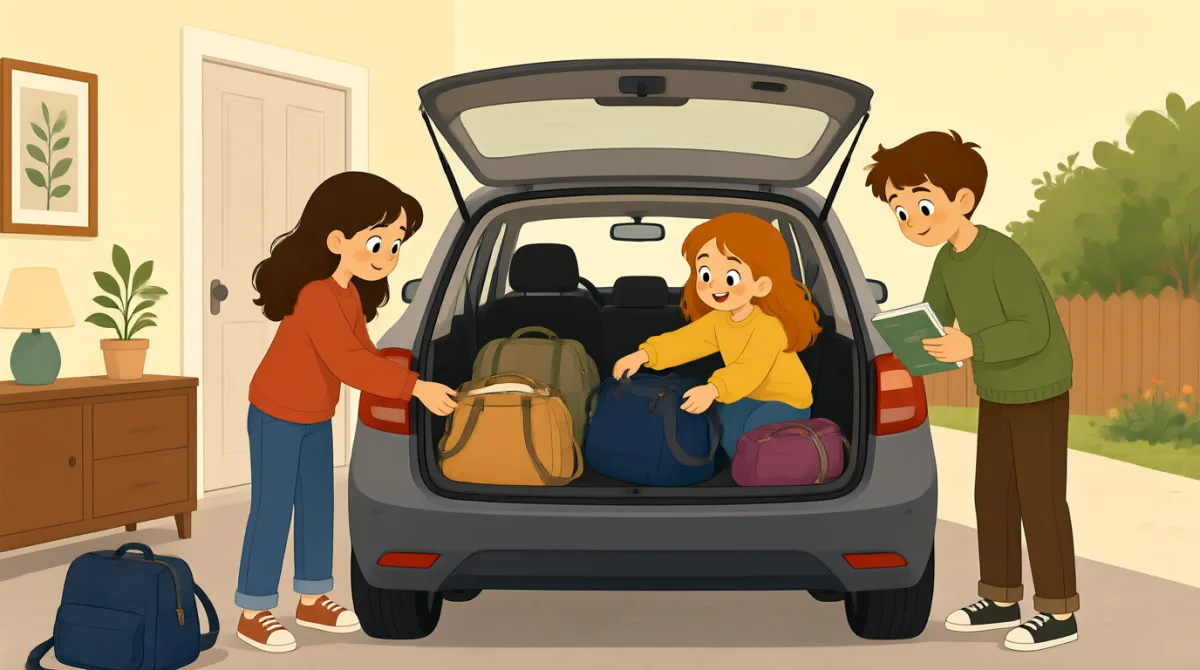

Okay, the trunk’s almost full already. Should we put the cooler in the back seat instead?
よし、もうトランクがほとんどいっぱいだね。クーラーボックスは代わりに後部座席に置く?

Maybe, but let’s keep the back seat clear if we can. We’ll need room for our jackets and snacks.
そうだね。でもできれば後部座席は空けておこう。上着やおやつを置くスペースが必要だから。

I can move my suitcase. It’s soft, so we could fit it beside the spare tire.
私のスーツケースを動かせるよ。柔らかいから、スペアタイヤの横に入れられると思う。
Good idea. I’ll put the first-aid kit and water bottles up front, where we can reach them easily.
いい考えだね。救急箱と水のボトルは前のほうに置くよ。すぐ手が届くところにね。
Let’s not block the rear window, though. I want to be able to see clearly when I’m driving.
でも、後ろの窓はふさがないようにしよう。運転するとき、ちゃんと見えるようにしておきたいんだ。
Right. And the phone chargers and road map should stay in the glove box, not buried under bags.
そうだね。それに、スマホの充電器と道路地図はグローブボックスに入れておこう。バッグの下に埋もれないようにね。
There’s still a loose bag rolling around. Can we tuck it between the cooler and the seat?
まだバッグが一つ、転がってるね。クーラーボックスと座席の間に押し込める?
Sure, but let’s check that everything’s secure before we go. I don’t want anything flying forward if I brake.
いいよ。でも出発前に、全部しっかり固定されてるか確認しよう。ブレーキをかけたときに、何かが前に飛んでくるのは困るから。
Essentials are easy to reach, and the window’s clear. I think we’re all set.
必要なものはすぐ手が届くし、窓もふさがってないね。これで準備できたと思う。
語彙8
- the trunk’s almost fullトランクがほとんどいっぱいだ
The trunk is the storage space at the back of a car. This phrase means there is very little room left in it.
「trunk」は車の後部にある荷物入れのことです。この表現は、もうほとんど空きスペースがないという意味です。
- keep the back seat clear後部座席を空けておく
This means not putting things on the back seat so it remains open and available. You can use “keep [a space] clear” when you want an area to stay free of objects.
これは、後部座席に物を置かず、空いた状態にしておくという意味です。場所に物を置かずに空けておきたいときは、“keep [a space] clear” を使えます。
- fit it beside the spare tireスペアタイヤの横に入れる
“Fit” means to put something into a space where it can be accommodated. “Beside” tells us the suitcase will go next to the spare tire.
“Fit” は、ある物をスペースに収まるように入れるという意味です。“Beside” は、スーツケースをスペアタイヤの横に置くことを表しています。
- reach them easily簡単に手が届く
This means being able to get or touch the items without difficulty. Use “easy to reach” for things you want to keep accessible.
これは、苦労せずに物を取ったり触ったりできるという意味です。すぐに使えるようにしておきたい物には、“easy to reach” を使います。
- block the rear window後ろの窓をふさぐ
To block the rear window means to cover or obstruct it so the driver cannot see through it clearly. The rear window is the back window of a car.
後ろの窓をふさぐとは、運転手が窓越しにはっきり見えないように、窓を覆ったり視界を遮ったりすることです。“rear window” は車の後ろ側の窓です。
- buried under bagsバッグの下に埋もれて
Here, “buried” means hidden beneath other things, so the items are difficult to find or get to. It can also describe something covered by a large amount of other objects.
ここでの “buried” は、ほかの物の下に隠れていて、見つけたり取り出したりするのが難しいという意味です。たくさんの物に覆われている様子を表すこともできます。
- tuck it between the cooler and the seatクーラーボックスと座席の間に押し込む
“Tuck” means to put something neatly into a small or available space. Use “between” to describe a place in the space separating two things.
“Tuck” は、狭い場所や空いているスペースに物をきちんと入れるという意味です。“Between” は、二つの物の間の場所を表すときに使います。
- flying forward if I brakeブレーキをかけたときに前に飛んでくる
This describes loose items moving toward the front of the car when the driver stops suddenly. “Brake” means to slow down or stop a vehicle.
運転手が急に止まったとき、固定されていない物が車の前方に動く様子を表しています。“Brake” は、乗り物の速度を落としたり止めたりすることです。
重要な文8
- 1
Should we put the cooler in the back seat instead?
代わりにクーラーボックスを後部座席に置く?
This is a natural way to suggest a different place for something. Use “Should we… instead?” to ask whether another option would be better.
これは、物を別の場所に置く案を提案するときの自然な言い方です。“Should we… instead?” を使うと、ほかの選択肢のほうがよいか尋ねられます。
- 2
We’ll need room for our jackets and snacks.
上着やおやつを置くスペースが必要だから。
This sentence gives a reason for keeping space available. Use “We’ll need room for…” when explaining what space is required for.
この文では、スペースを空けておく理由を伝えています。何のためにスペースが必要なのか説明するときは、“We’ll need room for…” を使えます。
- 3
I can move my suitcase.
私のスーツケースを動かせるよ。
This is a simple, helpful offer to change where something is. Use “I can…” to offer to do a task or solve a small problem.
これは、物の置き場所を変えることを申し出る簡潔で親切な言い方です。作業を引き受けたり、ちょっとした問題を解決したりするときは、“I can…” を使えます。
- 4
I’ll put the first-aid kit and water bottles up front, where we can reach them easily.
救急箱と水のボトルは前のほうに置くよ。すぐ手が届くところにね。
This explains both where items will go and why they will be placed there. You can use “I’ll put [items] [place], where…” to describe a plan and its purpose.
物をどこに置くかと、なぜそこに置くのかの両方を説明する文です。“I’ll put [items] [place], where…” を使うと、予定とその目的を伝えられます。
- 5
Let’s not block the rear window, though.
でも、後ろの窓はふさがないようにしよう。
This politely warns the group not to do something, while “though” adds a contrasting point. Use “Let’s not…” to suggest avoiding an action.
これは、何かをしないようにグループに伝えながら、“though” で対照的な点を付け加えています。“Let’s not…” を使うと、ある行動を避けようと提案できます。
- 6
The phone chargers and road map should stay in the glove box, not buried under bags.
スマホの充電器と道路地図はグローブボックスに入れておこう。バッグの下に埋もれないようにね。
This sentence states where important items should be kept and where they should not be. Use “should stay in…” to suggest a suitable place for something.
この文では、大事な物をどこに置くべきか、またどこに置くべきでないかを伝えています。物を置くのに適した場所を提案するときは、“should stay in…” を使えます。
- 7
Let’s check that everything’s secure before we go.
出発前に、全部しっかり固定されてるか確認しよう。
This is a useful way to suggest a final safety check. Use “Let’s check that…” before leaving or starting an activity.
これは、最後に安全確認をしようと提案するときに便利な言い方です。出発前や何かを始める前に確認を提案するときは、“Let’s check that…” を使います。
- 8
I don’t want anything flying forward if I brake.
ブレーキをかけたときに、何かが前に飛んでくるのは困るから。
This explains a safety concern and gives a reason for securing loose items. Use “I don’t want [something] happening if…” to describe an outcome you want to prevent.
これは、安全上の心配と、動きやすい物を固定する理由を伝えています。防ぎたい結果を説明するときは、“I don’t want [something] happening if…” を使えます。