Packing the Car
收拾行李装车
Before leaving, Emma, Mia, and Jack pack the car and check that they have the essentials. They rearrange their bags to make room and keep important items easy to reach.
出发前,Emma、Mia 和 Jack 把行李装进车里,并检查是否带齐必需品。他们调整行李摆放,腾出空间,也让重要物品方便拿取。
对话9
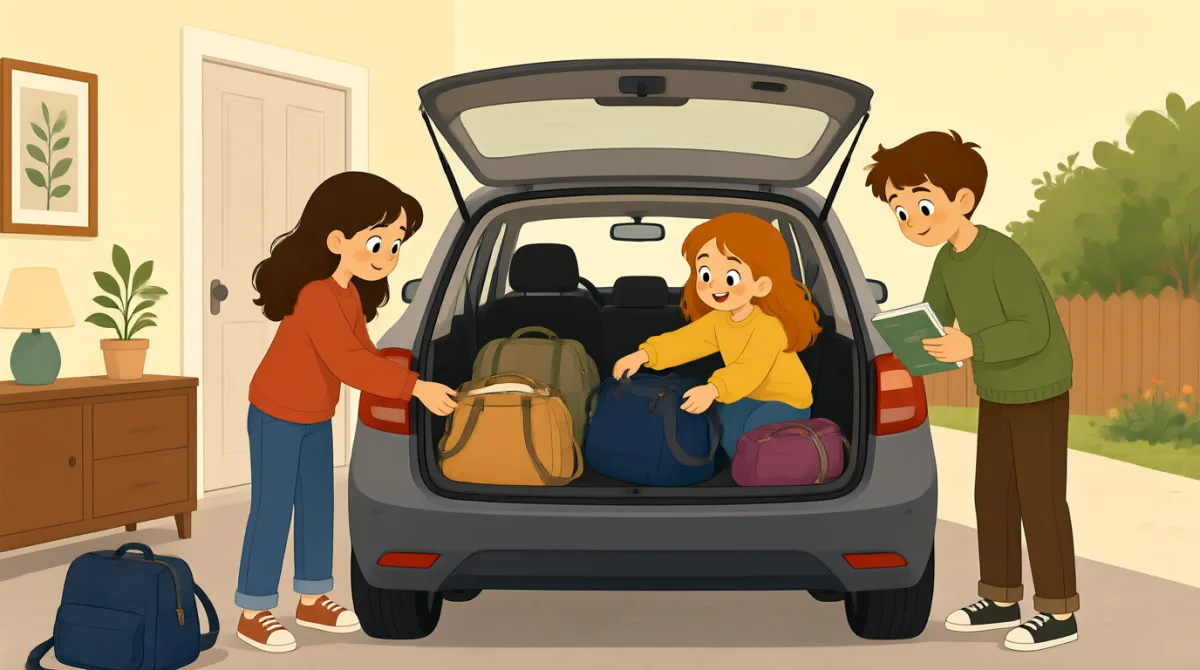

Okay, the trunk’s almost full already. Should we put the cooler in the back seat instead?
好吧,后备箱已经快装满了。我们要不要把冷藏箱放到后座?

Maybe, but let’s keep the back seat clear if we can. We’ll need room for our jackets and snacks.
也许可以,不过尽量把后座空出来吧。我们还得留地方放外套和零食。

I can move my suitcase. It’s soft, so we could fit it beside the spare tire.
我可以挪一下我的行李箱。它是软的,可以塞到备胎旁边。
Good idea. I’ll put the first-aid kit and water bottles up front, where we can reach them easily.
好主意。我把急救包和水瓶放在前面,这样我们拿起来方便。
Let’s not block the rear window, though. I want to be able to see clearly when I’m driving.
不过,别挡住后车窗。我开车时得看得清楚。
Right. And the phone chargers and road map should stay in the glove box, not buried under bags.
没错。手机充电器和路线图也应该放在手套箱里,别埋在行李下面。
There’s still a loose bag rolling around. Can we tuck it between the cooler and the seat?
还有个包在里面滚来滚去。我们能把它塞在冷藏箱和座椅之间吗?
Sure, but let’s check that everything’s secure before we go. I don’t want anything flying forward if I brake.
可以,不过出发前我们检查一下东西是不是都放稳了。我可不想一刹车,东西就飞到前面来。
Essentials are easy to reach, and the window’s clear. I think we’re all set.
必需品都放在方便拿的地方,车窗也没被挡住。我觉得都准备好了。
词汇8
- the trunk’s almost full后备箱快装满了
The trunk is the storage space at the back of a car. This phrase means there is very little room left in it.
后备箱是汽车后部用来放东西的空间。这个说法表示里面几乎没有剩余空间了。
- keep the back seat clear让后座保持空着
This means not putting things on the back seat so it remains open and available. You can use “keep [a space] clear” when you want an area to stay free of objects.
意思是别在后座上放东西,让它空着备用。想表达让某个地方不放东西、保持空着时,可以用“keep [a space] clear”。
- fit it beside the spare tire把它塞在备胎旁边
“Fit” means to put something into a space where it can be accommodated. “Beside” tells us the suitcase will go next to the spare tire.
“Fit”指把某样东西放进一个容得下它的空间里。“Beside”表示行李箱会放在备胎旁边。
- reach them easily方便拿到它们
This means being able to get or touch the items without difficulty. Use “easy to reach” for things you want to keep accessible.
意思是不用费力就能拿到或够到这些物品。想说某样东西放在方便拿取的地方,可以用“easy to reach”。
- block the rear window挡住后车窗
To block the rear window means to cover or obstruct it so the driver cannot see through it clearly. The rear window is the back window of a car.
“Block the rear window”指遮住或挡住后车窗,让司机无法清楚地透过车窗看出去。后车窗就是汽车后部的车窗。
- buried under bags埋在包底下
Here, “buried” means hidden beneath other things, so the items are difficult to find or get to. It can also describe something covered by a large amount of other objects.
这里的“buried”指被其他东西压在下面,因此很难找到或拿到。它也可以形容某样东西被大量物品盖住。
- tuck it between the cooler and the seat把它塞在冷藏箱和座椅之间
“Tuck” means to put something neatly into a small or available space. Use “between” to describe a place in the space separating two things.
“Tuck”指把东西整齐地塞进一处狭小或空着的空间里。用“between”来描述两样东西之间的空间。
- flying forward if I brake如果我刹车,东西就会往前飞
This describes loose items moving toward the front of the car when the driver stops suddenly. “Brake” means to slow down or stop a vehicle.
这描述的是司机突然停车时,没固定好的物品会朝车头方向移动。“Brake”指让车辆减速或停下来。
重点句子8
- 1
Should we put the cooler in the back seat instead?
要不把冷藏箱放到后座?
This is a natural way to suggest a different place for something. Use “Should we… instead?” to ask whether another option would be better.
这是自然地提出把某样东西放到另一个地方的说法。用“Should we… instead?”来询问另一个选择是不是更好。
- 2
We’ll need room for our jackets and snacks.
我们还得留地方放外套和零食。
This sentence gives a reason for keeping space available. Use “We’ll need room for…” when explaining what space is required for.
这句话说明了为什么要留出空间。解释需要腾出空间来放什么东西时,可以用“We’ll need room for…”。
- 3
I can move my suitcase.
我可以挪一下我的行李箱。
This is a simple, helpful offer to change where something is. Use “I can…” to offer to do a task or solve a small problem.
这是主动提出帮忙调整某样东西位置的简单说法。可以用“I can…”来表示愿意做某件事或解决一个小问题。
- 4
I’ll put the first-aid kit and water bottles up front, where we can reach them easily.
我会把急救包和水瓶放在前面,这样我们拿起来方便。
This explains both where items will go and why they will be placed there. You can use “I’ll put [items] [place], where…” to describe a plan and its purpose.
这句话既说明了东西要放在哪里,也解释了这样放的原因。可以用“I’ll put [items] [place], where…”来描述计划及其目的。
- 5
Let’s not block the rear window, though.
不过,咱们别挡住后车窗。
This politely warns the group not to do something, while “though” adds a contrasting point. Use “Let’s not…” to suggest avoiding an action.
这句话委婉地提醒大家不要做某件事,而“though”则补充了一个转折的想法。可以用“Let’s not…”来建议大家避免某个行动。
- 6
The phone chargers and road map should stay in the glove box, not buried under bags.
手机充电器和路线图应该放在手套箱里,别埋在包底下。
This sentence states where important items should be kept and where they should not be. Use “should stay in…” to suggest a suitable place for something.
这句话说明了重要物品应该放在哪里,以及不应该放在哪里。可以用“should stay in…”来建议某样东西适合放在什么地方。
- 7
Let’s check that everything’s secure before we go.
出发前我们检查一下东西是不是都放稳了。
This is a useful way to suggest a final safety check. Use “Let’s check that…” before leaving or starting an activity.
这是建议出发前做最后一次安全检查的实用说法。在出发或开始某项活动前,可以用“Let’s check that…”。
- 8
I don’t want anything flying forward if I brake.
我可不想一刹车,东西就飞到前面来。
This explains a safety concern and gives a reason for securing loose items. Use “I don’t want [something] happening if…” to describe an outcome you want to prevent.
这句话说明了对安全的担忧,也解释了为什么要固定好没放稳的物品。可以用“I don’t want [something] happening if…”来描述你想避免的情况。