Noticing the Broken Fence
壊れたフェンスに気づく
Jack notices that the fence between his yard and his neighbor Mia’s has started leaning. They take a closer look and talk about what needs fixing.
ジャックは、自分の庭と隣人のミアの庭の間にあるフェンスが傾き始めていることに気づく。二人で近くから確認し、どこを直す必要があるか話し合う。
会話8
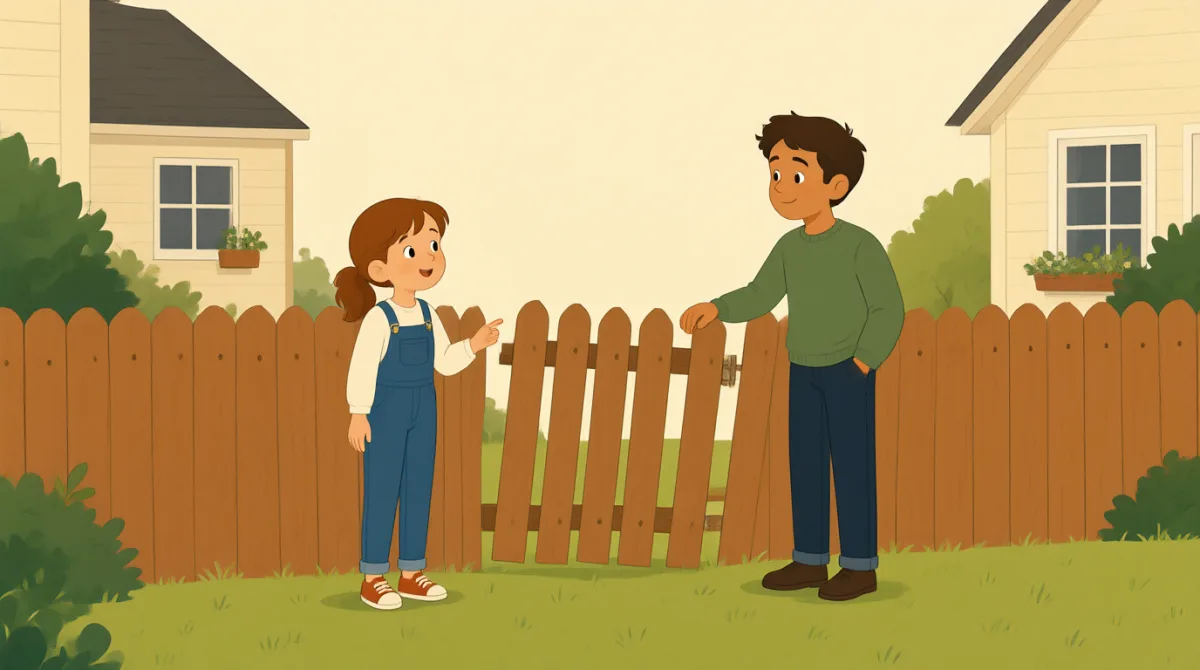

Hey, Mia, have you noticed the fence between our yards? It’s started leaning pretty badly near the back.
ねえ、ミア、うちの庭の間のフェンス、気づいてた?奥のほうがかなり傾き始めてるんだ。

Oh, I hadn’t seen that. Is it leaning toward your yard or mine?
あ、気づかなかった。そっちの庭側に傾いてるの?それとも私の庭側?
Toward mine, mostly. I spotted it this morning when I was taking out the trash.
ほとんどこっち側だね。今朝、ごみを出しに行ったときに気づいたんだ。
Let’s take a closer look. The boards look a little loose from here, too.
もう少し近くで見てみよう。ここから見ても、板がちょっと緩んでるみたいだね。
Yeah, this post is wobbly, and there’s a gap at the bottom. I think the ground shifted after all that rain.
うん、この支柱はぐらついてるし、下のほうに隙間もあるね。あの大雨のあとに地面が動いたんだと思う。
That makes sense. Do you think we can fix just this section, or does the whole fence need work?
なるほどね。この部分だけ直せばよさそう?それともフェンス全体を修理する必要があるかな?
Hard to tell yet. A couple of boards might need replacing, but we should check the posts before it gets worse.
まだ何とも言えないね。板を何枚か交換する必要があるかもしれないけど、もっとひどくなる前に支柱も確認したほうがいいね。
Agreed. Let’s figure out what needs fixing first. Then we can look into the cost and decide what to do.
そうだね。まず、どこを直す必要があるか確認しよう。それから費用を調べて、どうするか決めよう。
語彙8
- started leaning傾き始めた
Began to tilt to one side. Use this to describe something that is no longer standing straight.
片側に傾き始めた、という意味です。まっすぐ立っていたものが傾いてきたときに使います。
- take a closer lookもう少し近くで見る
Look at something more carefully. You can use this when you want to inspect a problem together.
何かをもっと注意深く見ることです。問題を一緒に詳しく確認したいときに使えます。
- wobblyぐらついている
Unsteady and moving from side to side. Here, it describes a fence post that may need repair.
不安定で、左右に揺れることです。ここでは、修理が必要かもしれないフェンスの支柱を表しています。
- a gap at the bottom下のほうに隙間がある
An open space near the lower edge of something. Use this phrase to point out a space that should not be there.
何かの下端近くに空間があることです。本来あるはずのない隙間を指摘するときに使えます。
- the ground shifted地面が動いた
The earth moved or changed position. This phrase can explain why a fence or other structure has become unstable.
地面が動いたり、位置が変わったりしたという意味です。フェンスなどの構造物が不安定になった理由を説明するときに使えます。
- Hard to tell yet.まだ何とも言えないね。
It is not possible to know for sure at this time. Use this short response when you need more information before deciding.
今の時点では、確かなことがわからないという意味です。判断する前にもっと情報が必要なときに使える短い返事です。
- need replacing交換する必要がある
Need to be removed and replaced with new ones. Use this phrase when something is too damaged to keep using.
取り外して、新しいものに替える必要があるという意味です。傷みがひどく、そのまま使い続けられないものについて話すときに使います。
- look into the cost費用を調べる
Find out how much something will cost. You can use this phrase when you are considering a repair or purchase.
いくらかかるかを確認することです。修理や購入を検討しているときに使えます。
重要な文8
- 1
It’s started leaning pretty badly near the back.
奥のほうがかなり傾き始めてるんだ。
This sentence clearly describes a problem and says where it is. Reuse “It’s started [doing something]” to report a recent change.
問題の内容と場所をはっきり伝える文です。“It’s started [doing something]”を使うと、最近起きた変化を伝えられます。
- 2
Let’s take a closer look.
もう少し近くで見てみよう。
This is a natural way to suggest examining something more carefully together. You can use it when checking a problem or detail.
何かを一緒にもっと注意深く調べようと提案する自然な言い方です。問題や細かい点を確認するときに使えます。
- 3
I think the ground shifted after all that rain.
あの大雨のあとに地面が動いたんだと思う。
This sentence gives a possible reason for what happened. Reuse “I think [something happened] after [event]” to explain a likely cause.
何かが起きた理由として、可能性のあるものを挙げる文です。“I think [something happened] after [event]”を使うと、起きたことの原因として考えられることを説明できます。
- 4
Do you think we can fix just this section, or does the whole fence need work?
この部分だけ直せばよさそう?それともフェンス全体を修理する必要があるかな?
This is a useful way to ask whether a repair can be limited or needs to be larger. Reuse the “just this …, or the whole …?” structure when comparing options.
修理を一部分だけで済ませられるのか、もっと大がかりな修理が必要なのかを尋ねるのに便利な表現です。“just this …, or the whole …?”の形を使うと、選択肢を比べられます。
- 5
Hard to tell yet.
まだ何とも言えないね。
This short, conversational response says you do not have enough information to decide. You can use it before checking something more carefully.
判断するには情報が足りないと伝える、短くて会話らしい返事です。何かを詳しく確認する前に使えます。
- 6
A couple of boards might need replacing, but we should check the posts before it gets worse.
板を何枚か交換する必要があるかもしれないけど、もっとひどくなる前に支柱も確認したほうがいいね。
This sentence identifies a possible repair and suggests a sensible next step. Reuse “might need [action], but we should [next step]” to discuss uncertain problems.
必要かもしれない修理を挙げたうえで、次にすべきことを提案する文です。“might need [action], but we should [next step]”を使うと、まだはっきりしない問題について話せます。
- 7
Let’s figure out what needs fixing first.
まず、どこを直す必要があるか確認しよう。
This is a practical way to suggest identifying the problem before making a plan. You can use “Let’s figure out…” to propose solving something together.
計画を立てる前に、問題点を特定しようと提案する実用的な言い方です。“Let’s figure out…”を使うと、何かを一緒に解決しようと提案できます。
- 8
Then we can look into the cost and decide what to do.
それから費用を調べて、どうするか決めよう。
This sentence lays out a clear next step after assessing a problem. Reuse “look into the cost” when you need to find out the price before deciding.
問題を確認したあとの次の段取りを、わかりやすく示す文です。決める前に価格を調べたいときは、“look into the cost”を使えます。