Noticing the Broken Fence
Jack notices that the fence between his yard and his neighbor Mia’s has started leaning. They take a closer look and talk about what needs fixing.
Dialogue8
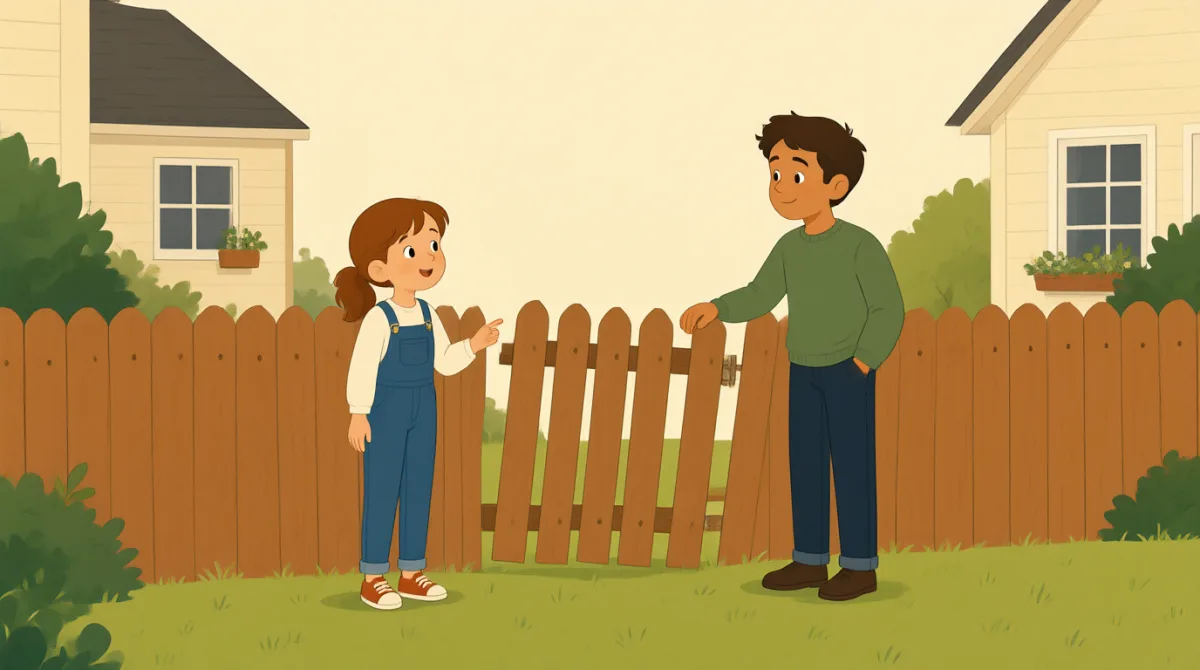

Hey, Mia, have you noticed the fence between our yards? It’s started leaning pretty badly near the back.

Oh, I hadn’t seen that. Is it leaning toward your yard or mine?
Toward mine, mostly. I spotted it this morning when I was taking out the trash.
Let’s take a closer look. The boards look a little loose from here, too.
Yeah, this post is wobbly, and there’s a gap at the bottom. I think the ground shifted after all that rain.
That makes sense. Do you think we can fix just this section, or does the whole fence need work?
Hard to tell yet. A couple of boards might need replacing, but we should check the posts before it gets worse.
Agreed. Let’s figure out what needs fixing first. Then we can look into the cost and decide what to do.
Vocabulary8
- started leaning
Began to tilt to one side. Use this to describe something that is no longer standing straight.
- take a closer look
Look at something more carefully. You can use this when you want to inspect a problem together.
- wobbly
Unsteady and moving from side to side. Here, it describes a fence post that may need repair.
- a gap at the bottom
An open space near the lower edge of something. Use this phrase to point out a space that should not be there.
- the ground shifted
The earth moved or changed position. This phrase can explain why a fence or other structure has become unstable.
- Hard to tell yet.
It is not possible to know for sure at this time. Use this short response when you need more information before deciding.
- need replacing
Need to be removed and replaced with new ones. Use this phrase when something is too damaged to keep using.
- look into the cost
Find out how much something will cost. You can use this phrase when you are considering a repair or purchase.
Key Sentences8
- 1
It’s started leaning pretty badly near the back.
This sentence clearly describes a problem and says where it is. Reuse “It’s started [doing something]” to report a recent change.
- 2
Let’s take a closer look.
This is a natural way to suggest examining something more carefully together. You can use it when checking a problem or detail.
- 3
I think the ground shifted after all that rain.
This sentence gives a possible reason for what happened. Reuse “I think [something happened] after [event]” to explain a likely cause.
- 4
Do you think we can fix just this section, or does the whole fence need work?
This is a useful way to ask whether a repair can be limited or needs to be larger. Reuse the “just this …, or the whole …?” structure when comparing options.
- 5
Hard to tell yet.
This short, conversational response says you do not have enough information to decide. You can use it before checking something more carefully.
- 6
A couple of boards might need replacing, but we should check the posts before it gets worse.
This sentence identifies a possible repair and suggests a sensible next step. Reuse “might need [action], but we should [next step]” to discuss uncertain problems.
- 7
Let’s figure out what needs fixing first.
This is a practical way to suggest identifying the problem before making a plan. You can use “Let’s figure out…” to propose solving something together.
- 8
Then we can look into the cost and decide what to do.
This sentence lays out a clear next step after assessing a problem. Reuse “look into the cost” when you need to find out the price before deciding.