Noticing the Broken Fence
Al notar que la cerca está rota
Jack notices that the fence between his yard and his neighbor Mia’s has started leaning. They take a closer look and talk about what needs fixing.
Jack se da cuenta de que la cerca entre su patio y el de su vecina Mia ha empezado a inclinarse. La miran más de cerca y hablan de lo que hay que arreglar.
Diálogo8
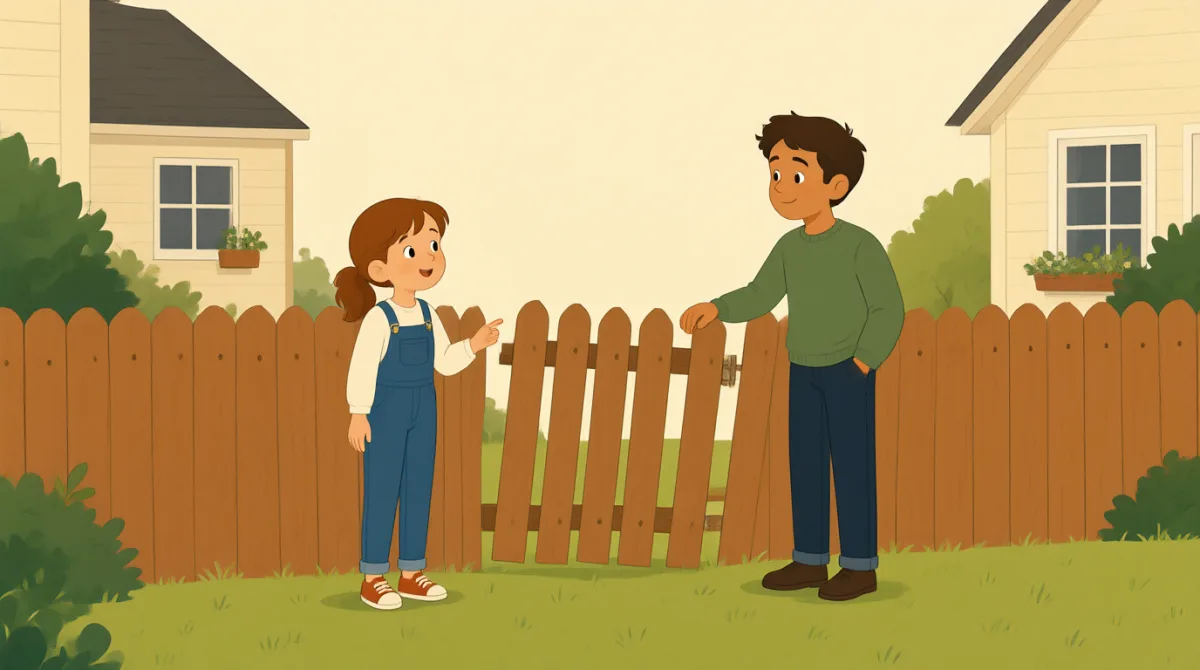

Hey, Mia, have you noticed the fence between our yards? It’s started leaning pretty badly near the back.
Oye, Mia, ¿te has fijado en la cerca entre nuestros patios? Ha empezado a inclinarse bastante hacia atrás.

Oh, I hadn’t seen that. Is it leaning toward your yard or mine?
Ah, no me había dado cuenta. ¿Se inclina hacia tu patio o hacia el mío?
Toward mine, mostly. I spotted it this morning when I was taking out the trash.
Más que nada, hacia el mío. Lo noté esta mañana cuando estaba sacando la basura.
Let’s take a closer look. The boards look a little loose from here, too.
Vamos a mirarla más de cerca. Desde aquí, las tablas también parecen un poco sueltas.
Yeah, this post is wobbly, and there’s a gap at the bottom. I think the ground shifted after all that rain.
Sí, este poste se tambalea y hay un hueco en la parte de abajo. Creo que el suelo se movió después de tanta lluvia.
That makes sense. Do you think we can fix just this section, or does the whole fence need work?
Tiene sentido. ¿Crees que podemos arreglar solo esta parte o hay que reparar toda la cerca?
Hard to tell yet. A couple of boards might need replacing, but we should check the posts before it gets worse.
Todavía es difícil saberlo. Puede que haya que cambiar un par de tablas, pero deberíamos revisar los postes antes de que empeore.
Agreed. Let’s figure out what needs fixing first. Then we can look into the cost and decide what to do.
De acuerdo. Primero veamos qué hay que arreglar. Después averiguamos cuánto costaría y decidimos qué hacer.
Vocabulario8
- started leaningha empezado a inclinarse
Began to tilt to one side. Use this to describe something that is no longer standing straight.
Empezó a ladearse hacia un lado. Se usa para describir algo que ya no está derecho.
- take a closer lookmirar más de cerca
Look at something more carefully. You can use this when you want to inspect a problem together.
Examinar algo con más atención. Puedes usar esta expresión cuando quieras inspeccionar un problema junto con otra persona.
- wobblytambaleante
Unsteady and moving from side to side. Here, it describes a fence post that may need repair.
Inestable y que se mueve de un lado a otro. Aquí describe un poste de cerca que quizá necesite reparación.
- a gap at the bottomun hueco en la parte de abajo
An open space near the lower edge of something. Use this phrase to point out a space that should not be there.
Un espacio abierto cerca del borde inferior de algo. Usa esta expresión para señalar un espacio que no debería estar ahí.
- the ground shiftedel suelo se movió
The earth moved or changed position. This phrase can explain why a fence or other structure has become unstable.
La tierra se desplazó o cambió de posición. Esta expresión puede explicar por qué una cerca u otra estructura se ha vuelto inestable.
- Hard to tell yet.Todavía es difícil saberlo.
It is not possible to know for sure at this time. Use this short response when you need more information before deciding.
Por ahora no se puede saber con certeza. Usa esta respuesta breve cuando necesites más información antes de decidir.
- need replacinghay que cambiar
Need to be removed and replaced with new ones. Use this phrase when something is too damaged to keep using.
Es necesario quitar algo y poner algo nuevo en su lugar. Usa esta expresión cuando algo está demasiado dañado para seguir usándolo.
- look into the costaveriguar cuánto cuesta
Find out how much something will cost. You can use this phrase when you are considering a repair or purchase.
Descubrir cuánto costará algo. Puedes usar esta expresión cuando estés pensando en hacer una reparación o una compra.
Frases clave8
- 1
It’s started leaning pretty badly near the back.
Ha empezado a inclinarse bastante hacia atrás.
This sentence clearly describes a problem and says where it is. Reuse “It’s started [doing something]” to report a recent change.
Esta frase describe claramente un problema e indica dónde está. Puedes reutilizar “It’s started [doing something]” para contar que algo ha cambiado hace poco.
- 2
Let’s take a closer look.
Vamos a mirarla más de cerca.
This is a natural way to suggest examining something more carefully together. You can use it when checking a problem or detail.
Esta es una forma natural de proponer que examinen algo con más atención juntos. Puedes usarla al revisar un problema o un detalle.
- 3
I think the ground shifted after all that rain.
Creo que el suelo se movió después de tanta lluvia.
This sentence gives a possible reason for what happened. Reuse “I think [something happened] after [event]” to explain a likely cause.
Esta frase ofrece una posible razón de lo ocurrido. Puedes reutilizar “I think [something happened] after [event]” para explicar una causa probable.
- 4
Do you think we can fix just this section, or does the whole fence need work?
¿Crees que podemos arreglar solo esta parte o hay que reparar toda la cerca?
This is a useful way to ask whether a repair can be limited or needs to be larger. Reuse the “just this …, or the whole …?” structure when comparing options.
Esta es una forma útil de preguntar si la reparación puede limitarse a una parte o si debe ser más amplia. Puedes reutilizar la estructura “just this …, or the whole …?” al comparar opciones.
- 5
Hard to tell yet.
Todavía es difícil saberlo.
This short, conversational response says you do not have enough information to decide. You can use it before checking something more carefully.
Esta respuesta breve y conversacional indica que no tienes suficiente información para decidir. Puedes usarla antes de revisar algo con más atención.
- 6
A couple of boards might need replacing, but we should check the posts before it gets worse.
Puede que haya que cambiar un par de tablas, pero deberíamos revisar los postes antes de que empeore.
This sentence identifies a possible repair and suggests a sensible next step. Reuse “might need [action], but we should [next step]” to discuss uncertain problems.
Esta frase señala una posible reparación y propone un siguiente paso sensato. Puedes reutilizar “might need [action], but we should [next step]” para hablar de problemas cuya solución aún no está clara.
- 7
Let’s figure out what needs fixing first.
Primero veamos qué hay que arreglar.
This is a practical way to suggest identifying the problem before making a plan. You can use “Let’s figure out…” to propose solving something together.
Esta es una forma práctica de proponer que identifiquen el problema antes de hacer un plan. Puedes usar “Let’s figure out…” para proponer resolver algo juntos.
- 8
Then we can look into the cost and decide what to do.
Después averiguamos cuánto costaría y decidimos qué hacer.
This sentence lays out a clear next step after assessing a problem. Reuse “look into the cost” when you need to find out the price before deciding.
Esta frase plantea un siguiente paso claro después de evaluar un problema. Puedes reutilizar “look into the cost” cuando necesites averiguar el precio antes de decidir.