Noticing the Broken Fence
망가진 울타리 살펴보기
Jack notices that the fence between his yard and his neighbor Mia’s has started leaning. They take a closer look and talk about what needs fixing.
잭은 자기 마당과 이웃 미아의 마당 사이에 있는 울타리가 기울기 시작한 걸 알아차려요. 둘은 가까이 가서 살펴보고 무엇을 고쳐야 할지 이야기해요.
대화8
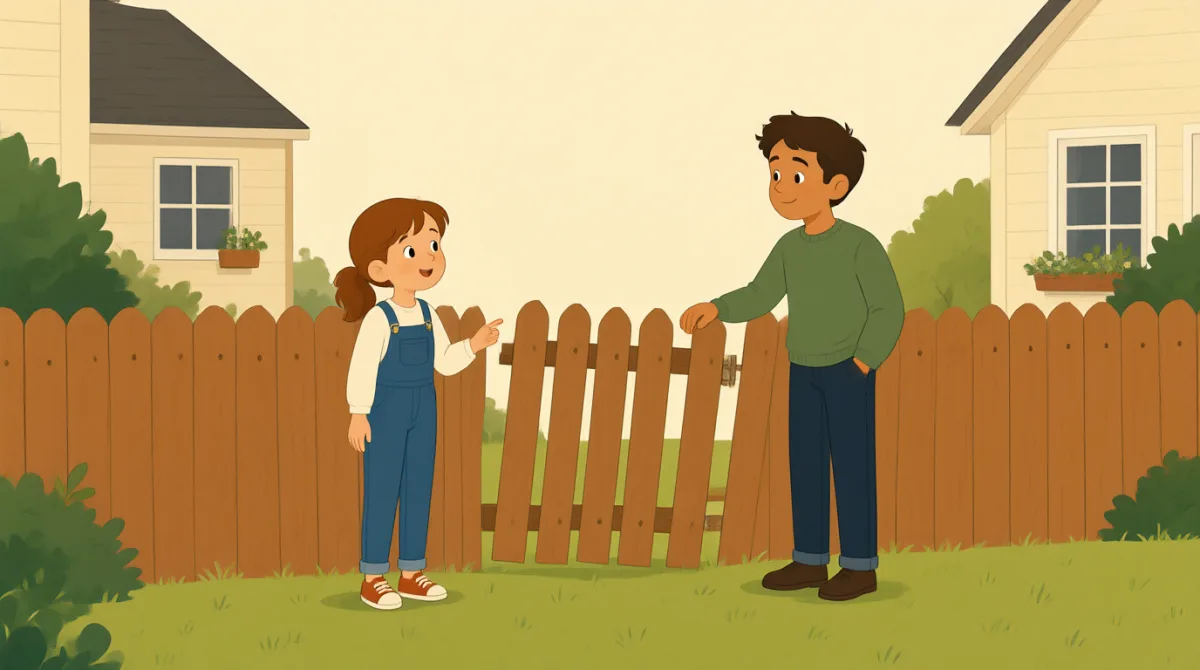

Hey, Mia, have you noticed the fence between our yards? It’s started leaning pretty badly near the back.
미아, 우리 마당 사이에 있는 울타리 봤어? 뒤쪽이 꽤 많이 기울기 시작했어.

Oh, I hadn’t seen that. Is it leaning toward your yard or mine?
아, 난 못 봤어. 네 마당 쪽으로 기울었어, 아니면 내 쪽으로?
Toward mine, mostly. I spotted it this morning when I was taking out the trash.
대부분 내 쪽으로 기울었어. 오늘 아침에 쓰레기 버리러 나갔다가 봤어.
Let’s take a closer look. The boards look a little loose from here, too.
가까이 가서 살펴보자. 여기서 봐도 판자들이 좀 헐거워 보여.
Yeah, this post is wobbly, and there’s a gap at the bottom. I think the ground shifted after all that rain.
그러네. 이 기둥이 흔들리고, 밑에 틈도 있어. 비가 그렇게 많이 온 뒤에 땅이 움직인 것 같아.
That makes sense. Do you think we can fix just this section, or does the whole fence need work?
그럴 만하네. 이 부분만 고치면 될까, 아니면 울타리 전체를 손봐야 할까?
Hard to tell yet. A couple of boards might need replacing, but we should check the posts before it gets worse.
아직은 잘 모르겠어. 판자 몇 개는 교체해야 할지도 모르지만, 더 심해지기 전에 기둥들을 확인해야 해.
Agreed. Let’s figure out what needs fixing first. Then we can look into the cost and decide what to do.
맞아. 우선 뭐가 고장 났는지부터 알아보자. 그다음에 비용을 알아보고 어떻게 할지 정하면 돼.
어휘8
- started leaning기울기 시작하다
Began to tilt to one side. Use this to describe something that is no longer standing straight.
한쪽으로 기울기 시작했다는 뜻이에요. 똑바로 서 있지 않게 된 것을 묘사할 때 써요.
- take a closer look가까이서 자세히 살펴보다
Look at something more carefully. You can use this when you want to inspect a problem together.
무언가를 더 주의 깊게 보는 거예요. 함께 문제를 점검하고 싶을 때 쓸 수 있어요.
- wobbly흔들리는
Unsteady and moving from side to side. Here, it describes a fence post that may need repair.
안정되지 않고 이리저리 움직이는 상태예요. 여기서는 수리가 필요할 수도 있는 울타리 기둥을 묘사해요.
- a gap at the bottom아래쪽에 난 틈
An open space near the lower edge of something. Use this phrase to point out a space that should not be there.
무언가의 아래 가장자리 근처에 생긴 빈 공간이에요. 없어야 할 틈을 가리킬 때 쓰는 표현이에요.
- the ground shifted땅이 움직였다
The earth moved or changed position. This phrase can explain why a fence or other structure has become unstable.
땅이 움직이거나 위치가 바뀌었다는 뜻이에요. 울타리 같은 구조물이 불안정해진 이유를 설명할 때 쓸 수 있어요.
- Hard to tell yet.아직은 잘 모르겠어.
It is not possible to know for sure at this time. Use this short response when you need more information before deciding.
지금은 확실히 알 수 없다는 뜻이에요. 결정하기 전에 더 많은 정보가 필요할 때 짧게 대답하는 표현이에요.
- need replacing교체해야 하다
Need to be removed and replaced with new ones. Use this phrase when something is too damaged to keep using.
기존 것을 빼고 새것으로 바꿔야 한다는 뜻이에요. 너무 손상돼서 계속 쓸 수 없는 것을 말할 때 써요.
- look into the cost비용을 알아보다
Find out how much something will cost. You can use this phrase when you are considering a repair or purchase.
무언가에 비용이 얼마나 드는지 알아보는 거예요. 수리나 구매를 고려할 때 쓸 수 있어요.
핵심 문장8
- 1
It’s started leaning pretty badly near the back.
뒤쪽이 꽤 많이 기울기 시작했어.
This sentence clearly describes a problem and says where it is. Reuse “It’s started [doing something]” to report a recent change.
이 문장은 문제가 무엇인지 분명히 설명하고 어디에 있는지도 알려줘요. 최근에 달라진 점을 말할 때 “It’s started [doing something]”을 활용해 보세요.
- 2
Let’s take a closer look.
가까이 가서 살펴보자.
This is a natural way to suggest examining something more carefully together. You can use it when checking a problem or detail.
함께 무언가를 더 자세히 살펴보자고 제안할 때 자연스럽게 쓸 수 있는 표현이에요. 문제나 세부 사항을 확인할 때 사용해 보세요.
- 3
I think the ground shifted after all that rain.
비가 그렇게 많이 온 뒤에 땅이 움직인 것 같아.
This sentence gives a possible reason for what happened. Reuse “I think [something happened] after [event]” to explain a likely cause.
이 문장은 어떤 일이 일어난 이유를 추측해서 말해요. 그럴듯한 원인을 설명할 때 “I think [something happened] after [event]”를 활용해 보세요.
- 4
Do you think we can fix just this section, or does the whole fence need work?
이 부분만 고치면 될까, 아니면 울타리 전체를 손봐야 할까?
This is a useful way to ask whether a repair can be limited or needs to be larger. Reuse the “just this …, or the whole …?” structure when comparing options.
수리를 일부만 하면 되는지 아니면 더 크게 해야 하는지 물을 때 유용한 표현이에요. 선택지를 비교할 때 “just this …, or the whole …?” 구조를 활용해 보세요.
- 5
Hard to tell yet.
아직은 잘 모르겠어.
This short, conversational response says you do not have enough information to decide. You can use it before checking something more carefully.
결정하기에 정보가 충분하지 않다는 뜻의 짧고 일상적인 대답이에요. 무언가를 더 자세히 확인하기 전에 쓸 수 있어요.
- 6
A couple of boards might need replacing, but we should check the posts before it gets worse.
판자 몇 개는 교체해야 할지도 모르지만, 더 심해지기 전에 기둥들을 확인해야 해.
This sentence identifies a possible repair and suggests a sensible next step. Reuse “might need [action], but we should [next step]” to discuss uncertain problems.
이 문장은 필요할 수도 있는 수리를 말하고 합리적인 다음 단계도 제안해요. 확실하지 않은 문제를 이야기할 때 “might need [action], but we should [next step]”을 활용해 보세요.
- 7
Let’s figure out what needs fixing first.
우선 뭐가 고장 났는지부터 알아보자.
This is a practical way to suggest identifying the problem before making a plan. You can use “Let’s figure out…” to propose solving something together.
계획을 세우기 전에 문제부터 파악하자고 제안하는 실용적인 표현이에요. 함께 해결책을 찾자고 할 때 “Let’s figure out…”을 써 보세요.
- 8
Then we can look into the cost and decide what to do.
그다음에 비용을 알아보고 어떻게 할지 정하면 돼.
This sentence lays out a clear next step after assessing a problem. Reuse “look into the cost” when you need to find out the price before deciding.
문제를 살펴본 다음 무엇을 할지 순서대로 제안하는 문장이에요. 결정하기 전에 가격을 알아봐야 할 때 “look into the cost”를 활용해 보세요.