A Home Run!
Un coup de circuit !
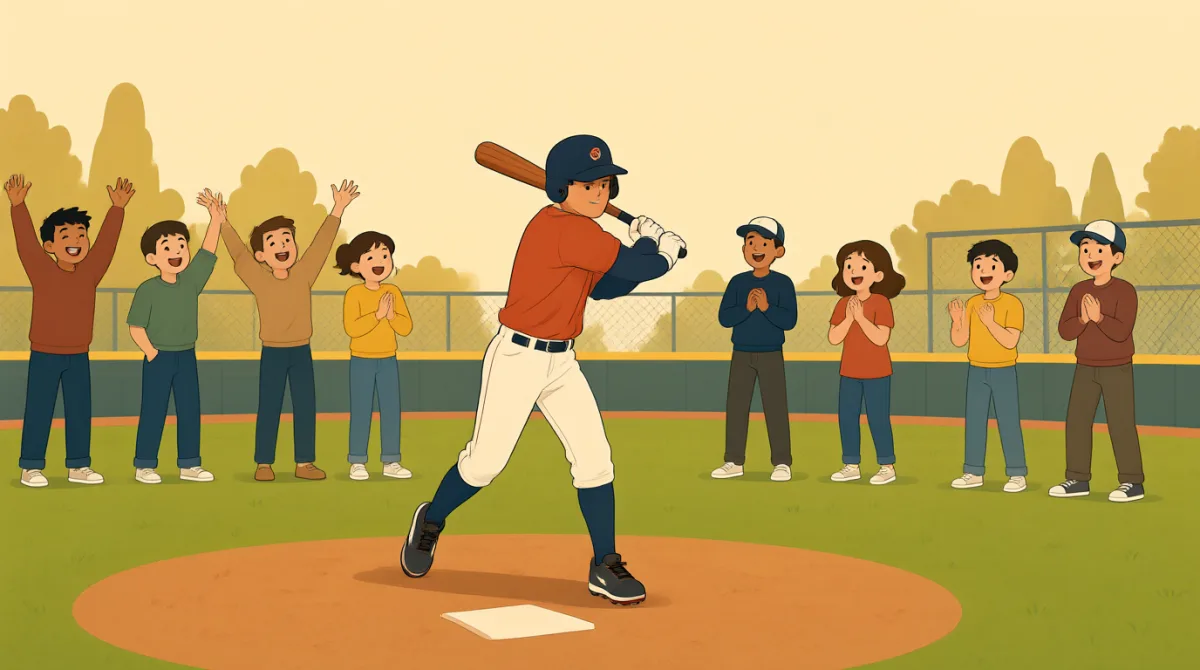
The batter hits a home run, and everyone cheers. The friends talk about the exciting play and enjoy the game.
Le frappeur réussit un coup de circuit et tout le monde applaudit. Les amis parlent de cette action spectaculaire et profitent du match.
Dialogue8

Wow, that ball is flying so high! Is it going over the wall?
Waouh, cette balle vole vraiment haut ! Elle va passer par-dessus le mur ?

It’s gone! That’s a home run! Everyone’s cheering!
Elle est sortie ! C’est un coup de circuit ! Tout le monde applaudit !

Yes! The batter hit the ball out of the park. Our team gets a run.
Oui ! Le frappeur a envoyé la balle hors du terrain. Notre équipe marque un point.
That was amazing! Does the batter run around all the bases now?
C’était incroyable ! Le frappeur va faire le tour de toutes les bases maintenant ?
That’s right. He runs past first, second, and third base, then comes home.
C’est ça. Il passe par la première, la deuxième et la troisième base, puis il revient au marbre.
He made it! What a great play. I’m glad we came today.
Il a réussi ! Quelle belle action ! Je suis content qu’on soit venus aujourd’hui.
Me too! The crowd is so loud. I want to watch another inning.
Moi aussi ! Le public fait tellement de bruit. J’ai envie de regarder une autre manche.
Let’s enjoy the game. Maybe our team will hit another home run!
Profitons du match. Peut-être que notre équipe va réussir un autre coup de circuit !
Vocabulaire8
- home runcoup de circuit
A home run is a hit that lets the batter run around all the bases and score. Here, the ball goes over the wall.
Un “home run” est une frappe qui permet au frappeur de faire le tour des bases et de marquer un point. Ici, la balle passe par-dessus le mur.
- cheeringapplaudir, acclamer
Cheering means shouting to show that you are happy or excited. Fans cheer when their team makes a great play.
“Cheering” signifie crier pour montrer qu’on est content ou enthousiaste. Les supporters applaudissent et acclament leur équipe quand elle réussit une belle action.
- out of the parkhors du terrain
This phrase means hitting the ball beyond the edge of the baseball field. It can also describe doing something very successfully.
L’expression “out of the park” signifie envoyer la balle au-delà des limites du terrain de baseball. Elle peut aussi décrire une grande réussite.
- basesbases
Bases are the four places a player runs to score in baseball. The batter runs past each base and then comes home.
Les “bases” sont les quatre endroits que les joueurs doivent atteindre pour marquer au baseball. Le frappeur passe par chaque base avant de revenir au marbre.
- made itréussir, y arriver
This means that someone succeeded in reaching a place or completing something. Here, the batter reaches home plate safely.
“Made it” signifie que quelqu’un a réussi à atteindre un endroit ou à accomplir quelque chose. Ici, le frappeur arrive au marbre sans être éliminé.
- crowdpublic
A crowd is a large group of people in one place. At a game, the crowd may cheer loudly.
Une “crowd” est un grand groupe de personnes réunies au même endroit. Pendant un match, le public peut applaudir et crier très fort.
- inningmanche
An inning is one part of a baseball game. You can use this word when talking about how much of the game you want to watch.
Une “inning” est une période d’un match de baseball, appelée une manche en français. Tu peux utiliser ce mot pour parler de la partie du match que tu veux regarder.
- hit another home runréussir un autre coup de circuit
This means to hit the ball out of the park again. You can use it to talk about what you hope a baseball player will do.
“Hit another home run” signifie envoyer une nouvelle fois la balle hors du terrain. Tu peux employer cette expression pour dire ce que tu espères qu’un joueur de baseball fera.
Phrases clés8
- 1
Is it going over the wall?
Elle va passer par-dessus le mur ?
Use this question when you think something may pass over a barrier. You can also ask, “Is it going over the fence?”
Pose cette question quand tu penses que quelque chose pourrait passer par-dessus un obstacle. Tu peux aussi demander : “Is it going over the fence?” (Est-ce que ça va passer par-dessus la clôture ?)
- 2
That’s a home run!
C’est un coup de circuit !
This is a short, excited way to say that a batter has hit a home run. You can use “That’s a [thing]!” to react to something you see.
C’est une façon brève et enthousiaste de dire qu’un frappeur a réussi un coup de circuit. Tu peux utiliser “That’s a [thing]!” pour réagir à quelque chose que tu vois.
- 3
Our team gets a run.
Notre équipe marque un point.
This sentence explains that your team scores a point in baseball. You can replace “our team” with another team or player.
Cette phrase explique que ton équipe marque un point au baseball. Tu peux remplacer “our team” par le nom d’une autre équipe ou d’un joueur.
- 4
Does the batter run around all the bases now?
Le frappeur va faire le tour de toutes les bases maintenant ?
Use this question to ask what happens next. The present simple with “does” is useful for asking about rules or usual actions.
Pose cette question pour demander ce qui se passe ensuite. Le présent simple avec “does” permet de poser des questions sur les règles ou sur ce qui se passe habituellement.
- 5
I’m glad we came today.
Je suis content qu’on soit venus aujourd’hui.
Use this phrase to say you feel happy about a choice or experience. You can change the ending, as in “I’m glad we came to the game.”
Utilise cette phrase pour dire que tu es heureux d’avoir fait un choix ou vécu une expérience. Tu peux changer la fin, comme dans “I’m glad we came to the game.” (Je suis content qu’on soit venus au match.)
- 6
The crowd is so loud.
Le public fait tellement de bruit.
This is a simple way to describe the sound of a large group of people. Replace “loud” with another adjective to describe the crowd.
C’est une façon simple de décrire le bruit produit par un grand groupe de personnes. Remplace “loud” par un autre adjectif pour décrire le public.
- 7
I want to watch another inning.
J’ai envie de regarder une autre manche.
Use “I want to” to say what you would like to do. You can replace “watch another inning” with another activity.
Utilise “I want to” pour dire ce que tu aimerais faire. Tu peux remplacer “watch another inning” par une autre activité.
- 8
Maybe our team will hit another home run!
Peut-être que notre équipe va réussir un autre coup de circuit !
Use “Maybe” and “will” to talk about something that could happen in the future. You can replace “hit another home run” with another possible action.
Utilise “Maybe” et “will” pour parler de quelque chose qui pourrait se produire à l’avenir. Tu peux remplacer “hit another home run” par une autre action possible.