A Home Run!
Um home run!
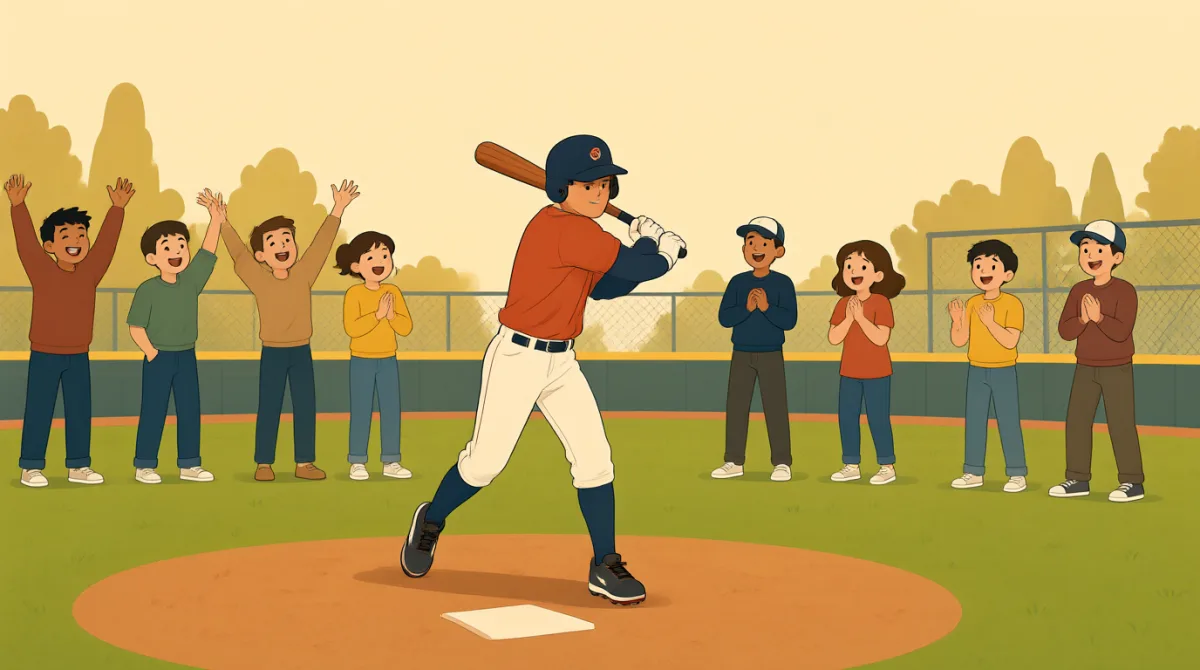
The batter hits a home run, and everyone cheers. The friends talk about the exciting play and enjoy the game.
O rebatedor acerta um home run, e todos comemoram. Os amigos conversam sobre a jogada emocionante e curtem o jogo.
Diálogo8

Wow, that ball is flying so high! Is it going over the wall?
Uau, a bola está voando tão alto! Será que vai passar por cima do muro?

It’s gone! That’s a home run! Everyone’s cheering!
Foi pra fora! Isso é um home run! Todo mundo está comemorando!

Yes! The batter hit the ball out of the park. Our team gets a run.
Isso! O rebatedor mandou a bola para fora do campo. Nosso time marca um ponto.
That was amazing! Does the batter run around all the bases now?
Que jogada incrível! Agora o rebatedor vai passar por todas as bases?
That’s right. He runs past first, second, and third base, then comes home.
Isso mesmo. Ele passa pela primeira, segunda e terceira base e depois chega ao home plate.
He made it! What a great play. I’m glad we came today.
Ele conseguiu! Que jogada incrível. Ainda bem que viemos hoje.
Me too! The crowd is so loud. I want to watch another inning.
Eu também! A torcida está fazendo muito barulho. Quero assistir a mais uma entrada.
Let’s enjoy the game. Maybe our team will hit another home run!
Vamos curtir o jogo. Quem sabe nosso time acerta outro home run!
Vocabulário8
- home runhome run
A home run is a hit that lets the batter run around all the bases and score. Here, the ball goes over the wall.
Home run é uma rebatida que permite ao rebatedor passar por todas as bases e marcar um ponto. Aqui, a bola passa por cima do muro.
- cheeringcomemorando
Cheering means shouting to show that you are happy or excited. Fans cheer when their team makes a great play.
“Cheering” significa gritar para mostrar que você está feliz ou animado. Os torcedores comemoram quando o time faz uma grande jogada.
- out of the parkpara fora do campo
This phrase means hitting the ball beyond the edge of the baseball field. It can also describe doing something very successfully.
Essa expressão significa rebater a bola para além dos limites do campo de beisebol. Também pode descrever fazer algo muito bem.
- basesbases
Bases are the four places a player runs to score in baseball. The batter runs past each base and then comes home.
As bases são os quatro pontos pelos quais um jogador passa para marcar um ponto no beisebol. O rebatedor passa por cada base e depois chega ao home plate.
- made itconseguiu
This means that someone succeeded in reaching a place or completing something. Here, the batter reaches home plate safely.
Essa expressão significa que alguém conseguiu chegar a um lugar ou concluir algo. Aqui, o rebatedor chega em segurança ao home plate.
- crowdmultidão
A crowd is a large group of people in one place. At a game, the crowd may cheer loudly.
Uma multidão é um grande grupo de pessoas reunidas em um lugar. Em um jogo, a torcida pode comemorar fazendo muito barulho.
- inningentrada
An inning is one part of a baseball game. You can use this word when talking about how much of the game you want to watch.
Uma entrada é uma parte de um jogo de beisebol. Você pode usar essa palavra para falar sobre quanto do jogo quer assistir.
- hit another home runacertar outro home run
This means to hit the ball out of the park again. You can use it to talk about what you hope a baseball player will do.
Isso significa rebater a bola para fora do campo outra vez. Você pode usar essa expressão para falar do que espera que um jogador de beisebol faça.
Frases-chave8
- 1
Is it going over the wall?
Será que vai passar por cima do muro?
Use this question when you think something may pass over a barrier. You can also ask, “Is it going over the fence?”
Use essa pergunta quando achar que algo pode passar por cima de uma barreira. Você também pode perguntar “Será que vai passar por cima da cerca?”.
- 2
That’s a home run!
Isso é um home run!
This is a short, excited way to say that a batter has hit a home run. You can use “That’s a [thing]!” to react to something you see.
Essa é uma forma curta e animada de dizer que um rebatedor acertou um home run. Você pode usar “That’s a [thing]!” para reagir a algo que está vendo.
- 3
Our team gets a run.
Nosso time marca um ponto.
This sentence explains that your team scores a point in baseball. You can replace “our team” with another team or player.
Essa frase explica que seu time marca um ponto no beisebol. Você pode substituir “our team” por outro time ou jogador.
- 4
Does the batter run around all the bases now?
Agora o rebatedor vai passar por todas as bases?
Use this question to ask what happens next. The present simple with “does” is useful for asking about rules or usual actions.
Use essa pergunta para saber o que acontece em seguida. O presente simples com “does” é útil para perguntar sobre regras ou ações habituais.
- 5
I’m glad we came today.
Ainda bem que viemos hoje.
Use this phrase to say you feel happy about a choice or experience. You can change the ending, as in “I’m glad we came to the game.”
Use essa expressão para dizer que você está feliz com uma escolha ou experiência. Você pode mudar o final, como em “I’m glad we came to the game.”
- 6
The crowd is so loud.
A torcida está fazendo muito barulho.
This is a simple way to describe the sound of a large group of people. Replace “loud” with another adjective to describe the crowd.
Essa é uma forma simples de descrever o som de um grande grupo de pessoas. Substitua “loud” por outro adjetivo para descrever a torcida.
- 7
I want to watch another inning.
Quero assistir a mais uma entrada.
Use “I want to” to say what you would like to do. You can replace “watch another inning” with another activity.
Use “I want to” para dizer o que você gostaria de fazer. Você pode substituir “watch another inning” por outra atividade.
- 8
Maybe our team will hit another home run!
Quem sabe nosso time acerta outro home run!
Use “Maybe” and “will” to talk about something that could happen in the future. You can replace “hit another home run” with another possible action.
Use “Maybe” e “will” para falar de algo que pode acontecer no futuro. Você pode substituir “hit another home run” por outra ação possível.